Office washrooms: a new reality
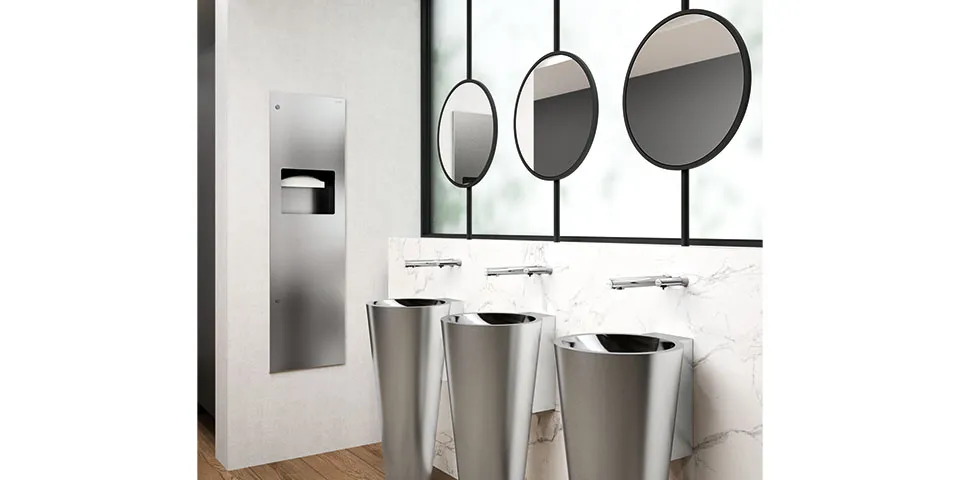
Now that we have reached a new phase in the exit strategy from the coronavirus crisis, employees are returning to the office full-time or part-time. Do office washroom facilities still meet their expectations? We are seeing new habits emerge, mindsets change and new rules being imposed. More than ever, it is essential to install washroom facilities with a range of features suited to public spaces.

Touch-free operation improves hygiene
(New) rules
In the current pandemic, the highest standards of hygiene have become an absolute requirement. In washrooms, for example, extra attention must be paid to door handles, taps at handwashing stations, shower taps, points of contact on shower doors, toilet cubicle handles and toilet flush buttons. Cleaning frequency should take account of the number of people using these facilities. Drinking water companies also advise continuing to follow the legionella prevention plan. Businesses without a (mandatory) legionella prevention plan are also advised to flush their pipework thoroughly before putting it back into use. This can be done by opening all the taps briefly and allowing the water to run gently for one minute. Above all, the key advice is to enter and use the workplace only after washing or disinfecting your hands thoroughly.
Self-closing mechanical or electronic basin taps improve hygiene because there is no need to touch the tap after washing your hands. Any bacteria or viruses on the handles are therefore not transferred back onto the hands. Manually flushing the system is labour-intensive and costly, especially in larger installations, so electronic taps offer a major advantage here too: they feature an automatic periodic antibacterial flush, making manual flushing unnecessary. This periodic antibacterial flush is activated when the tap has not been used for 24 hours, preventing water from stagnating in the tap and pipework.
Touch-free operation improves hygiene
New habits
With the importance of hand hygiene being emphasised at length, we now wash our hands an average of 12 times a day. Traditional basin taps use 9 litres per minute. If washing your hands takes 32 seconds, including wetting, soaping and rinsing, and the tap is left running throughout, total consumption is 4.8 litres per use*. The impact of more frequent handwashing on water consumption is significant, rising from 24 litres to 57.6 litres per person per day*.
For environmental reasons, we need to reduce this increased water consumption. Compared with a traditional basin tap, DELABIE's self-closing mechanical or electronic taps maximise water savings. They enable owners to reduce their water bills without compromising user comfort. The tap closes automatically after 7 seconds (mechanical models) or when hands are removed from the detection zone (sensor-operated models), and has a restricted flow rate of 3 litres per minute at 3 bar. Users can therefore wet their hands, apply soap and rinse without the tap running continuously. With an electronic DELABIE tap, water consumption falls to 0.6 litres per use, a reduction of almost 90%*.
Reliable, durable and easy to operate
New mindset
Many employees are still working from home part-time or full-time. After weeks away, some find it daunting to return to the office. They hope to catch up with colleagues, sharpen their skills, express their creativity and, above all, feel comfortable and safe in the workplace. It may sound strange, but washroom facilities also play an important role in this sense of comfort and safety. Users expect washrooms to be not only clean and accessible, but also places where they can relax and feel comfortable.
Choosing products carefully can help: taps and accessories should have a sleek design with minimal joints, so dirt and bacteria cannot accumulate. One-piece models with a simple design have a clear hygiene advantage over complex designs.
Workplace washrooms require accessories that can withstand regular cleaning and are durable and reliable. Its non-porous, smooth surface and bacteriostatic properties make stainless steel the ideal material for washroom facilities. It is easy to clean using less cleaning product, and after cleaning, the level of bacteria, germs and dirt retained is up to 20 times lower than with other materials such as glass or plastic.
Hygiene is likely to remain high on the public health agenda. Handwashing and disinfection are essential weapons in the fight against the spread of germs and bacteria. Employers need solutions that provide employees with washroom facilities that are comfortable, hygienic, water-saving and reliable. The Delabie website offers a wide range of targeted solutions.
*Calculation of water consumption per person per day
| Flow rate | Wetting | Soaping | Rinsing | Water consumption per use | Water consumption per person per day |
| Traditional tap, 9 l/min | 5 sec. | 20 sec. | 7 sec. | 4.8L
(32 sec.) |
4.8L x 5 uses = 24L
4.8L x 12 uses = 57.6L |
| Electronic tap, 3 l/min | 5 sec. | 7 sec. | 0.6L
(12 sec.) |
0.6L x 5 uses = 3L
0.6L x 12 uses = 7.2L |
A business enquiry for Delabie? Get in touch
Companies in this story
Keep following this
Get an email when a new story is published. No account needed.
- ThemeFuture-proof water and sanitary systems
- SubjectSanitaryware
- CompanyDelabie