A ventilation unit to suit every school and every classroom
Text Lieke BousemaImage Ned Air
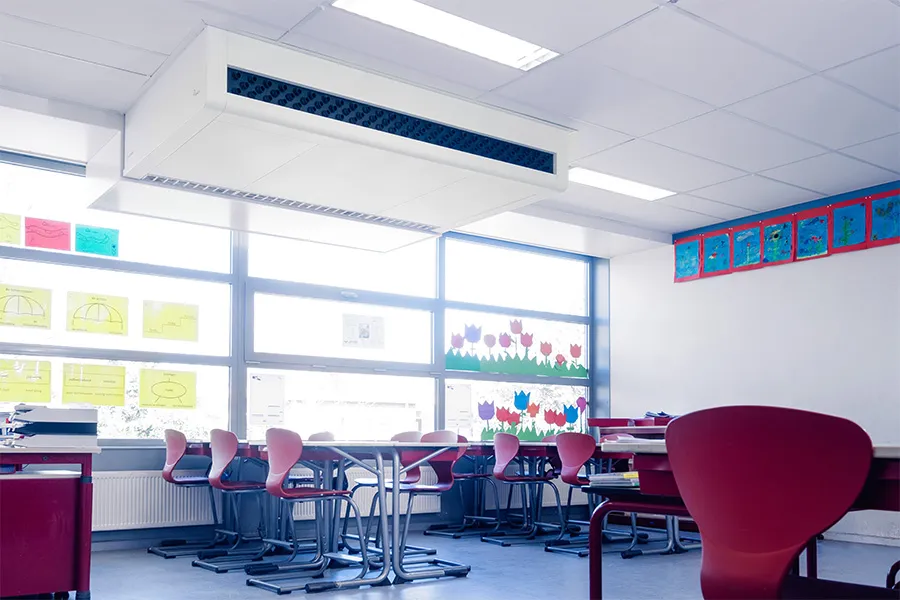
Every child, student and teacher is entitled to plenty of fresh air. With this ambition in mind, Ned Air developed EduComfort, a modern, fully demand-controlled decentralised ventilation unit with heat recovery that can be integrated into any school and classroom with minimal building work. The decentralised ventilation unit then ensures optimum ventilation in line with the Programme of Requirements for Fresh Schools, promoting the wellbeing and performance of pupils and teachers while reducing absenteeism due to illness.
Good ventilation in primary and secondary education has been a focus since 2015. That year saw the introduction of the Programme of Requirements for Fresh Schools, which sets specific performance requirements for energy efficiency, air quality, and thermal, acoustic and visual comfort. Ned Air has been developing, building and supplying decentralised ventilation units that meet these requirements for ten years. In recent years, the market leader has sold more than 2,500 EduComfort school ventilation units. “We have been the go-to ventilation partner for new-build projects for years,” says Vincent de Vries, Area Manager South at Ned Air. “But we also work on renovation projects, because EduComfort requires only minimal building work. Our EduComfort 1000 and EduComfort CM 1100 LN (Low Noise) units excel in terms of noise, sustainability, weight and ease of installation. The decentralised units can be easily suspended in any classroom, after which only two air connections need to be made to the outside.”

Installation above the suspended ceiling
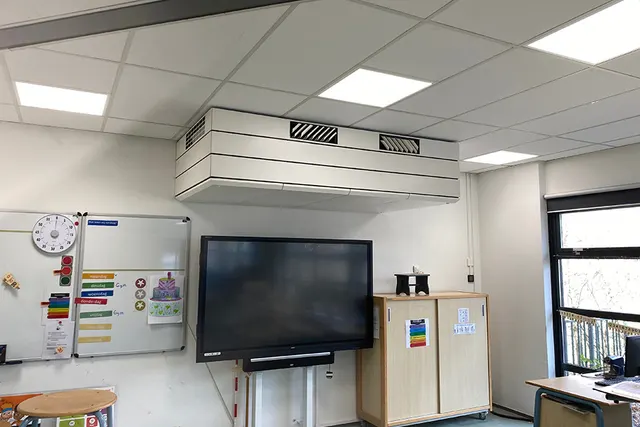
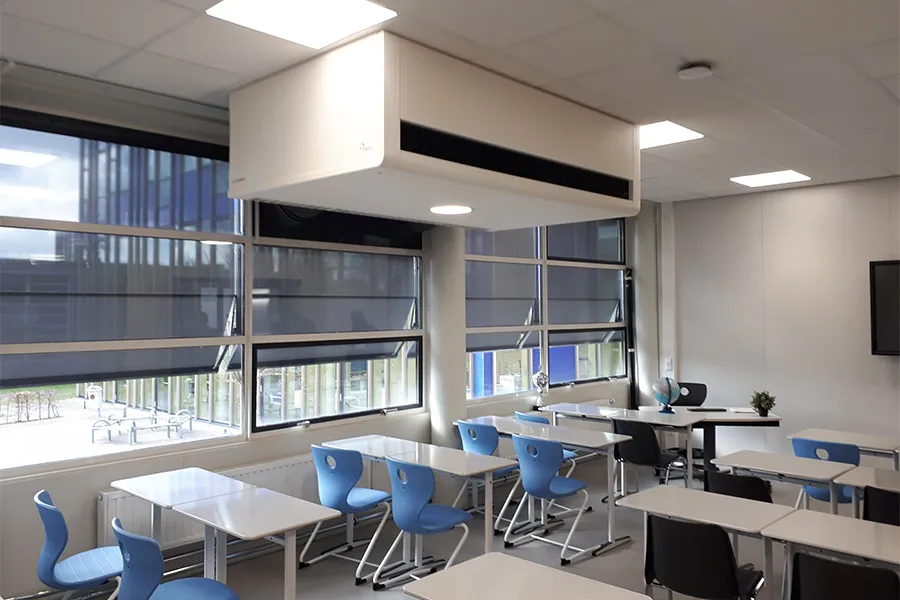
“Many classrooms have suspended ceilings, above which EduComfort school ventilation units can be fitted perfectly,” says De Vries. “Our supply air grilles then ensure perfect air distribution throughout the classroom. Partial recessed or surface mounting is also possible, with installers able to choose between a top or rear connection. Each unit is also available in a mirrored version.”
Also suitable for listed buildings
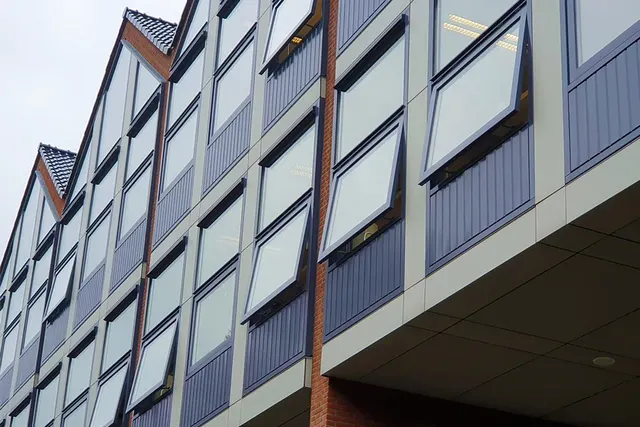
EduComfort units are also ideal for making listed school buildings more sustainable and improving them. Such buildings often still lack a mechanical ventilation system. And where one is present, it often no longer meets current ventilation requirements. “Upgrading the existing, often centralised system to meet current air quality requirements is often complex from a building perspective,” says De Vries. “As a result, teachers have to open the windows to air the classroom and lower CO2 levels. But with winter approaching, energy costs high and the sustainability challenge demanding, this is not desirable. EduComfort addresses this issue too, as the units provide ventilation almost invisibly, preserving the school’s distinctive appearance.”
Fresh Schools Class B
The decentralised EduComfort school ventilation units have been developed in accordance with the Programme of Requirements for Fresh Schools Class B. “The units keep CO2 levels in the classroom under control using 100% fresh outdoor air and meet the maximum noise level of 33 dB(A) at 950 m3/h,” says De Vries. “The use of EC plug fans, a low air velocity and counterflow heat recovery delivers an optimum thermal efficiency of 90%, keeping energy consumption for the end user to a minimum. The heat exchanger has a bypass for night-time summer ventilation, allowing classrooms to be cooled efficiently when outdoor temperatures are lower.”
Ventilation without draught complaints
Thanks to innovative supply air jets, draughts are a thing of the past. “The jets can be adjusted individually, ensuring that the air velocity in the classroom always stays within the required limit of 0.16 m/s, in accordance with the Programme of Requirements for Fresh Schools. This also makes our EduComfort units suitable for any classroom, regardless of its size.”
A clear overview, even remotely
The ventilation units can be fitted with a touchscreen control display on request, allowing users to set the desired supply air temperature. “This is useful in summer, for example, as it allows the cooling function to be used to its full potential,” says De Vries. CO2 levels can also be read on the display. “As users do not always know what these levels mean, the figures are accompanied by a traffic-light LED indicator in green, orange or red. Green means the CO2 level in the room is fine, orange indicates that improvement is needed through additional ventilation, and red means immediate action is required.” With an internet connection and the EduConnect server, the units can also be easily monitored remotely, both by the installer and by Ned Air’s service department.
Quiet, lightweight and circular
EduComfort school ventilation units are among the quietest on the market and can be fitted with cooling and heating as required. The units are also notable for being largely circular in design. “Recycled PET bottles and pressed paper are used for insulation,” says De Vries. “In addition, most of the sendzimir-galvanised steel has been replaced with aluminium, making the units even lighter.”
A business enquiry for Ned Air? Get in touch
Companies in this story

Keep following this
Get an email when a new story is published. No account needed.
- ThemeHealthy indoor air
- SubjectFrisse Scholen
- CompanyNed Air