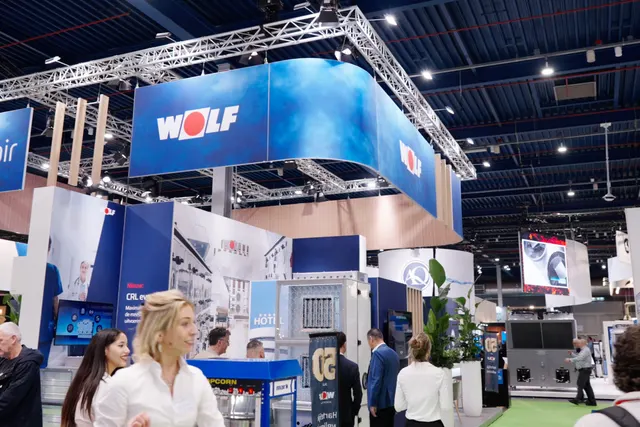
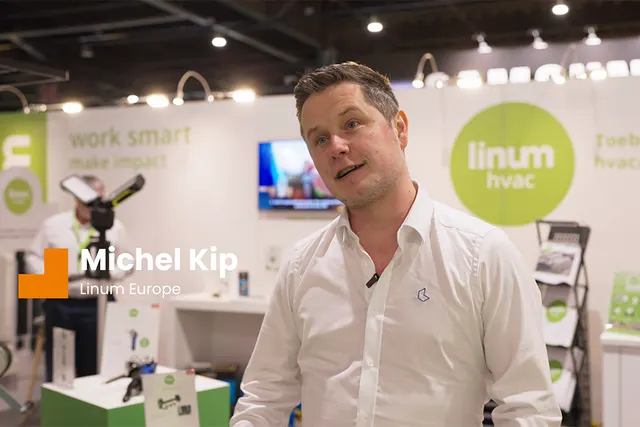
The right tap for every building: Delabie showcases bespoke solutions at VSK
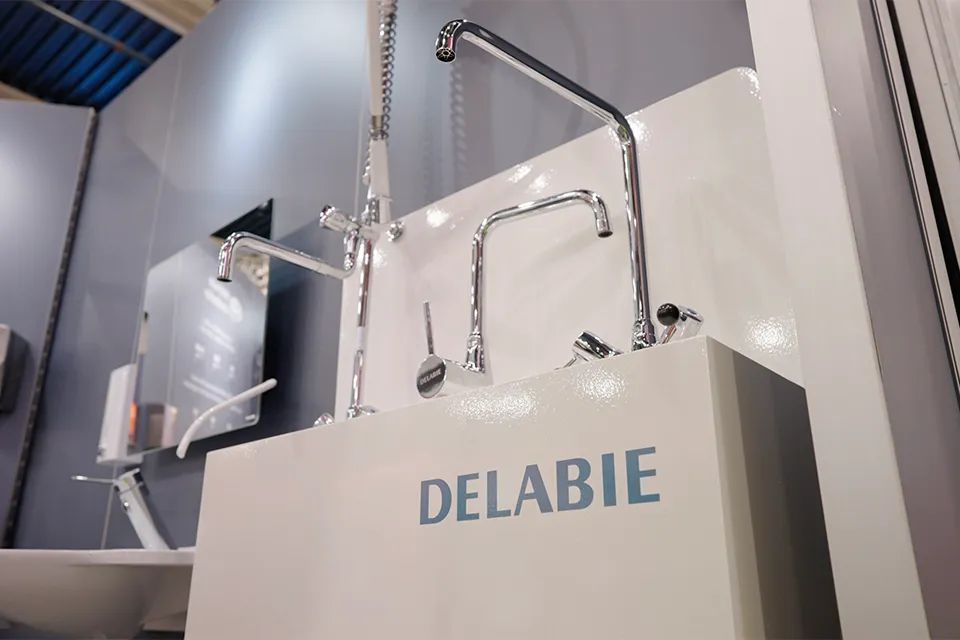
At the VSK trade fair, Delabie presented its water-saving tap solutions for both residential and non-residential buildings. Its range includes self-closing taps and electronic sensor taps that use significantly less water than traditional taps.
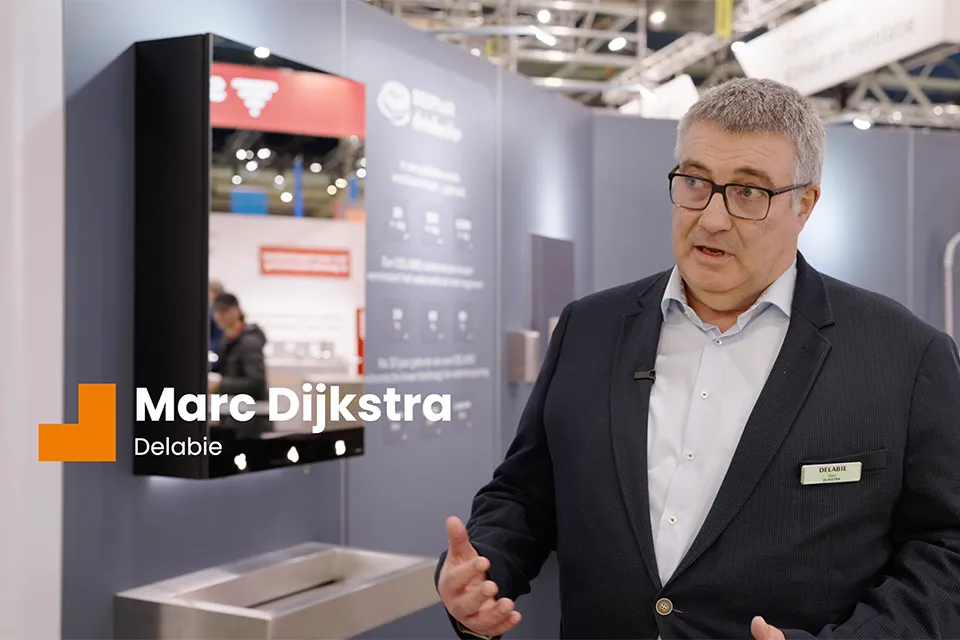
At home, a standard tap often runs unnecessarily while you wash your hands. Self-closing and sensor-controlled taps ensure water only flows when needed. With a lower flow rate and an automatic shut-off function, water savings can reach 80 to 90 per cent. This makes these solutions not only sustainable, but also cost-effective at a time when water is becoming increasingly precious.
Delabie also highlights the importance of choosing the right solution for each type of building. In non-residential settings, such as offices, schools and airports, taps are used far more frequently than in homes. Products therefore need to be not only water-efficient, but also robust and able to withstand intensive use. The focus is on comfort, durability and functionality tailored to the specific application.
A business enquiry for Delabie? Get in touch
Full transcript
00:00:05 – 00:00:07
Delabie has
00:00:07 – 00:00:11
taps that are either self-closing or electronic,
00:00:11 – 00:00:12
with sensor control.
00:00:12 – 00:00:13
So for each
00:00:13 – 00:00:16
wash, you can actually save 5 litres of water with
00:00:16 – 00:00:17
a washbasin tap.
00:00:17 – 00:00:21
But overall, you can save 80 to 85, even 90% of the water
00:00:21 – 00:00:23
compared with a traditional tap at home.
00:00:23 – 00:00:27
Water is getting more expensive, more precious, so we need to use it responsibly.
00:00:27 – 00:00:29
And that is what we are also trying to achieve.
00:00:29 – 00:00:32
Use as little water as possible while still being comfortable.
00:00:32 – 00:00:36
At home, you wash your hands with an average flow rate of 9 litres.
00:00:36 – 00:00:37
You wet your hands.
00:00:37 – 00:00:39
Then you reach for the soap, but the tap keeps running.
00:00:39 – 00:00:41
20 seconds, 30 seconds.
00:00:41 – 00:00:44
Then you rinse your hands and turn off the tap.
00:00:44 – 00:00:47
With a sensor tap or a self-closing tap,
00:00:48 – 00:00:49
you wet your hands,
00:00:49 – 00:00:52
apply soap, then rinse them.
00:00:52 – 00:00:54
And that is with a flow rate of 3 litres per minute.
00:00:54 – 00:00:55
So that is a huge saving.
00:00:55 – 00:00:57
80-90% water savings.
00:00:57 – 00:01:00
And that is why I think it is important to point out that you need to consider the function of the building.
00:01:00 – 00:01:02
Because there is never one solution for every
00:01:02 – 00:01:03
building or type of building.
00:01:03 – 00:01:06
Read the full transcriptCollapse transcript
There is always a specific solution for a specific building and
00:01:06 – 00:01:08
specific use.
00:01:08 – 00:01:10
You can see the difference between the products we use at home
00:01:10 – 00:01:12
and the products we use in non-residential buildings.
00:01:12 – 00:01:14
Frequent use is something we see in
00:01:14 – 00:01:17
non-residential buildings. That is one of the biggest differences we see, of course.
00:01:17 – 00:01:19
It is many times higher in non-residential buildings.
00:01:19 – 00:01:22
To give you an idea, we use a tap at home 20 times a day.
00:01:22 – 00:01:24
And over that period, the number quickly
00:01:24 – 00:01:26
rises to
00:01:26 – 00:01:28
at least 200 times, and perhaps even at an airport,
00:01:28 – 00:01:30
to 14-1,500 times a day.
00:01:30 – 00:01:32
And a product ultimately has to be designed for that and
00:01:32 – 00:01:33
has to be able to withstand it.
Companies in this story


Keep following this
Get an email when a new story is published. No account needed.
- SubjectVSK
- CompanyDelabie
- CompanyVSK