Compact, whisper-quiet unit for decentralised applications
Fresh Schools. “If only we had them,” says Arend Jan Pothoven, managing director of Spirair Luchttechniek. “Then the coronavirus crisis would also have been easier to deal with. The same applies here as with other pathogens: the higher the concentration, the sooner and more severe the infection. Reducing the concentration is therefore essential, and good ventilation is how you do that.”
‘We need to treat renovation and new-build separately in the Fresh Schools guidelines’
Spirair Luchttechniek, based in Nijkerk, is a ventilation specialist that presents itself as a knowledge-sharing wholesaler, able to work with the installer and consultant to put together a suitable solution for every project. Pothoven: “These include systems for use in schools, in particular the decentralised heat recovery unit Whisper Air.”
Conflicting requirements
Pothoven first wants to share his views on the issues with the guidelines: “With Fresh Schools, the requirements conflict, particularly when it comes to how they are assessed. For Fresh Schools Class B, the requirement is a CO2 concentration of no more than 950 ppm and a maximum noise level of 33 dB(A) from the installation. The explanatory notes state: ‘To meet the Class B requirement, a ventilation capacity of at least 8.5 dm³/s (30.6 m³/hour) per person is normally required.’ The ventilation capacity recommended in the explanatory notes amounts to 950 m³/hour for a standard class size. But perhaps we can achieve that CO2 concentration with 400 m³/hour. We find that outside the Randstad, 500 to 600 m³/hour keeps levels well below 950 ppm, regardless of the season and weather. The more air, the more noise, especially if the classroom acoustics are poor. My position is that a low CO2 concentration and a healthy indoor climate should take priority over a school that is unhealthy but quiet. This is especially true in, for example, practical classrooms, where noise levels are already somewhat higher. The noise-control measures and quiet equipment needed to get below the limit are costly and unaffordable for most schools.”
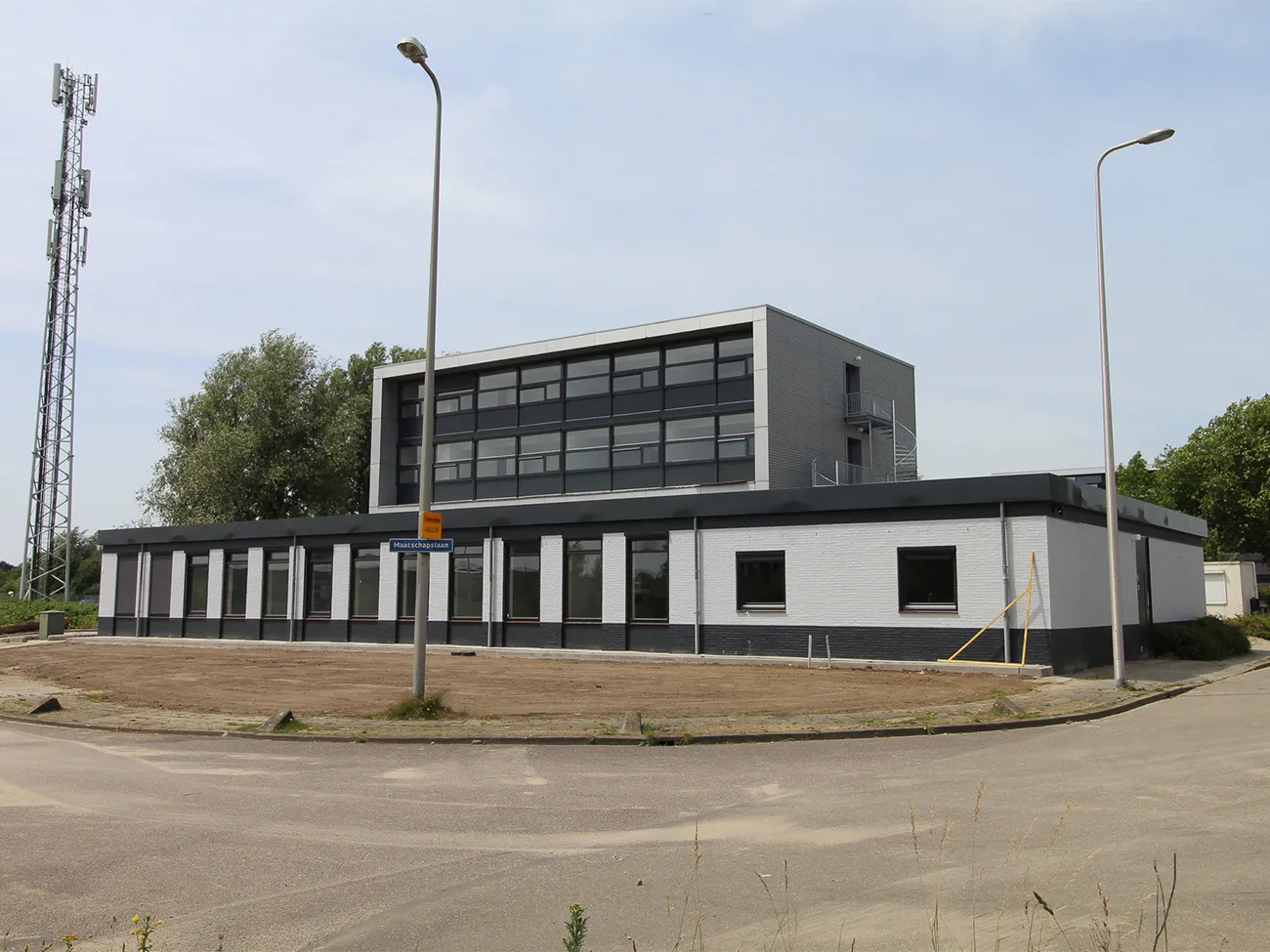
Trial measuring CO2, temperature and RH in a classroom at Griftland College in Soest. Graph 1 shows measurements from 23 March to 19 April 2017 without Whisper Air; Graph 2 covers the periods 25 September to 5 October and 6 to 17 November with Whisper Air.
Whisper Air
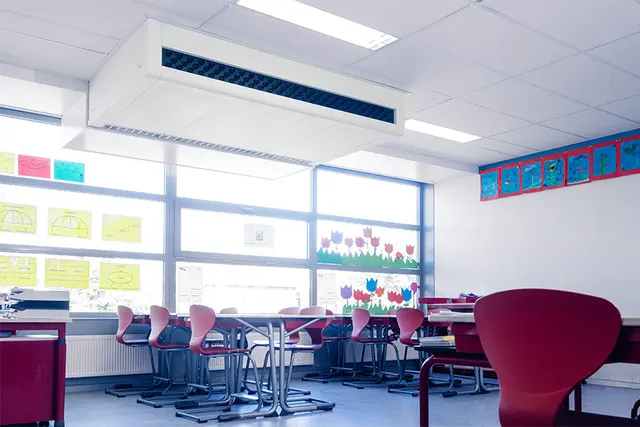
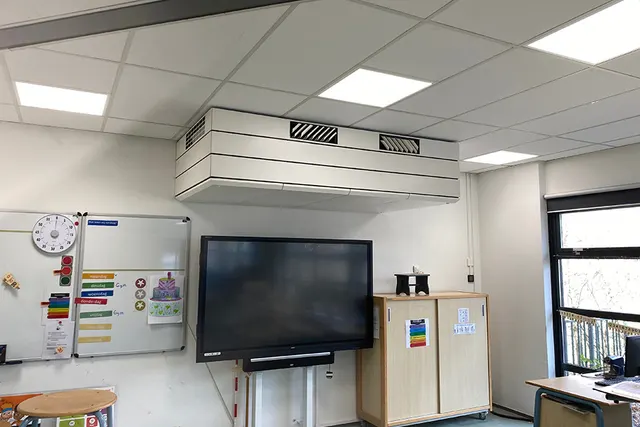
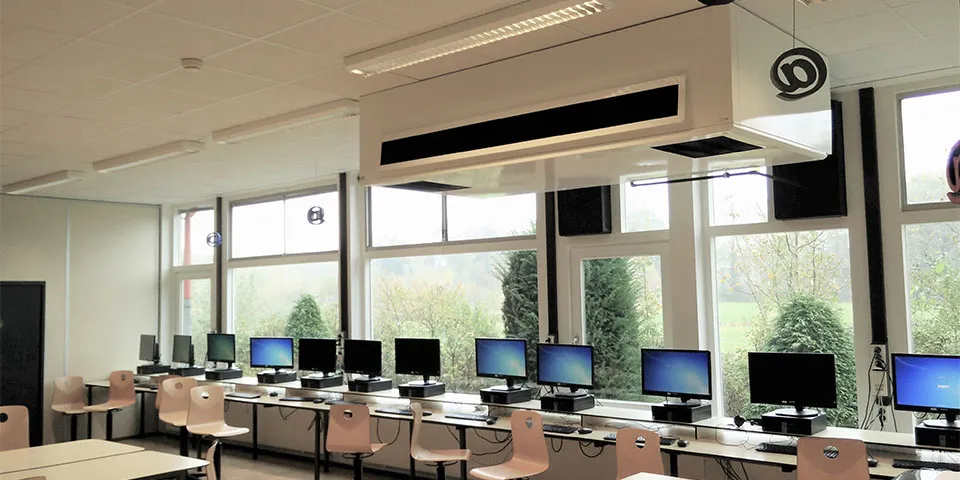
Now for Spirair’s solution: Whisper Air, a very quiet decentralised unit for use in renovation and new-build projects. Pothoven: “The design needs to take careful account of how the building will be used, the hours of use and the occupancy of the various spaces. Where these differ significantly, a single central ventilation system can be a very expensive solution, as controlling such a system requires, among other things, a building management system and variable air volume dampers. Using several smaller systems can then be a better solution, both in terms of energy and cost. It is possible to ventilate some parts of the building centrally and, where necessary, ventilate rooms locally using decentralised systems.”
A tailored solution
Whisper Air is a tailored solution that can be used as a decentralised system. At 33 dB(A), the unit meets Class B requirements. Whisper Air has a heat recovery efficiency of 90% and fully automatic controls for the most energy-efficient operation. The system also offers extensive comfort controls for every season, with automatic ventilation and, if desired, a boost function that can provide ventilation at 150% of maximum capacity for a set period. Adjustable night ventilation provides free cooling, so the classroom can be as fresh and cool as possible each morning.
Making a distinction
And what should be done with the Fresh Schools guidelines? Pothoven: “Fresh Schools sets a target, with requirements for noise levels. When I talk to acoustics specialists, they say they have yet to find a decentralised ventilation unit that meets all the requirements without additional measures. And the limit may even be tightened to 30 dB(A). That might be achievable centrally, but not with decentralised systems unless additional measures are taken. The units would become enormous, even though decentralised systems are the most suitable option for renovation. I think we therefore need to make a clearer distinction between renovation and new-build. That would be better for all stakeholders.”
Question about this story? Ask your question
Keep following this
Get an email when a new story is published. No account needed.
- ThemeHealthy indoor air
- SubjectFrisse Scholen