Decentralised school ventilation with cooling and heating

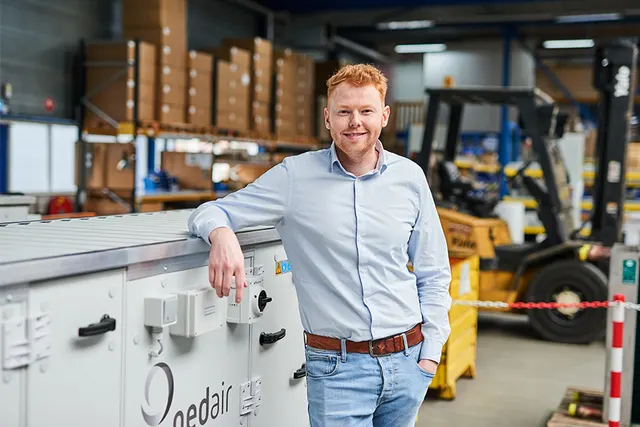
In normal times, the summer holidays are when schools can make a real push to improve their indoor climate. “That remains just as urgent today,” says Wouter Wijma, managing director of Nedair and a board member of VLA, the Association of Suppliers of Air-Handling Equipment. “CO₂ levels are still too high in almost three-quarters of all primary and secondary school classrooms.”
Awareness of this issue has grown in recent years, partly as a result of the Frisse Scholen regulations. Wijma says: “When you realise that a good indoor climate means fewer health complaints, less absenteeism, better concentration and better performance among both pupils and teachers, you are more motivated to do something about it. The coronavirus crisis has made it even clearer how important air quality is.”
Tightening requirements
Given the upward trend in average temperatures, Wijma expects the regulations to be revised. “As a board member of VLA, I am in contact with Froukje van Dijken of BBA. On behalf of RVO, she is leading the work on the updated Programme of Requirements for Frisse Scholen. I think it will be published in September this year, and my personal expectation is that it will be slightly stricter, particularly regarding temperature exceedances. And that has implications for building services.”
Cooling demand
Wijma explains: “In practice, when you ventilate and use heat recovery, there is always a difference between the indoor and outdoor temperatures. As long as that difference does not get too large, there is no problem. But when it is warm both outside and indoors, applying heat recovery becomes difficult. You could ventilate at night using 100% outdoor air via a bypass, but as soon as the children arrive in the morning and the sun comes out, the room heats up very quickly. In that case, temperature exceedances become too high and last too long. Cooling demand then rises rapidly. We have been supplying decentralised systems to schools for more than five years, and people often assumed that cooling and heating were included with the ventilation. But they are not.”
Cooling and heating as standard
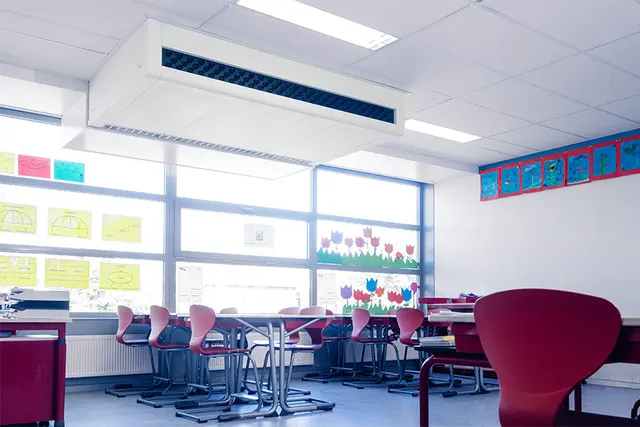
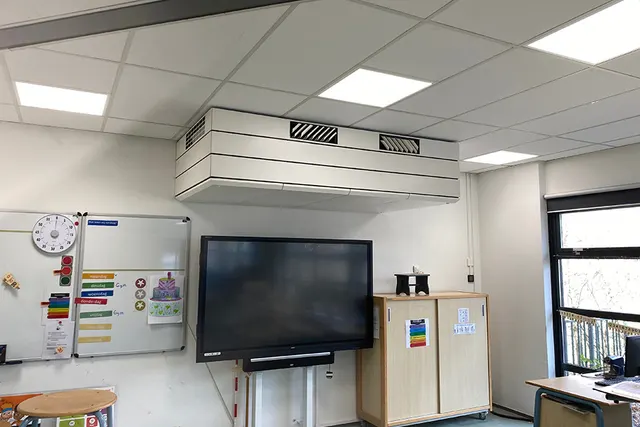
That is why Nedair will soon be launching the next generation of school ventilation units. Wijma says: “The EduComfort 950 is often installed alongside the decentralised ventilation as a separate split system. The new range will come with a cooling and heating module built into its compact casing as standard. The first models are currently being manufactured and tested. They also have a capacity of 950 m³/h, making them suitable for Frisse Scholen Class B. We will add units with capacities of 1,000, 800 and 600 m³/h, allowing us to supply Germany, France and Belgium as well. With a heat pump on the roof, an inverter could provide heating and cooling to three classrooms at once. This solution is also highly suitable for small-scale housing developments.”
Circularity
Another area in which Nedair wants to be a trendsetter is circularity. Wijma says: “It is strange that all sound attenuators in the Netherlands are insulated with glass fibre. You do not want that in your lungs. Two years ago, we replaced it with hypoallergenic polyester wool made from recycled PET bottles. It is strange that we are still the only ones to have done so. Our next step is to use pressed paper for insulation. We are already testing it. However, making it fireproof and circular is not easy.” He concludes: “Nedair’s mission is to provide everyone with a healthy indoor climate, and education is one of our markets that receives special attention. We set the bar high and get ahead of the curve, so that we meet future standards early. We also develop new products together with our customers, installers and school boards. You can never overestimate the value of staying in touch with your target audience.”
Question about this story? Ask your question
Keep following this
Get an email when a new story is published. No account needed.
- ThemeHealthy indoor air
- SubjectFrisse Scholen