‘Mass customisation’ for education

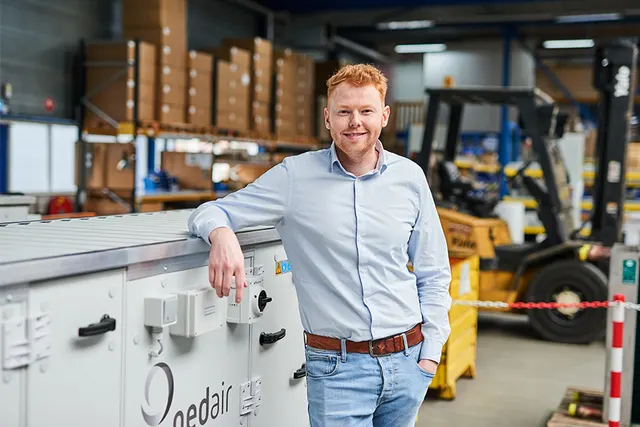
“Ventilation is crucial. That was already true for schools in the Netherlands before the coronavirus crisis, but now we are even more aware that pathogens can also spread through the air.” Speaking is Wouter Wijma, managing director of Nedair and the newly appointed chair of the VLA, the Association of Air Technology Equipment Suppliers. “The case of a choir rehearsal in America was telling. Despite all the preventive measures, a large choir sang in a poorly ventilated room, with one infected person present. That person became a superspreader: within an hour, everyone was infected.”
Diluting indoor air with fresh outdoor air is therefore the guiding principle. Primary schools have now reopened, and other educational institutions will (probably) open their doors again after the holidays. Wijma: “The difficulty is that the crisis has put a stop to investment. No one dares to make decisions, including local authorities and school boards. That is unwise when you consider that 80 per cent of schools are still poorly ventilated. There is also still confusion because the RIVM has not yet taken a position on the airborne transmission of COVID-19. One positive effect is that we in the ventilation sector are making some headway. For years we have been saying that ventilation is more important than heating or cooling, and people are slowly beginning to realise this. Suppliers and installers are ready to tackle those 80 per cent.”
You simply cannot achieve Frisse Scholen Class B without heat recovery.
No split air-conditioning systems
What advice would you give school boards, with summer approaching? Wijma: “At the very least, make sure you keep ventilating, using open windows and mechanical extract ventilation. Split air-conditioning units, or any other form of cooling that recirculates air, are no longer an option. Unless you also provide seven times the ventilation rate. The air-conditioning industry will not like that. Winter is more difficult, because mechanical ventilation alone brings cold air inside. The heating will have to be switched on, and heat recovery is an option if budgets are limited. You simply cannot achieve Frisse Scholen Class B without heat recovery.”
Warmer summers
Another factor is that summers, and springs too, are getting warmer. Wijma: “According to various guidelines, the ideal temperature in classrooms is between 18 and 22°C. Above 25°C, thermal comfort declines and performance suffers. People can also develop headaches and feel short of breath. You cannot solve this overheating by opening the windows. That is why we are seeing more and more schools install cooling. For large schools, it can be cost-effective to use thermal energy storage for heating and cooling. A sorption wheel may also be a viable option. You still need mechanical cooling, but less than with a standard heat exchanger. Large schools and offices are already doing this. But ventilation and temperature control are not the whole story. Fine and ultrafine particulate concentrations are too high, particularly near busy roads and industrial sites. A demand-controlled solution could be developed for this, as Piet Jacobs of TNO recently argued. What does not work is fitting an electrostatic filter in your system to capture virus particles and fine dust. These filters produce ozone, which you absolutely do not want in your classroom.”
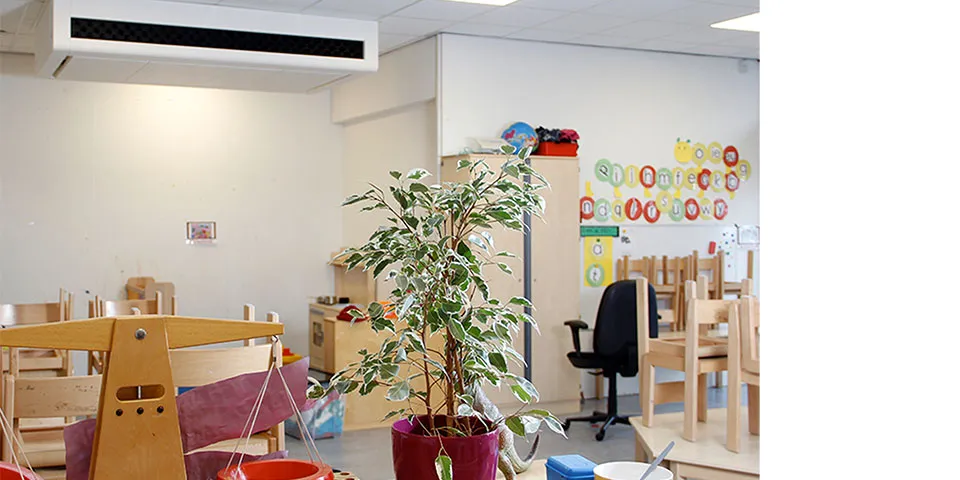
EduComfort 950.
Scaling up
Back to the solutions. Whatever the problem, Nedair has an answer. “We have a decentralised ventilation unit designed specifically for education, the EduComfort 950,” Wijma continues. “We work from a standardised principle, just as Volkswagen builds many models on the basis of a scalable chassis platform. We take the same approach to air handling. You need a certain number of square metres to teach groups of 25 or 30 pupils, and air-handling components are also largely standardised. We build concepts around these components, scaling them up and adapting them to the specific requirements of each project. That is what we call ‘mass customisation’. Supplying ten cabinets, one with a heating section and another with a humidifier, used to be called bespoke work. Today, we call it configurable.”
Cooling and heating as standard
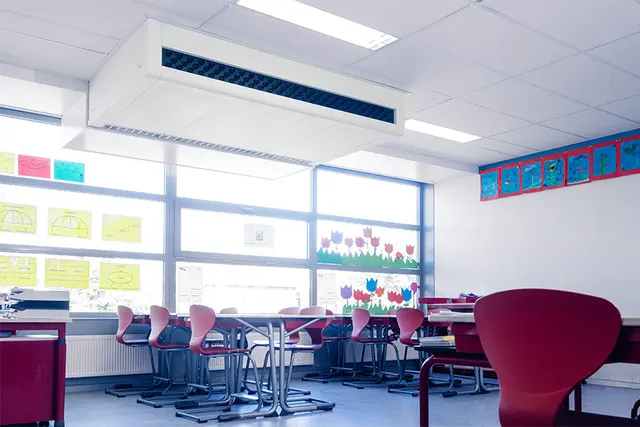
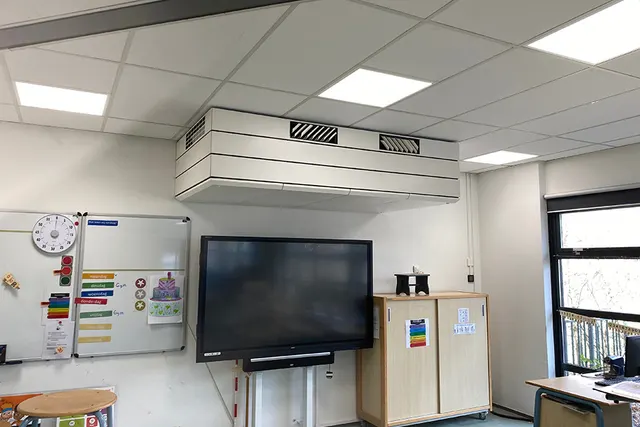
“The Educomfort 950 is a good example of ‘mass customisation’ and, just as importantly, at 32.4 dB(A) it is the quietest unit on the market, as verified by the acoustics specialists at Peutz. This compact, plug-and-play system uses 100 per cent outdoor air, has supply and extract ducts through the roof or façade, and can be operated in every conceivable way and connected to a building management system,” says Wijma. “A separate split system is sometimes used alongside it for cooling. A new version will be launched shortly, with a cooling and heating section built in as standard. That is how we want to make fresh air available to everyone, even when it gets really hot.”
Positive pressure
Wijma sees other interesting developments coming to school construction in the not-too-distant future: “Operating theatres and cleanrooms use positive pressure and displacement systems, which allow virus particles and other pathogens to travel in only one direction: outwards. This could be a solution for the future, bearing in mind that cold air should never be supplied at foot level. What I certainly do not see happening is schools being saddled with specifications such as those for offices, as many people are proposing. That would mean 60 m³/h per person and a maximum of 800 ppm CO2. If you supply 1,800 m³/h somewhere, you get extreme draught complaints. And that is exactly what we do not want.”
Question about this story? Ask your question
Keep following this
Get an email when a new story is published. No account needed.
- ThemeHealthy indoor air
- SubjectFrisse Scholen