Projects need to be assessed at every stage

Although progress has been made in recent years and almost all new schools are now built in accordance with the Fresh Schools Programme of Requirements, there is still a great deal, a very great deal, to be done. The Netherlands has 8,000 primary and secondary schools, including more than 6,700 primary schools. Five years ago, indoor climate quality was inadequate in 80% of these schools. That figure has probably fallen only marginally. “It takes a very long time to tackle thousands of schools.”
Fresh Schools: a major challenge
Froukje van Dijken works for consultancy bba binnenmilieu and specialises in indoor environments in schools and childcare centres. Until the end of 2019, she spent five years working on the Rotterdam Fresh Schools Assessment pilot, in collaboration with the GGD. “The pilot was launched under the then alderman, now minister, Hugo de Jonge, to explore how we could improve our approach to refurbishment and new-build projects in relation to the Fresh Schools criteria.”
Consequences
The reasons behind all the initiatives to create fresh schools remain the same. Air quality, room temperature and/or acoustics are poor in too many schools, or there are draughts. This has significant consequences for the health and performance of pupils and teachers. A better indoor climate means greater comfort, fewer health complaints, better academic performance and less absenteeism.
This prompted the national government and a number of municipalities and provinces to launch initiatives and pilot projects. The problem has proved stubborn on many fronts. Van Dijken: “Between 2015 and 2019, we carried out a Fresh Schools Assessment for fifty schools in Rotterdam. The municipality aims to ensure that the indoor environment in every school meets Fresh Schools Class B. The Fresh Schools Assessment involved checking in detail, for each project and at different stages, whether the specified performance requirements could be met. We found that a great deal of progress had been made, but that there was still room for improvement at every stage.”
Fine on paper
“At the VO stage, we focus mainly on the indoor climate concept. Later, when we review the specification, we check that the performance requirements have been set out clearly and made binding, so that the installer or contractor can be held responsible for meeting them where necessary. At handover, we check whether the requirements have also been met in practice. It is the sum of many details that ultimately determines the end quality. For example, a school may be handed over with a well-controlled ventilation system, but dust may have been left in the ventilation ducts during construction. This construction dust will then be blown along with the ventilation air, causing irritation to the mucous membranes and a feeling of dry air. Everything is fine on paper, but if the finishing touches are not made during construction, complaints will arise. That is why assessment at every stage is essential.”
Fresh Schools advisers
To make this assessment possible on a large scale, Van Dijken advocates using independent Fresh Schools advisers. “Schools are a particular type of project, with their own quirks and pitfalls. Technical expertise is not the only thing that matters. An understanding of what is important in school accommodation, and what often goes wrong in practice, is just as essential. To achieve better end quality, it is advisable to have an independent third party review the project, with an eye for conflicting interests. More advisers of this kind are needed to carry out the Fresh Schools Assessment on all school projects. We are seeing more and more parties take up the Fresh Schools approach. Programmes have now been set up in Rotterdam, Amsterdam and Groningen. Individual school boards have also carried out surveys and want to improve their building stock.”
Tailored solutions
Van Dijken does not have a single solution for every school. “It is usually a matter of tailoring the approach to the project. I also think it helps to involve the contractors earlier in the design process. A good adviser can develop a concept that suits the building and the client’s requirements. The installer can play a part in developing the design. Look beyond the investment costs: energy consumption and maintenance costs for building services are usually higher than the initial investment,” she says. On the trend towards rising temperatures, she adds: “Fifteen years ago, the thinking was that schools were not smart offices, and that children could wear shorts and skirts to school in the warmer months. There was also the summer holiday closure: why install expensive cooling for just those few weeks? I can partly understand that argument, but it does not change the fact that pupils are at school to learn. If it gets too warm, their performance suffers. Funding bodies still often say that cooling in schools is a luxury, while also stressing the importance of sustainability. With heat pumps, you can provide some cooling at no extra cost. We are gradually seeing cooling being used in new-build schools.”
RIVM
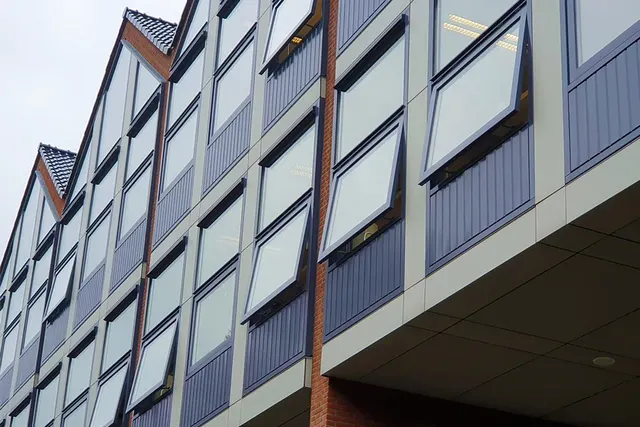
Then came coronavirus. Van Dijken: “Hopefully, this will bring the issue of schools and indoor climate into sharper focus. There is considerable evidence that airborne transmission plays a major role in the spread of the virus. In many so-called ‘super-spreading events’, people kept a sufficient distance from one another and followed hygiene measures. The common factor was poor ventilation in the space. So, alongside the advice from RIVM, our advice is: ventilate, ventilate, ventilate. This is important in any case for academic performance and health. The risk of flu or a cold is much lower with good ventilation, and this probably applies to coronavirus too. You might think the older schools would face the greatest obstacles to making improvements. But old school buildings, with their high ceilings and top-hung windows, were designed so that windows could be opened in winter without causing much draught. Later came suspended ceilings and classrooms with poor ventilation. Those old classrooms were not so bad after all. Everyone is now well aware of the importance of good ventilation, and there is now an additional compelling reason. Schools that are not up to standard should act sooner rather than later. Do not wait two or three years.”
The key coronavirus advice for schools:
1. Ventilate, ventilate, ventilate.
2. Air the rooms regularly.
3. Switch off CO2-based control so that ventilation is always at maximum. Even
when the classroom is only half full.
4. Set the system to run on a timer. Continue ventilating for two hours before and two hours after
the room is in use.
5. Keep the ventilation running at a low setting overnight.
6. Instruct teachers on how to use the ventilation facilities.
Find out more
www.rvo.nl (search for frisse scholen), www.binnenmilieu.nl, www.ruimte-ok.nl
Question about this story? Ask your question
Keep following this
Get an email when a new story is published. No account needed.
- SubjectFrisse Scholen