School ventilation systems will soon be in short supply

It is not the manufacturers of ventilation units that will hold things up, but the schools themselves. If educational institutions want to get their ventilation in order this summer, they will need to move quickly.
Materials and components are becoming scarcer and more expensive at a rapid pace. If all schools make their decisions late and at the same time, many will end up on the waiting list and pay a higher price.
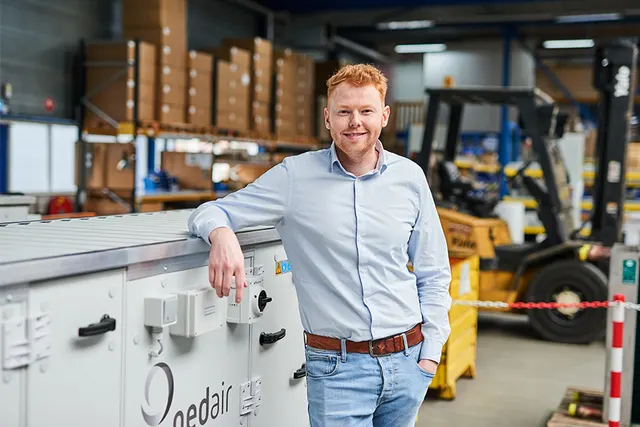
Wouter Wijma, managing director of Ned Air, a manufacturer of air handling systems among other products, is crystal clear on the subject: those who act quickly will be served first, while delays will prove costly. “The € 100 million in Specific Grant for School Ventilation (SUVIS) funding has been allocated. The results and awards are coming in, and it is now time for schools to respond. And that is happening slowly.”
Shortages
Wijma is somewhat critical: “We see schools sticking to the old routine: ordering in May and installing during the summer holidays. In a normal summer, you are talking about 200 ventilation units. This year, that could easily rise to 600 or more. And that will be difficult, because these are not standard products sitting on the shelf. I need to know whether the unit has top or side connections, whether it needs to be mirrored, whether it needs an electric heater or cooling, and so on. The capacity constraints are mainly at our suppliers. There are shortages everywhere, especially of aluminium, copper and electronics. Stockpiling will only make the problem worse. If a component is unavailable, everything grinds to a halt. That is why those who act quickly will be the winners this summer.”
EduComfort 1000
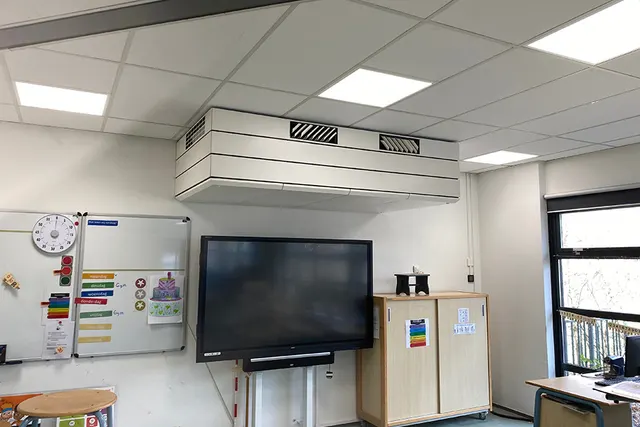
Meanwhile, Ned Air is busy working through its order book. “There are plenty of schools that are taking action. In Amsterdam, for example, the Healthy Schools Amsterdam project has been running for several years, and school buildings there are being fitted with good ventilation at a brisk pace. A great example is Kiem Montessori in Amsterdam-Oost, where installer Klaver Giant Alkmaar was the first to install our newly launched EduComfort 1000 unit. The school places a high priority on health and, in consultation with Klaver, chose this exceptionally quiet, CO2-controlled decentralised ventilation unit with heat recovery. Although the unit is designed to accommodate cooling, the school did not opt for it.”

Rooftop installations hidden from view
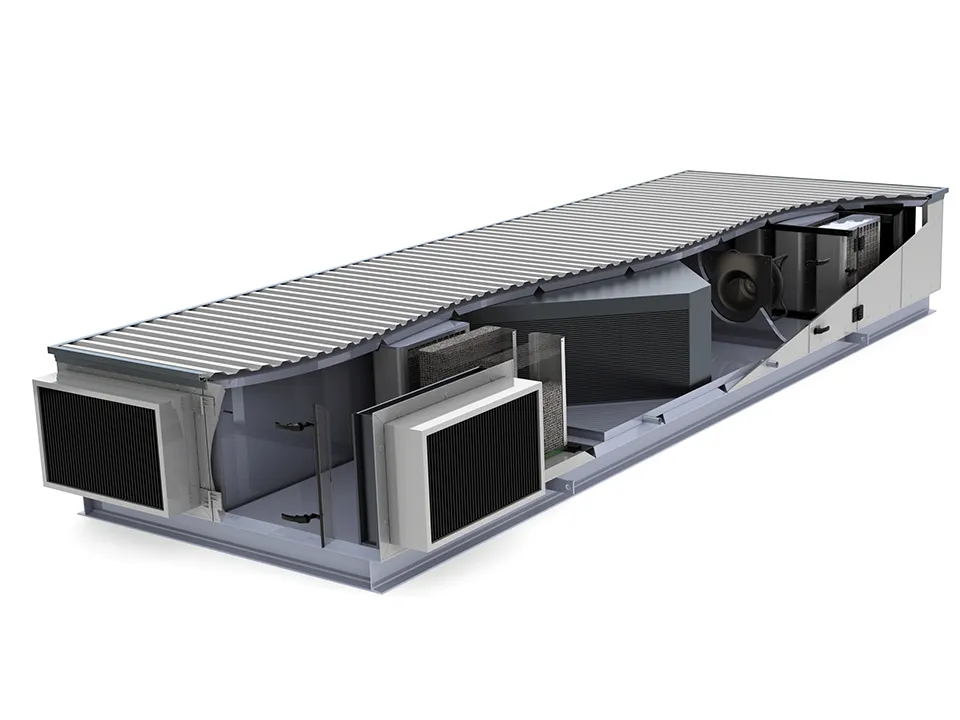
The EduComfort 1000 is an example of an in-house development through which Ned Air is responding to market demand. “That is one of our strengths: responding quickly to new developments. Our company is fully geared up to do that. Another example is a trend emerging on rooftops. We are increasingly seeing projects where air handling installations need to be hidden from view from a certain distance. It is partly an aesthetic requirement, but also based on the idea that what you can see, you can hear. For example, a specification may state that the air handling unit must be no more than 75 centimetres high. Ned Air is already ready for this development: we have reconfigured the unit and effectively flattened it into a wide, long box with a capacity of 1,000 to 15,000 cubic metres per hour. We are now set to supply several air handling units for a project, each 70 centimetres high, with solar panels installed on top and a raised edge added to the flat roof, one metre high. Out of sight, and everyone is happy.”
A business enquiry for Ned Air? Get in touch
Companies in this story
Keep following this
Get an email when a new story is published. No account needed.
- ThemeHealthy indoor air
- SubjectFrisse Scholen
- CompanyNed Air