‘Ventilation in schools can and must be improved’
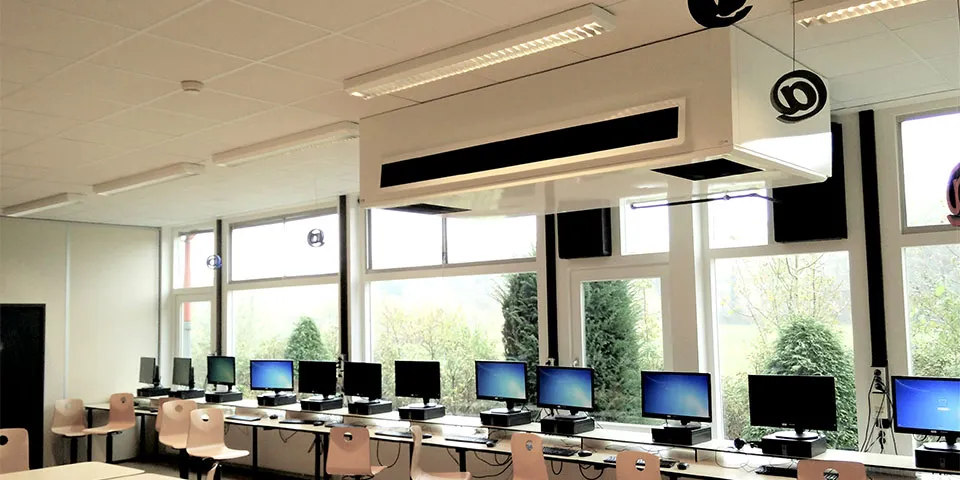
COVID-safe HVAC systems and a clear ventilation protocol. This is how schools can reduce the risk of a COVID-19 outbreak, says Maurice de Hond. The pollster has been calling for good ventilation for months, to tackle a route of virus transmission that is unaffected by keeping 1.5 metres apart: airborne transmission.
“In February this year, I discovered that the COVID-19 virus is transmitted not only through direct or indirect contact,” says De Hond. “Analyses of the virus’s transmission around the world showed that it spreads more rapidly when humidity is low. This made it highly likely that COVID-19 is also transmitted through the air. I was soon supported in this view by various scientific studies and experiments.”
How does airborne transmission of the virus work?
“When you cough or sneeze, but also, for example, when you talk or sing, droplets are released. Some are large droplets, which travel no further than a metre, while others are very small. These tiny droplets, known as aerosols, remain suspended in the air for a long time and travel further. If they contain the virus and are in an enclosed, poorly ventilated space, there is a good chance that people in the room will inhale the virus particles. This can infect many people in a relatively short time. Think, for example, of care homes, where large groups of residents and staff contracted the virus all at once. But aerosols can also transmit the virus during face-to-face contact between two people. Keeping 1.5 metres apart is not enough in that situation, which is why I consider it a simplistic approach.”

You are calling for particular attention to ventilation in schools. Why?
“Because the risk of infection via aerosols is high there. Scientific evidence shows that aerosols disperse quickly with good ventilation. However, the quality of HVAC systems in many schools is appalling. A 2013 study I read found that a large proportion of primary schools did not meet the requirements of the 2012 Building Regulations. We should also seriously question whether those regulations go far enough. After all, they were not designed to protect against diseases that spread through the air.”
What should schools do to minimise the risk of a COVID-19 outbreak?
“It all starts with awareness. School boards need to recognise the urgency of good ventilation. The RIVM’s position does not help. It says: ‘Ventilation is good, but it is not a way to prevent the spread of COVID-19.’ Schools are advised to comply with the Building Regulations, but ventilation in schools can and must be improved. I therefore say to school boards: check your HVAC system, set it up correctly and, if necessary, make it COVID-safe. I am also calling for CO2 monitors in every classroom and a ventilation protocol. This protocol would specify, for example, what to do when the maximum CO2 level in a room is reached. This and much more is set out in the Deltaplan Ventilatie, which I published on 24 June. However, the government has not acted on the plan.”
Suppose your Deltaplan had been implemented straight away. Could it have prevented the second wave of COVID-19, which we are now experiencing?
“In the Deltaplan, I call for all HVAC systems to be checked and made COVID-safe. Given the short timeframe, it would not have been possible to make every system COVID-safe. But it would have been possible to map out which spaces were COVID-safe and what measures were needed for those that were not. These could include opening windows, limiting the number of people allowed in or wearing face masks. In short, if the Deltaplan had been implemented straight away, we would now have greater clarity and would have needed less drastic measures. There would also be less risk of major outbreaks, and all the consequences they entail. What frustrates me is the ostrich approach in the Netherlands. Prime Minister Rutte keeps talking about ‘washing your hands raw’ and keeping 1.5 metres apart. The government has almost nothing to say about good ventilation. And yet in neighbouring countries such as Belgium and Germany, the importance of ventilation is now being recognised. Apparently, we have a Dutch variant of the virus. I find that reprehensible.”
Question about this story? Ask your question
Keep following this
Get an email when a new story is published. No account needed.
- ThemeHealthy indoor air
- SubjectFrisse Scholen