











A complete solution for Net Zero homes:
On-site energy storage is becoming an attractive option for more and more homeowners.
With household costs on the rise, Net Zero homes are popular. Following investment in floor, roof and cavity wall insulation, more and more households are installing solar panels, which are generating increasing amounts of energy. During the day, much of the energy generated is exported to the grid, while in the evening electricity is imported. For now, electricity supplied and consumed is still offset at the same rate on the annual bill, leaving residents better off overall. However, this so-called net metering scheme is being phased out gradually between 2023 and 2031, making it increasingly attractive to store energy on site. Top Systems’ Energy Storage Systems (ESS) are already addressing this need.
“As well as reflecting homeowners’ own commitment to sustainability, on-site energy storage is encouraged by the government. This is mainly because our energy grid was not designed for large-scale exports and/or mass consumption,” says Norman Heins, Energy Storage Systems Sector Specialist at Top Systems. “When residents cook and heat their homes electrically and/or charge their electric cars at the same time, this can overload the grid connection and/or the electricity network behind it. An energy storage system with lithium-ion or saltwater batteries smooths out these peaks. ESS systems can also serve very effectively as an emergency power supply.” ESS is still a niche market because of the investment involved, Heins says. “But as the net metering scheme is phased out, energy storage is becoming an attractive option for more and more homeowners.”
Net Zero living in Rijssen
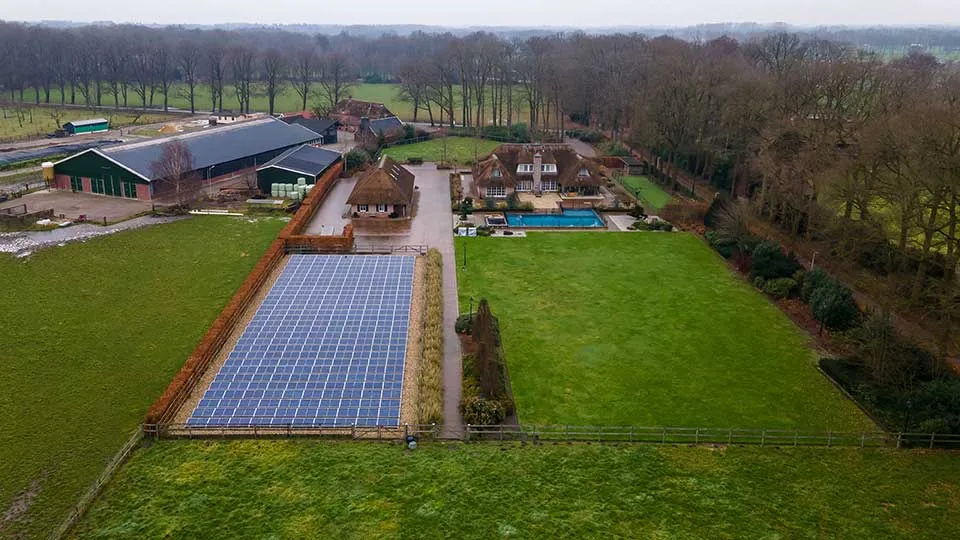
ESS is already an excellent choice for households with exceptional energy demands. One example can be found in the built-up area of Rijssen, where an energy generation and storage system has recently been installed, comprising no fewer than 290 solar panels, three inverter/charger combinations and eight MG lithium-ion batteries. “New-build homes are now required to be built without gas. A range of measures are also being taken to encourage Net Zero living,” says resident Jan-Reint Harbers. “My ambition is to achieve the same with our existing home, built in 2008. When we bought it in 2016, the first steps towards sustainability had already been taken. For example, the house already had a heat pump for heating and cooling. This made the move towards Net Zero living much easier.” The heat pump is one of the home’s biggest energy consumers, he says. And that is hardly surprising, given that the home has a volume of around 3,000 m³. “In 2017, we also converted the existing koi pond into a swimming pool. Since then, two three-phase heat pumps have kept the pool water at temperature.”
A system designed for the future
Harbers had two options for sustainable energy generation: a small wind turbine or solar panels. “Because our home is in a built-up area, a wind turbine was not an option. I also did not want to obstruct the view,” he says. “So the choice of solar panels was an easy one. Combining the installation with energy storage gave us a future-ready system in one go. It also meant that there was no need to upgrade the grid connection, and the value of our home increased.”
He turned to BestWatt, part of Rengineers and a specialist in complete sustainable energy solutions. “We advise on, supply and install solar panels, small wind turbines and energy storage systems, enabling customers to live self-sufficiently and no longer depend on an energy supplier,” says engineer Henk Bettink. “At our Experience Center in Barneveld, customers can see and try out a range of systems, including Top Systems’ ESS solutions, which stand out for their excellent value for money.” Harbers was immediately impressed by the systems, as well as by BestWatt’s professionalism, good communication and enthusiasm. “Together, we assessed energy consumption, requirements and possibilities. We then ran the numbers and identified the most suitable locations for energy generation and storage.”
As the home has a thatched roof, installing panels on it was not desirable, Harbers says. The solution was to convert the previous owner’s riding arena into a solar farm. “I levelled the existing arena, laid down a weed-control membrane and filled it with gravel to ensure good drainage. BestWatt then mounted all 290 solar panels on a steel frame.” Mounting the panels at a low height keeps the view unobstructed. “The highest part is just 40 cm above ground level.”
Battery system attracts plenty of attention
The solar panel installation is connected to a battery system installed in the loft of the detached shed. To design the battery system, Bettink contacted Top Systems. “We selected the right ESS solutions at our showroom in Bodegraven,” says Heins. “On our advice, they chose three bidirectional Victron Quattro 48/10000/140 10 kVA inverter/charger combinations. These not only charge the batteries with surplus solar energy, but also discharge them when additional power is needed, for example in the evening and at night. We also supplied eight MG lithium-ion batteries rated at 7.5 kWh each, 60 kWh in total, as well as a Victron Color Control panel.” Harbers says: “The battery system attracts plenty of attention. The control panel is particularly popular, as it shows us exactly how much energy we are generating and using at any given time, and how much energy is left in the batteries.”
BestWatt can also monitor the complete system remotely. It installed the energy generation and storage system in 2019. “We used Top Systems’ installation diagrams to fit the batteries,” says Bettink. “A technical specialist from Top Systems also visited the project, checked the installation and supervised commissioning.” Harbers is very satisfied with the system. So far, living Net Zero has worked well, he stresses. “That is hardly surprising, as 290 solar panels is a lot for my home and energy consumption. In time, however, our energy use will increase further, for example when we switch to electric cars. The system is ready for that.”
Saltwater batteries or hydrogen
Most ESS solutions are supplied with lithium-ion batteries, as in Rijssen, Heins says. “For those seeking the ultimate in sustainability, our saltwater batteries are also a very interesting option. Virtually no energy or heat is lost, and water and salt can, in principle, be reused indefinitely. That makes saltwater batteries the greenest battery system.” Top Systems has also recently started its first ESS hydrogen project, combining a hydrogen installation with saltwater batteries. “This, too, is a very
sustainable choice.”
A business enquiry for Top Systems B.V.? Get in touch
Companies in this story
Keep following this
Get an email when a new story is published. No account needed.
- ThemeEnergy generation and distribution
- SubjectGeneral
- CompanyTop Systems B.V.







