











A wonderfully cool home in this weather?
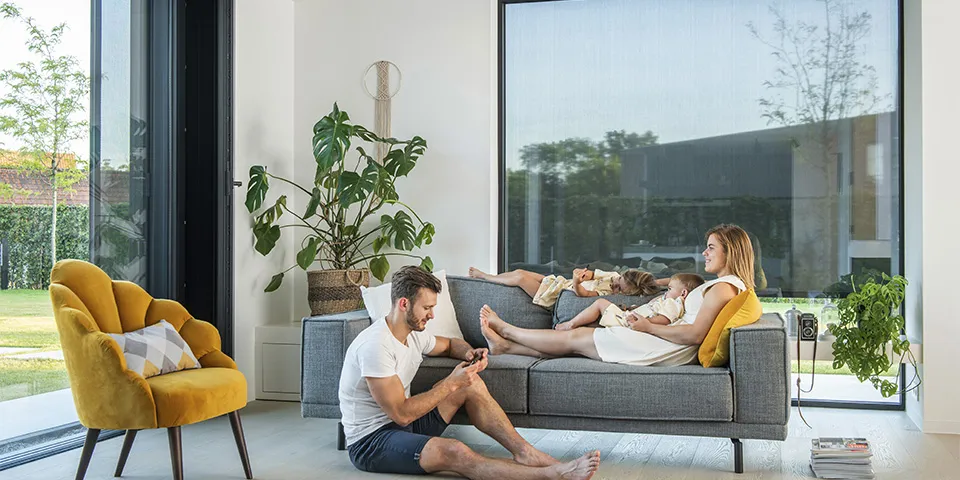
Temperatures above 30 degrees are set to bring a few more days of sweltering heat. Great for festival-goers, but less enjoyable if you can’t get your home to cool down. Turning to air conditioning may seem like the obvious choice, but it actually contributes to more heatwaves in the future. Fortunately, there are other solutions too.
Keep the sun out and let cooler night air in
Well-insulated and airtight homes: beware in summer
If CO2 emissions continue to rise at their current rate, the number of ‘summer days’ each year (with temperatures above 25 degrees) will increase. We all need to do our bit to keep our energy consumption as low as possible. Good insulation and airtight construction help with this. The downside is that, in this heat, there is a risk of indoor temperatures getting too high, and that the heat will be difficult to get back out again precisely because of the good insulation.
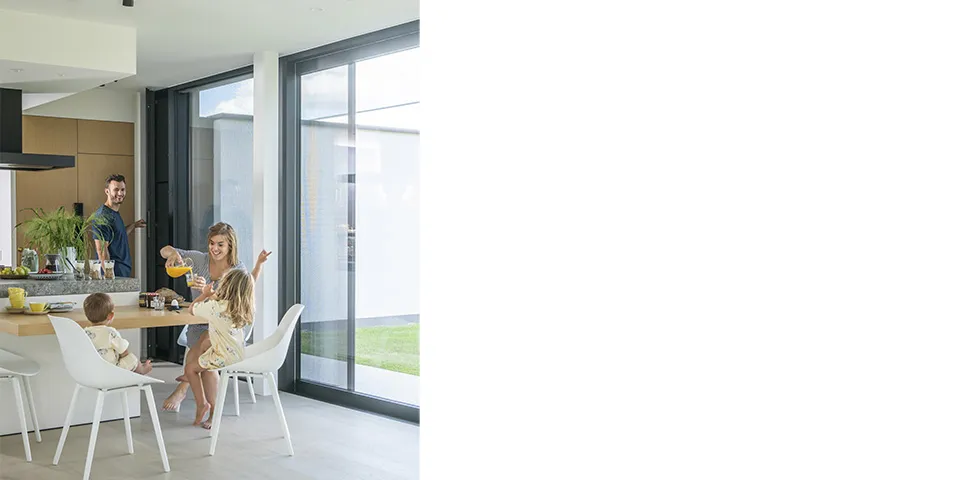
Air conditioning: solution or cause?
Running an air conditioner at full blast may seem like the obvious choice, but it is actually part of the problem. Air-conditioning units bring cool air into your home, but also expel heat outside. They are also real energy guzzlers, contributing to rising CO2 emissions and climate change. Did you know that an air conditioner running at full blast uses as much energy as 3 irons? This creates a vicious circle, as air conditioning indirectly contributes to ever more frequent heatwaves. Fortunately, there are alternative solutions too.
Keep the sun out
It’s as simple as it is logical: stop the sun from shining in through the windows. Large windows let plenty of daylight into your home, but when the sun shines directly on them, they literally create a ‘greenhouse effect’ indoors. External shading is the most effective solution, because it stops the sun before it reaches the glass. Fabric awnings or screens have the advantage that you can still open them to enjoy the warmth of the sun, for example in winter. What’s more, unlike roller shutters, you can still see outside. Shading keeps the sun’s rays out without blocking your view or the daylight. An awning can also help keep the sun out above south-facing windows.
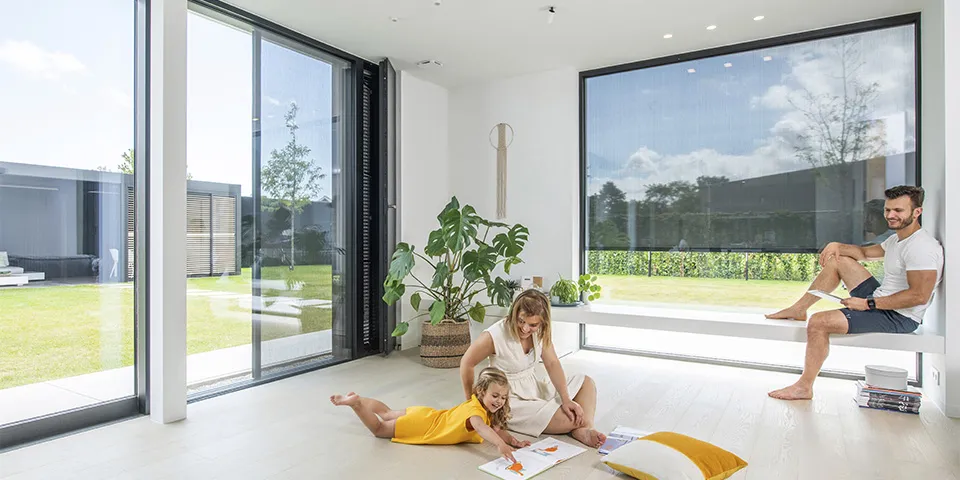
Let cooler night air in
An even more effective option is to combine external shading with intensive ventilation at night. The key is to bring in large volumes of cooler night air to cool your home. For example, you could leave 2 opposite-facing windows or sliding doors open all night. Better still, use window vents or louvred shutters built into the window frame. The integrated insect mesh keeps insects out, while the aluminium slats also help keep burglars at bay. That means you can ventilate safely and in complete comfort.
Questions & answers
Why is it better to keep the sun out with external shading than to block it indoors with curtains?
Without shading, direct sunlight enters through the glass as short-wave radiation, heating the interior (floors, furniture and walls). The heated interior then radiates the heat back as long-wave radiation, which is reflected by the glass. The heat is effectively trapped inside the home, which is a problem in a well-insulated house. The key, then, is to stop the sun’s rays before they reach the windows.
Is shading alone enough to keep my home completely cool?
Installing shading makes a big difference, but it is strongly recommended that you combine it with intensive natural ventilation, particularly at night. Intensive natural ventilation uses large volumes of naturally flowing air to cool the home at no cost. It is used when the outdoor air is cooler than the indoor air. This is usually the case at night, which is why the principle is also known as ‘night cooling’. To use this principle in a home, one or more vents are fitted on the outside of the window.
How durable and weather-resistant is fabric shading?
You can lower fabric shading with confidence even in bad weather, including heavy rain and wind, as its guide system can withstand wind speeds of up to 130 km/h. Fibreglass fabrics perform best in terms of tautness and dimensional stability, and are also highly resistant to moisture and heat. The fabric is UV-resistant and colourfast, and only needs regular cleaning with a mild detergent to last for many years.
Will external shading still let daylight into my home? And will I still be able to see outside?
Unlike roller shutters, fabric shading does not restrict light or visual contact with the outside. When you lower roller shutters, you lose the view of the garden. With fabric shading, by contrast, you retain the view while blocking the harsh sunlight. This is useful, for example, if you want to keep an eye on the children playing outside. There are also fixed external shading options, such as fixed or movable aluminium slats in front of a window, an aluminium awning above a window, or sliding panels that can be moved across the window. These also let you enjoy daylight while stopping the sun from unnecessarily heating your home.
Can external shading be controlled automatically?
Absolutely. What’s more, it is strongly recommended. External shading works best when controlled automatically, for example by a lux meter that lowers the shading once the sunlight reaches a certain level. This gives you a truly ‘smart home’ that looks after itself, whether you’re at home or not. External shading can of course also be controlled via existing home automation systems.
Does shading affect my home’s energy consumption?
Definitely! By preventing your home from heating up too quickly or too much, you also reduce the energy costs of cooling it down again with an expensive air-conditioning or cooling system. In the colder months, meanwhile, you can make full use of the sun’s heat and reduce your home’s heating costs.
What are the risks if my home overheats?
If you can no longer cool the indoor climate in your home, the main issue is discomfort: sleeping becomes difficult, you can’t find any relief from the heat indoors, and every task becomes harder. The better insulated and more airtight homes are, the harder it is for heat that has got inside to escape again. Research shows that the number of hot days per year is increasing, while the number of days on which heating is needed is falling. Shading is therefore becoming increasingly important to prevent overheating and reduce heating demand.
Find out more: Renson is currently running an online campaign with the slogan ‘fall in love with a wonderfully cool home’, showing how screens and night cooling can keep indoor temperatures under control in a sustainable, energy-efficient way. Visit https://www.renson.eu/nl-be/te-warm-in-huis
Question about this story? Ask your question
Keep following this
Get an email when a new story is published. No account needed.
- ThemeGas-free heating and cooling
- SubjectGeneral







