Childcare opts for decentralised ventilation
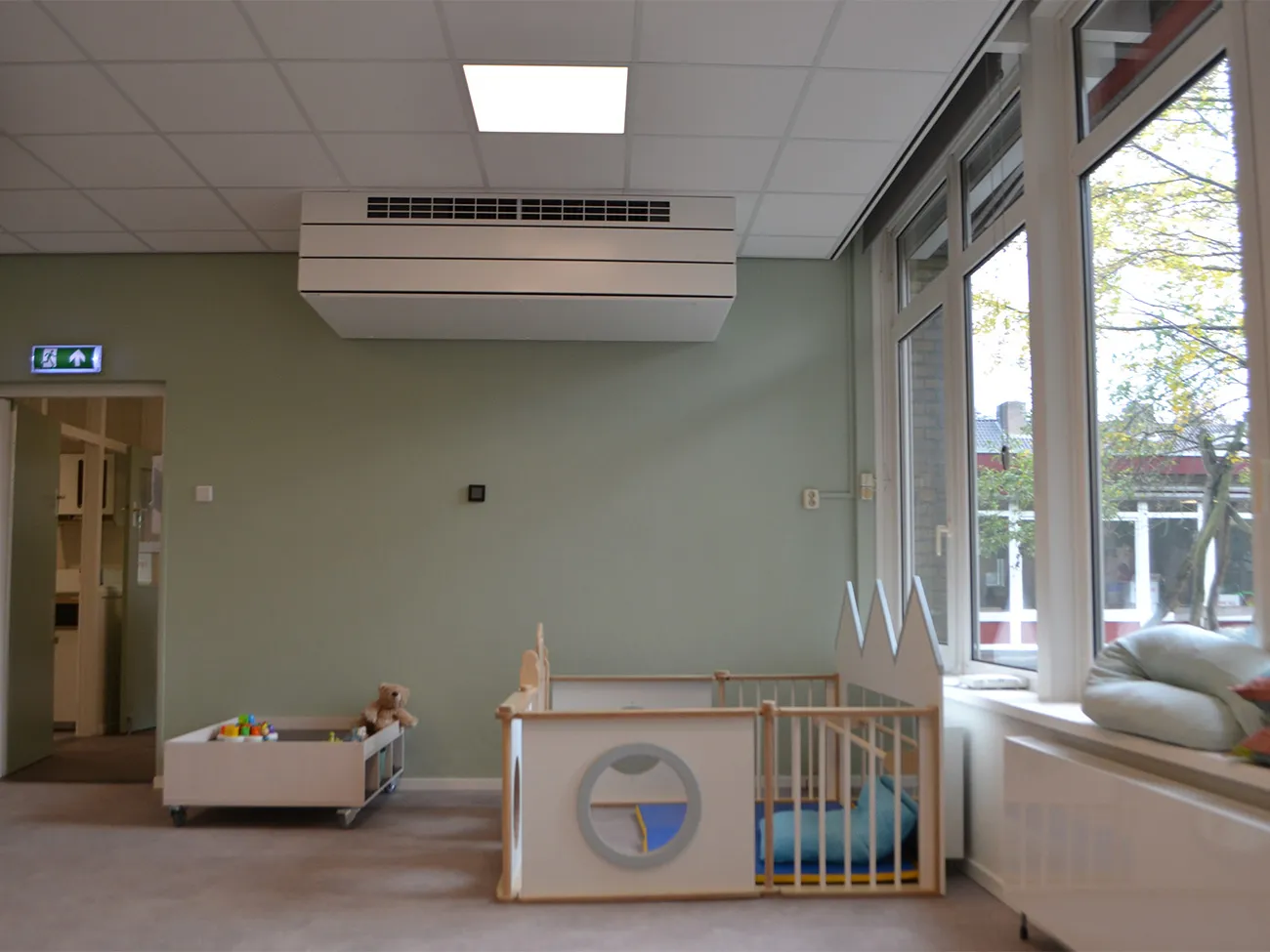
Danish manufacturer Airmaster has been providing healthy indoor air and optimum thermal comfort in offices, schools and childcare centres, among other settings, for more than 30 years. “Opening the windows is, of course, the easiest way to ventilate,” says Jean-Paul Pil, project adviser at Airmaster. “But to get ventilation right in every season, structural measures are needed. Childcare centres present a particular challenge because occupancy levels vary considerably. Children arrive and leave at different times, and often spend much of the day outdoors, depending on the season and weather. This results in varying occupancy levels and ventilation requirements. After all, not every room is used equally often. Play areas, for example, are used more actively and by more children than sleeping and changing rooms. Our decentralised heat recovery ventilation units provide a demand-controlled solution to suit all these needs.”
Airmaster mechanical ventilation units have recently been installed at the new Integraal Kind Centrum Berkelwijk in Leusden and at the Korein childcare centre on St. Adrianusstraat in Eindhoven. “The latter project involved a major renovation,” says Pil. “The childcare centre was completely stripped back internally and fitted with new electrical systems, water pipes, a heating system and a ventilation system, making the existing building fit for the future again. The aim was to find a simple and cost-effective ventilation solution. Another important consideration was selecting a system that would keep CO2 levels in the rooms as low as possible, helping to reduce the spread of coronavirus.”
A considered choice of decentralised ventilation
The building services contractor, Van den Hoff Installatiebedrijf, chose to work with Airmaster on the ventilation system. “The installer had already mapped out all the possible ventilation solutions and made a deliberate choice to go with decentralised ventilation,” says Pil. “This is the ideal alternative to centralised ventilation. Not only are roofs in existing buildings often not strong enough to support a ventilation unit, but structural alterations may also be impossible or too expensive. Decentralised ventilation units can be suspended from the ceiling with ease and do not require complex ductwork. Fresh outdoor air is supplied and polluted indoor air extracted through the external wall or roof.”
The installer had already completed much of the preparatory work and determined the required flow rates and ventilation units for each room. “A colleague and I reviewed the design and carried out an on-site inspection,” says Pil. “Which systems were specified for which rooms? Could we ensure correct and optimal air distribution? Where would it be best to place the control panels? And which roof cowls would be suitable for efficiently extracting used indoor air? We also looked at how high the bunk beds would be in the sleeping rooms and what that meant for positioning the units. Based on our findings, we only needed to make a few recommendations for improvements to ensure the best possible installation for the childcare centre.”
Demand-controlled ventilation based on CO2
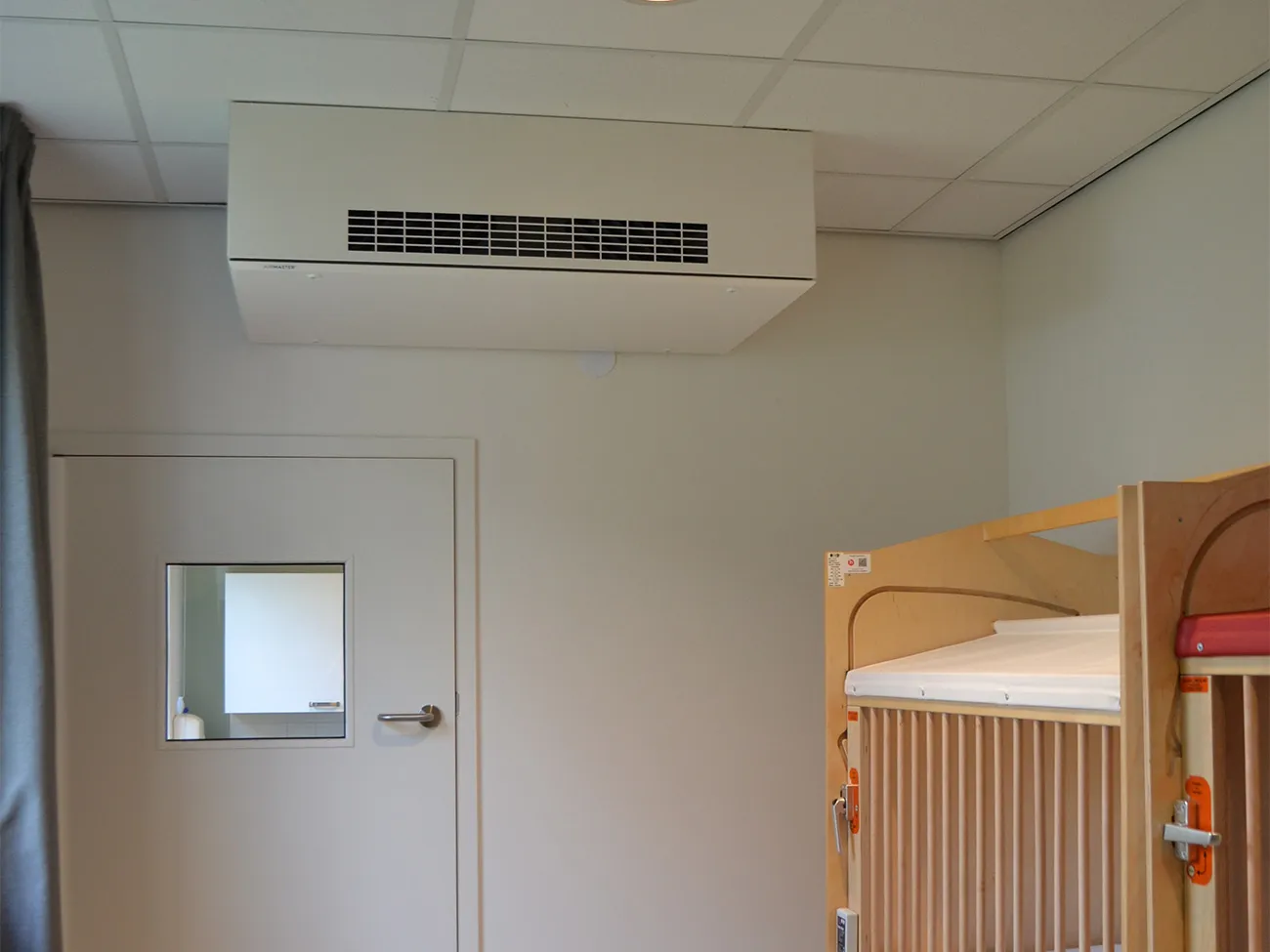
Airmaster supplies decentralised ventilation units for ceiling, wall and floor mounting, with capacities ranging from 115 to 1,200 m3/h. “Three models were selected for St. Adrianusstraat,” says Pil. “Our AM 800 units were chosen for the large rooms used for play and meals. AM 300 units were installed in the sleeping rooms, while the AM 150 was sufficient for the offices.” All 18 units are fitted with a CO2 sensor and operate completely independently. “The CO2 sensors provide demand-controlled ventilation based on the number of people in each room. CO2 levels are displayed on the control panel using clear colour codes and ppm values.”
The units normally run at 30% of their capacity, says Pil. “When the first children arrive in the morning and CO2 levels rise, the fan in the unit immediately and automatically ramps up. A heat exchanger efficiently warms the fresh outdoor air to 19°C before it is supplied to the room.” Airmaster units ensure high heat recovery, keeping heat losses to a minimum. “When it gets warmer outside, the bypass opens automatically, allowing outdoor air to be supplied directly to the room. The units also offer night-time ventilation and come with a programmable weekly timer. However, CO2 levels always take priority.” Airmaster ventilation units can also be connected to all common building management systems. “The units can also be controlled using our internet-based Airlinq® Online system.”
Support from start to finish
All Airmaster ventilation units for Korein were delivered to St. Adrianusstraat ready to plug and play. Airmaster kept a close eye on the project throughout and was also responsible for inspection and commissioning. A few months after handover, Pil reflects on a project that went smoothly and was a pleasure to work on. The rooms are well ventilated, and in winter the children no longer get red, chapped cheeks from dry air caused by the heating. The windows no longer need to be opened, which is important for the children’s safety. The installer and end user are both very satisfied, as demonstrated by several successful follow-up projects.
A business enquiry for Airmaster BV? Get in touch
Companies in this story

Keep following this
Get an email when a new story is published. No account needed.
- ThemeHealthy indoor air
- SubjectGeneral
- CompanyAirmaster BV