











Corona Safety Indicator helps reduce the risk of COVID-19
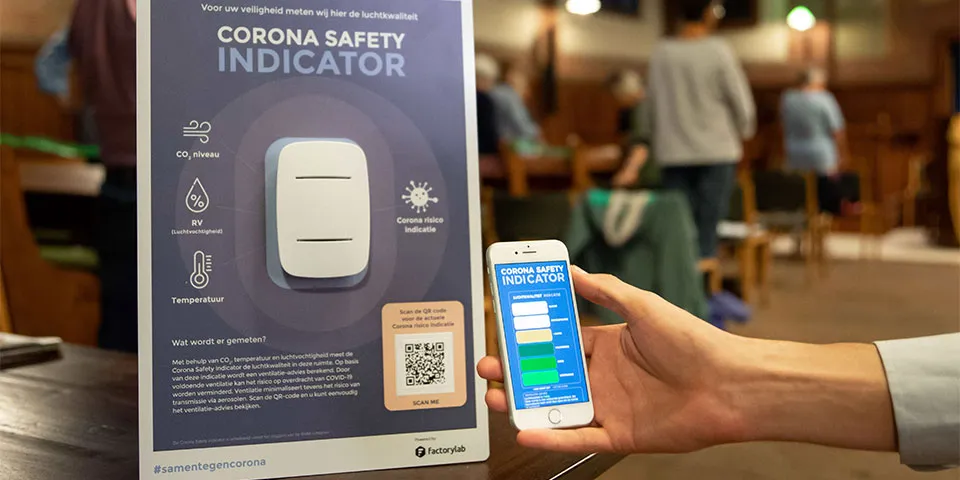
Ventilation reduces the risk of COVID-19 transmission. The Corona Safety Indicator uses carbon dioxide (CO2), temperature and humidity to measure air quality in a room.
Anyone can scan the QR code to check the current air quality in an office, shop, school or waiting room. Gertjan Strietman, co-founder of manufacturer FactoryLab, says: “Now that schools have started again and businesses are gradually returning to the office, this is an extremely useful, objective tool that can go a long way towards easing concerns.”
The Corona Safety Indicator is based on the Building Decree and guidelines from RIVM (‘Ventilation and COVID-19’) and GGD. As part of efforts to combat COVID-19, RIVM stresses the importance of ventilation: “It is important to air rooms even during breaks and when several people gather, for example for a meeting.”
Every minute
The sensors in the Corona Safety Indicator measure the air quality in a room every minute. The results are displayed via the QR code on a clear, six-point ‘traffic light’ scale, with no need to log in or register. Ventilation advice is also provided. Strietman says: “The information is also shared with the owner via a clear online dashboard, with alerts for potentially risky readings. The measurements are stored so that users can consult historical data and analyse patterns.”
800 ppm
People exhale carbon dioxide (CO2). Among other things, the Corona Safety Indicator measures the proportion of CO2 in the air in relation to humidity and temperature, and expresses this in parts per million (ppm). The presence of a virus cannot be measured, but the readings do give an indication of how clean the air is. Various organisations, including the VO-raad, recommend setting a maximum of 800 ppm because of coronavirus. This figure corresponds roughly to 40 to 50 cubic metres of fresh air per person per hour. If the level is too high, not only does the risk of infection increase, but many people also suffer from headaches, drowsiness or difficulty concentrating.
About FactoryLab
FactoryLab, based in Zwijndrecht, was founded in 2016 and has grown into an expert in collecting sensor data related to regulations in and around buildings. This data is transmitted and processed via the internet using ‘Long Range Low Power’, or LoRa technology, and presented in clear dashboards. FactoryLab solutions are used, among other things, to monitor the temperature in water pipes to prevent Legionella contamination, assess indoor climate in schools, and monitor air quality in offices and factories. FactoryLab has its own team of developers, programmers and IT specialists.
Question about this story? Ask your question
Keep following this
Get an email when a new story is published. No account needed.
- ThemeHealthy indoor air
- SubjectGeneral







