











Dutch manufacturer supplies pressurisation units for Canada’s zero-emission district heating network
After four years of development and preparation, Canada’s capital, Ottawa, is ready to accelerate the transition to a future-proof, zero-emission district heating network. The Energy Services Acquisition Program (ESAP) project will significantly modernise the existing district energy system, which supplies heating to 80 parliamentary and government buildings (total floor area: > 1.83 million m2) and cooling to 67 parliamentary and government buildings (total floor area: 1.73 million m2).
The old steam network in the capital region is the first in North America to be replaced by an electric system for cooling and low-temperature hot water for heating. The new energy system will significantly reduce greenhouse gas emissions, phase out ozone-depleting refrigerants and lower the cost of providing essential temperature control to parliamentary and government buildings in central Ottawa. The Ottawa River will help cool the water used to cool all buildings connected to the network.
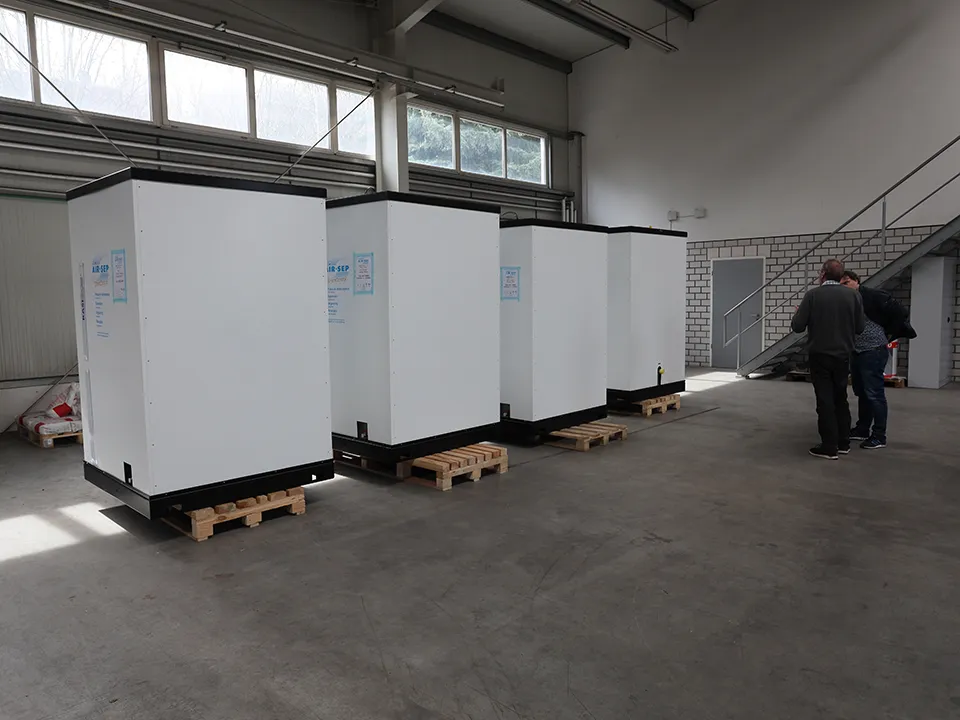
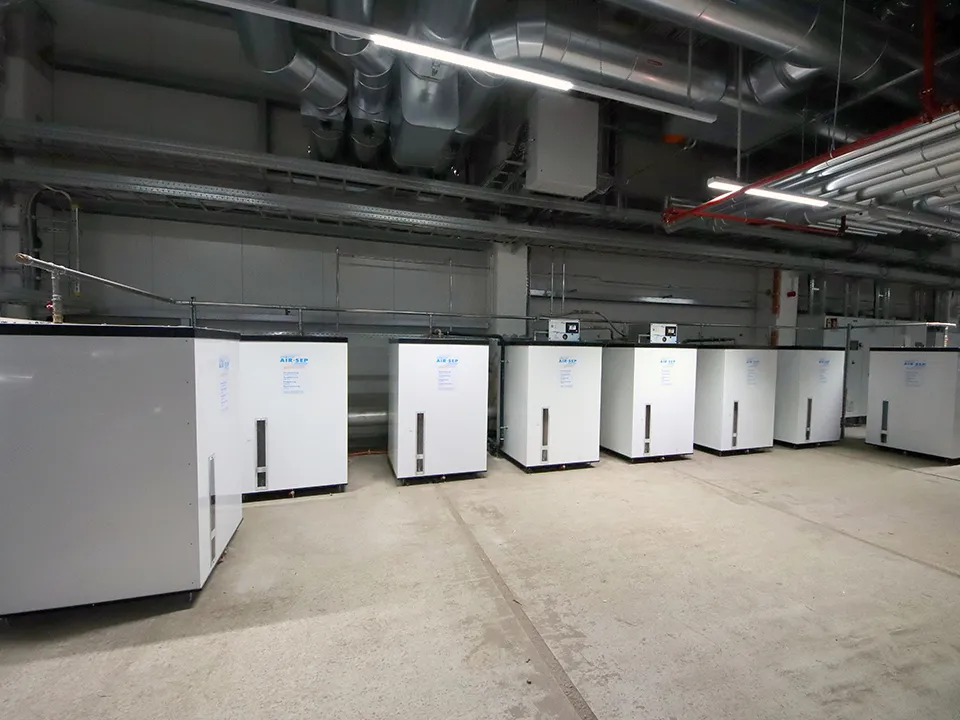
Six power plants have been designated to supply heating and cooling: Cliff, Tunney’s, NPB, NRC, RCMP and Confederation Hights. An important component of the energy system is the AIR-SEP® pressurisation units from KOREX Benelux, which provide system pressure maintenance, vacuum degassing, expansion, dirt collection and system make-up. To achieve this, the pressurisation units comprise an expansion vessel with an inlet valve, air vent valve, automatic filling unit and pressurisation pump, which eliminate air bubbles from the pipework. This allows the system water to circulate more freely, resulting in higher efficiency, fewer faults and a significantly longer service life for the installations.
Compact, complete expansion unit
The seeds of the Ottawa project were sown in 2018, when Mario van Gorsel, director of KOREX Benelux, met a major HVAC equipment distributor at the ISH trade fair in Frankfurt. “We had a good conversation, but there were no relevant projects at the time,” says Van Gorsel. “That changed in 2020, when the distributor suddenly got back in touch. They were looking for a compact, complete expansion unit that could automatically monitor and perform all functions (pressure maintenance, vacuum degassing, expansion, dirt collection and system make-up) in an integrated way. The AIR-SEP® can do this without any problems.”
First phase
The first phase of the ESAP project is the installation of the RCMP power plant, with a heating capacity of 18 MW, a heating water volume of 550,000 litres, a pressure of 2.5 Bar and a total expansion volume of 13,000 litres. “At the beginning of May, we delivered the AIR-SEP® pressurisation units for this part of the project and shipped them from our factory in Germany to Canada in a 40ft High Cube container,” says Van Gorsel. “This comprises 6 cascade-connected AIR-SEP® pressurisation units. The RCMP power plant will be connected on the heating side to 4 AIR-SEP® units, with an expansion water capacity of 2,400 litres (total capacity: 9,600 litres). For pressure maintenance on the cooling side, two AIR-SEP® units have been supplied, with a combined expansion water capacity of 4,800 litres. We have also already supplied 2 AIR-SEP® units for the Tunney’s power plant.”
Different temperature ranges
KOREX Benelux is currently hard at work engineering the AIR-SEP® pressurisation units for the Cliff power plant, which has a heating capacity of no less than 120 MW. “One interesting detail of the ESAP project is that the temperature difference between day and night in Canada is much greater than in the Netherlands,” says Van Gorsel. “In the Netherlands, there are only two occasions a year when all heating is switched off and then back on at the same time (May and October). In Canada, however, this happens twice a day. It is quite normal there for cooling to be used during the day and heating at night. Whereas supply and return temperatures of 80-70°C or 70-60°C are usual for heating in the Netherlands, in Canada they are 90-70°C. And whereas cooling in the Netherlands uses temperatures of 12-16°C, in Canada the design temperature is 4-6°C. We take this into account carefully in our engineering, ensuring that our installations will also operate perfectly in Canada.”
Een zakelijke vraag aan KOREX Benelux? Get in touch
Who worked on it
Energy Services Acquisition Program (ESAP) in Ottawa
- drukbehoudstations
 KOREX Benelux
Keep following this
Get an email when a new story is published. No account needed.
- ProjectEnergy Services Acquisition Program (ESAP)
- ThemeGas-free heating and cooling
- SubjectGeneral
- CompanyKOREX Benelux







