











Good corrosion protection prevents corrosion
Text Lieke BousemaImage Croonwolter&dros
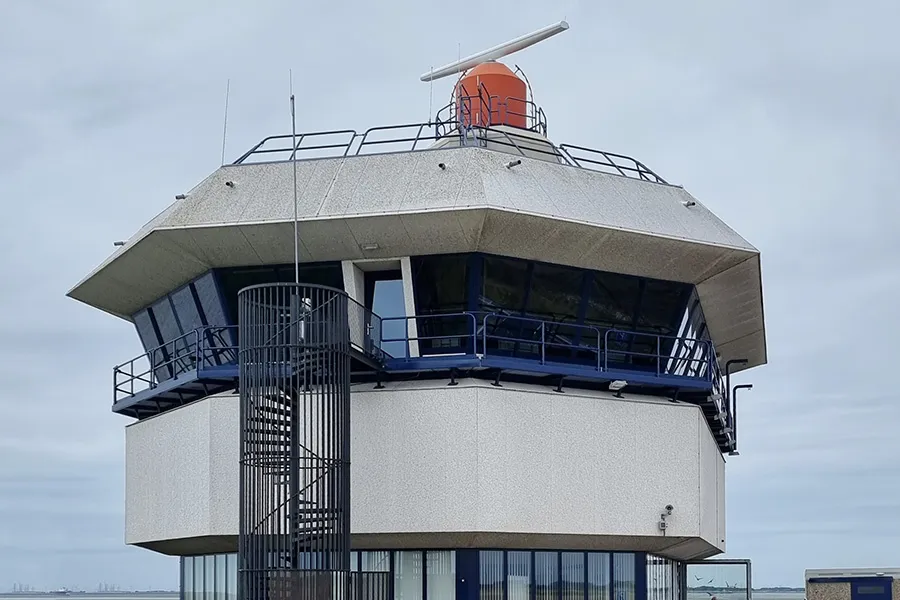
Like our roads, the Dutch and Belgian waterways have busy junctions. It is often difficult for skippers to keep track of everything at these points. That is why Rijkswaterstaat (the Netherlands) and the Agentschap voor Maritieme Dienstverlening en Kust (Belgium) have installed vessel traffic control centres at the busiest and most important junctions, where traffic controllers provide so-called ‘Vessel Traffic Services’. At the control centres, radar and a marine VHF radio are used to determine the position of vessels, allowing advice and instructions to be given. The Netherlands and Flanders have a total of 20 vessel traffic control centres, whose reliable operation is essential. The maintenance and (re)conditioning of the climate control systems play an important role in this.
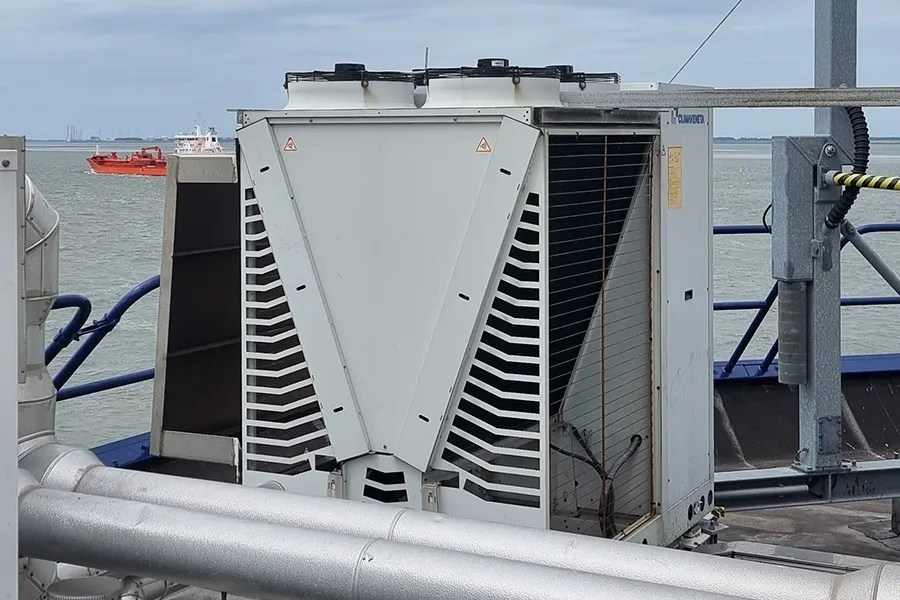
To keep the control centres in Zeebrugge, Vlissingen, Terneuzen, Hansweert and Zandvliet in optimum condition, the ‘Gemeenschappelijk Nautisch beheer Scheldegebied’ was established, a partnership between Rijkswaterstaat and Agentschap MDK. Within the so-called ‘Schelderadarketen’, Croonwolter&dros is responsible for the overall management of the radar stations. A recent contract involved cleaning and coating the outdoor air heat exchangers in two cooling systems dating from 2020, installed on the roofs of the control centres in Hansweert and Terneuzen. “Both control centres are right beside the salty seawater,” says Justin Engels, Contract Coördinator Maintenance at Croonwolter&dros. “The buildings and their systems are constantly exposed to a corrosive marine atmosphere, making appropriate precautions such as a protective coating essential. As the heat exchangers in Hansweert and Terneuzen did not yet have such a coating, we contacted Conpro Condensor Bescherming BV.”
Completely self-sufficient
According to Engels, choosing Conpro was an obvious decision. “There are few companies in the Netherlands specialising in condenser coating,” he says. “We had also had positive experiences with Conpro on previous projects. The collaboration in Hansweert and Terneuzen went very smoothly too. Rather than preparing a quotation remotely, Commercial Manager Timon Bol came straight to the project sites to carry out an on-site assessment.” Bol says: “Together, we assessed the condition of the outdoor air heat exchangers. We also surveyed their configuration and accessibility, which informed the work plan and quotation.” Engels adds: “Croonwolter&dros handled the coordination, while Conpro carried out the condenser coating entirely self-sufficiently and to a high standard.”
Solvent-free coating
To carry out the protective treatment on site, Conpro looked for climate-neutral days with no strong winds, rain or bright sunshine. “We used the fixed cage ladders to take our equipment up to the roof,” says Bol. “There, we dismantled the cooling units sufficiently to access both sides of the heat exchangers, from both the air intake and air outlet sides. We carefully cleaned the heat exchangers with a high-pressure washer and biodegradable industrial cleaning agents, removing any contaminants drawn in with the air. We then allowed the systems to dry before applying at least three coats of protective treatment. For this, we used our solvent-free PROGREEN® H2O surface treatment, applied in an extremely thin layer using specialist spraying equipment. The coating prevents salty sea air and microscopic contaminants such as fine dust, sulphur oxide, nitrogen dioxide and benzene from causing damage, helping to ensure a long service life for the systems.”
With this project, Conpro demonstrates that it excels not only in building services projects, but also in industry. The work was completed in early June.
Question about this story? Ask your question
Keep following this
Get an email when a new story is published. No account needed.
- SubjectGeneral







