











Hunter Douglas introduces new range of wall and ceiling systems with nano-perforations
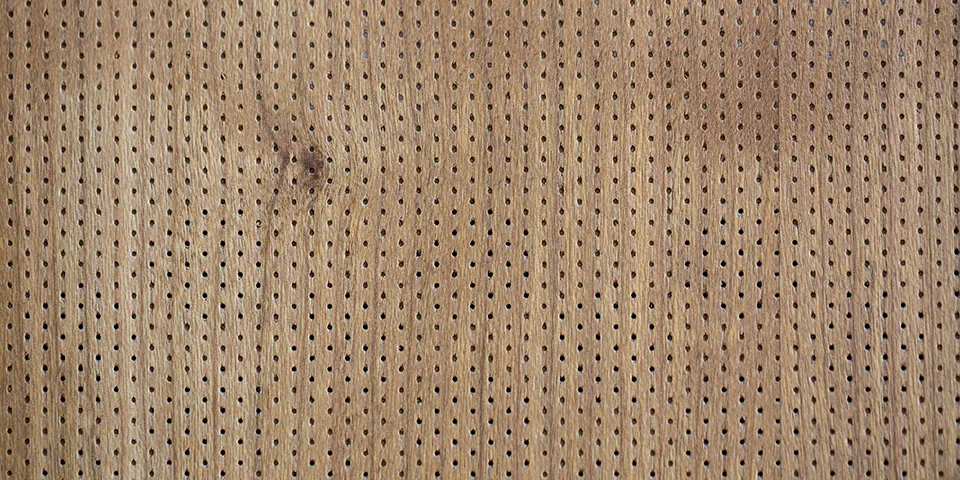
Hunter Douglas is launching an innovative range of wall and ceiling systems with nano-perforations. The wood veneer panels contain numerous microscopic perforations (Ø 0.5 mm), delivering high acoustic performance without compromising their aesthetic quality. “The nano-perforations in the wood veneer are so small that they are no longer visible to the naked eye even from a short distance, unlike conventional, visible perforations with a larger diameter, usually around 5 to 10 mm”, explains Chris Wielenga, business manager wood at Hunter Douglas. At the same time, the panels absorb more sound than panels with other types of perforation. “The nano-perforated panels have a tested sound absorption rating of up to αw: 0.95 and NRC: 0.90. Standard perforations generally achieve αw: 0.75 and NRC: 0.75 respectively.” With its nano-perforated panels, Hunter Douglas is responding to architects’ growing demand for acoustic and aesthetic wall and ceiling solutions. “We are seeing increasing interest in perforated panels because of their good acoustic performance. Although the perforations are small, conventional circular or slot perforations (5 to 10 mm) are still clearly visible from a greater distance. With nano-perforations, we offer an almost invisible alternative, which is greatly appreciated by many architects.” Architects have a wide choice of wood veneer types, sizes, finishes and configurations for the wall and ceiling panels. “This gives them considerable design freedom.” The nano-perforated panels are also durable, safe and easy to install and maintain.
Hunter Douglas will introduce its new range of wall and ceiling panels with nano-perforations at MaterialDistrict at Ahoy Rotterdam (stand I35, 12 to 14 March 2019).
The acoustic panels with nano-perforations comprise fire-retardant MDF (16 mm), a black acoustic fleece and a wood veneer top layer (0.5 mm) on both sides. Microscopic perforations with a diameter of 0.5 mm are punched into the top layer. The MDF has larger perforations (Ø 10 mm). Wielenga explains: “The microscopic perforations make the top layer appear unperforated, effectively covering the larger perforations in the MDF. This allows us to make the perforations in the MDF larger, thereby increasing sound absorption.” The punching technique, which differs from standard perforation techniques, produces higher-quality perforations. “Perforations are usually made by piercing the material with needles, but this only pushes the wood aside, and it then folds back, reducing absorption. Punching removes the wood completely.”
The range of panels gives architects a high degree of design freedom. First, architects can choose from more than 40 veneer types, which they can select themselves. “This is unique compared with competitors. We also buy veneer books ourselves and combine them into large sheets, allowing architects to help determine the quality and appearance. This includes the size of the grain pattern and the number of knots,” says Wielenga. “Most suppliers buy pre-veneered boards, so this option is not available.” Wall and ceiling panels are also available in various standard sizes (600 x 600 mm, 1200 x 600 mm, 1800 mm x 600, with a maximum length of 2780 mm for wall panels), and can be made to measure on request. Hunter Douglas also offers a choice of finishes: in addition to a standard UV lacquer, customers can choose from various gloss levels and pigmented lacquer (e.g. white wash). Finally, depending on how visible the joint should be, various configurations are available: concealed, semi-concealed or open joint.
The nano-perforated panels are fire-safe (B-s2, d0 according to EN 13501-1) and durable. The best part of the log is used sparingly to produce the decorative veneer. After use, usually at the end of a building’s service life, the panels can be recycled and used as a raw material for new panels.
Ceiling panels are installed in a T-24 grid, while wall panels are secured to a batten framework using special clips. Once installed, all systems provide full access to the plenum, as each panel can be removed individually.
The new range of wall and ceiling panels with nano-perforations is now available. Hunter Douglas will also introduce the wood veneer panels at MaterialDistrict at Ahoy Rotterdam (stand I35, 12 to 14 March 2019).
Question about this story? Ask your question
Keep following this
Get an email when a new story is published. No account needed.
- SubjectGeneral







