











‘If you don’t know about it, you can’t choose it’
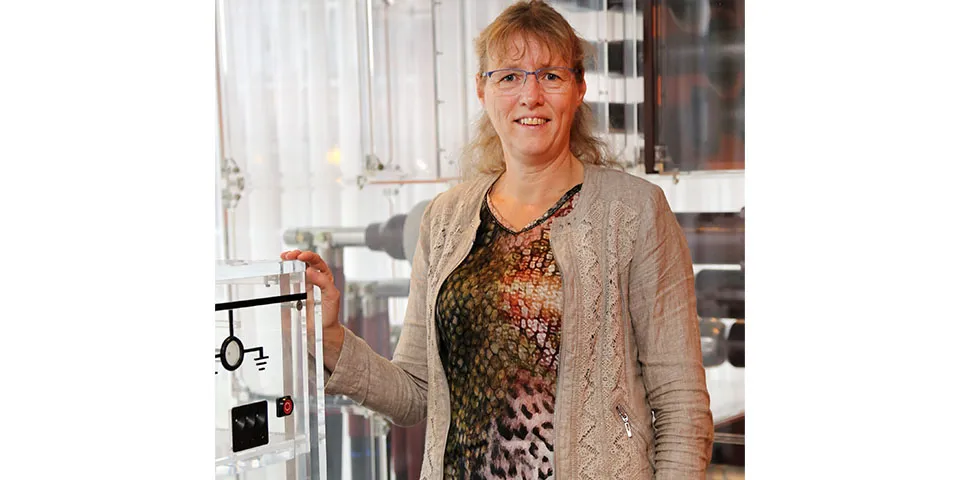
Elise Morskieft is passionate about engineering. After studying electrical engineering at HTS, she embarked on a career that began at Holec in 1985. Via Hitec and Imtech, she moved to Eaton Industries in Hengelo. She has worked there for more than fifteen years, most recently as Specialist Protection & Control R&D. Eaton is an international technology company that makes electronic components and has 97,000 employees worldwide. Engineering has always felt like a natural choice to her. That is not the case for every girl or woman, however.
Engineering was part of the family
Girls would rather study law, medicine or psychology. “That’s typical of the Netherlands,” says Morskieft. “In Spain, Poland and the Czech Republic, for example, you see many more girls in engineering. Is that down to perceptions, or careers advice? VHTO, the Dutch national expert organisation for girls and women in science, technology, engineering and maths, investigated this and found that the biggest influences are mothers and the home environment. The conclusion: if you don’t know about it or realise how enjoyable it is, you can’t choose it. I’m an example of that conclusion in practice. The situation in our own home is now exactly the reverse: our children hear little about the arts and humanities.”
Who or what inspired you to go into engineering?
Morskieft: “You either have an interest in engineering or you don’t, but your home environment has a major influence. There were five children in our family. My father was usually away for work, while my mother ran the household and repaired anything that broke. We didn’t throw much away. My mother’s approach was: if you want to get something done, just get started. If you don’t try, you certainly won’t succeed. And then you discover how fascinating it is to make something yourself. That’s a real source of inspiration. On top of that, I wasn’t good at languages at school, and I wanted to reason everything through. So I soon opted for a science-focused subject package. But I’m still amazed at how few girls choose engineering. I was the only girl in electrical engineering at HTS for four years. There were two girls in technical physics, one of whom was my sister.”
And you’re passing the bug on in your own family?
Laughing: “I think so. My eldest daughter and son are studying mechanical engineering, and my youngest daughter is studying industrial design. What I’ve noticed is that women are heavily outnumbered at the start of the course. That changes somewhat later, as more of the men drop out. Men and women have the same ability to succeed in engineering.”
The problem isn’t how to keep girls and women in the sector. The key is getting them through the door in the first place. Morskieft: “A campaign such as ‘A bright girl prepares for her future’ actually gave the impression that only a few girls study engineering. The result was even fewer applications. In general, campaigns do little to persuade girls to take the plunge. Giving them direct contact with the industry and with role models works better.”
Are you actively involved in encouraging girls to go into engineering?
Morskieft: “I do outreach work for VHTO in the region, acting as a role model in the field. VHTO also organises Girlsday once a year, when girls aged 10 to 15 visit companies. The aim is to introduce them to the engineering sector at an early age and show them how enjoyable it can be. Eaton takes part too. At first, we did this on an ad hoc basis, but funding from our nomination for Best Training Company allowed us to set up a dedicated engineering classroom. We now regularly organise visits for classes from primary and secondary schools. We start by giving a general introduction to electrical engineering, using fun examples. Then we show the children around our company, before letting them make things in the classroom. I teach the class too. Not as a woman, but as an engineer who wants to share her passion for engineering.”
Morskieft touches on a key point: “Being a woman plays no role for me. At Eaton, I’m one of many. It only becomes noticeable when we go out and about. It was the same at HTS. I’m valued not for my gender, but for my knowledge and skills. And I love engineering because I enjoy it.”
Question about this story? Ask your question
Keep following this
Get an email when a new story is published. No account needed.
- SubjectGeneral







