











Innovative new housing concept keeps young people in Nieuw-Weerdinge, Drenthe
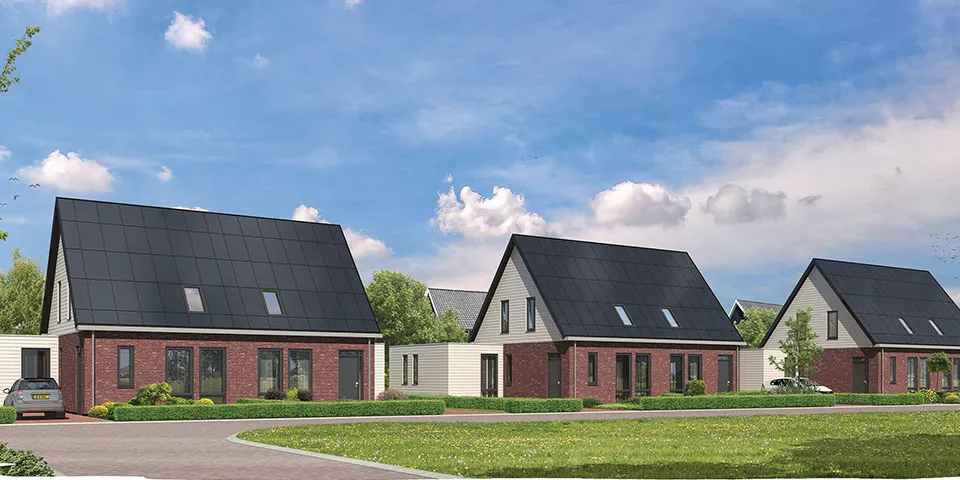
The village of Nieuw-Weerdinge in Drenthe has been losing young people for years because affordable starter homes are in short supply. To tackle this issue and sustain and boost the local economy, several villagers set out to find a high-quality yet affordable housing concept.
They settled on Q-vention, which has developed a future-proof, certified construction system for energy-positive homes. Based on this system, the housing needs of first-time buyers and their available budget, four pairs of semi-detached homes are being built in the Mandebroek 3 development. The homes are made from ready-made elements that can be assembled on site in no time.
The Q-vention homes will have a volume of around 340 cubic metres and comprise a ground floor and first floor. “The homes are based on a sustainable timber structure, finished with moisture- and fire-resistant Magoxx® board made from ground pebbles, circular Neopor® insulation and triple glazing,” says Ben Verstraten, technical director at Q-vention. “Thanks to the high-performance building envelope (Rc-value: 10.6), no heat is lost and energy consumption can be reduced considerably. All the homes will have an all-electric installation with instantaneous water heaters, infrared underfloor heating and a CO2-controlled Fresh-r ventilation system. They will also have solar roofs that generate enough energy to meet normal household needs. An energy performance guarantee is provided for this too. By accurately monitoring, controlling and optimising energy flows, electricity consumption is kept to a minimum, the service life of the installations is extended and maintenance can be tailored to requirements.”
Industrialised, standardised construction approach
Q-vention has now completed several homes in Almere, Uden, Mierlo and Helvoirt. However, the Nieuw-Weerdinge project marks the start of a more industrialised construction approach using standardised, coordinated building elements and installations. This will further shorten construction times and keep development and construction costs down, Verstraten explains. “To make the most of this approach, we set out to find supply-chain partners, including for the all-electric concept. We soon turned to Hager, which is well organised in the construction sector and supplies high-quality products. Hager is also highly innovative. The company was willing to fine-tune existing products and standardise them for the Q-vention construction method, as well as explore the possibilities of ‘the new way of building’ with an open mind.”
Skirting trunking system
“Ben Verstraten was looking for a reliable way to distribute the energy generated by the homes,” says Werner Roovers, Account Manager, Housing & Concepts at Hager. “He was very enthusiastic about our skirting trunking system, which can be integrated into the façade panels and conceals all the electrical wiring. The system looks and feels like skirting, with the added benefit that socket, antenna and data connections can easily be positioned on site. This saves a great deal of work on site.”
Smart Home automation solution
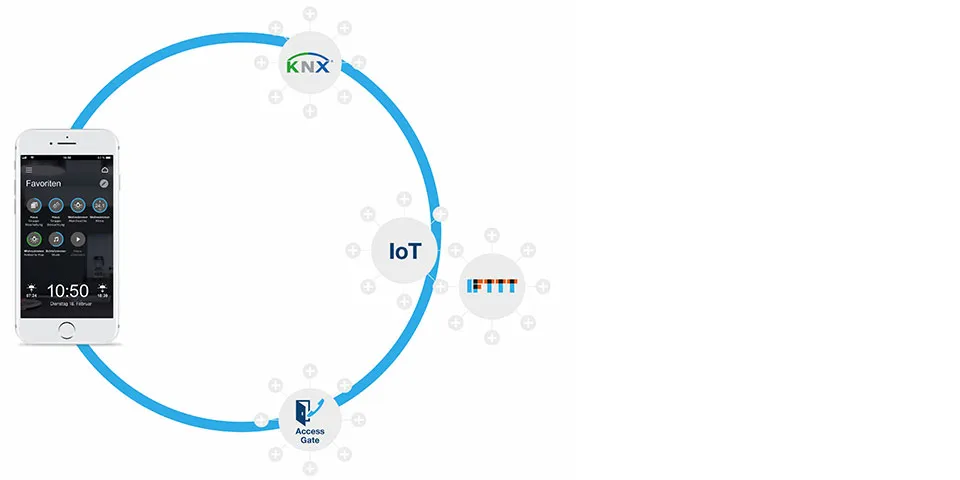
The trunking systems will be installed in various rooms, Roovers explains. “We have also proposed a future-proof, flexible Smart Home automation solution, allowing all the installations to be accessed and managed easily via a smartphone, including absence scenarios. Residents can fine-tune the installation using a Q-vention options list, for example by integrating energy monitoring and/or the control of solar shading and roller shutters. They can also add functions themselves in the future, such as a weather station and additional light fittings. To support Q-vention with the installation of the Smart Home systems and electrical services, we put Ben Verstraten in touch with Linde Kroon Elektrotechniek, with whom the all-electric installation is being further developed and optimised.”
Smart and ready-made
“Our challenge is to standardise the electrical installations in such a way that we end up with a smart, ready-made basic installation that is also very easy to install,” says Jeroen Lawant, Director of Linde Kroon Elektrotechniek. “All the homes will be fitted with a Hager Vision consumer unit. A single supply cable runs from this unit to the kitchen, where a Hager sub-distribution board supplies all the kitchen installations. This means there will be no need to run additional cables back to the consumer unit when extra appliances and socket outlets are added in the future.” There will also be a sub-distribution board upstairs, to supply, for example, the washing machine, tumble dryer and PV inverter. Lastly, a separate sub-distribution board will be installed for the instantaneous water heaters. “For home automation, we have chosen a KNX installation with basic on/off switching, which can be extended as required with dimming, app control and monitoring.”
To enable the electrical services to be installed quickly, Linde Kroon Elektrotechniek is currently exploring the use of ready-made electrical wiring harnesses with connectors, which can easily supply the Hager socket outlets and light switches. “The cable route for the KNX lighting, including switches and light points, will use bus cables,” says Lawant. “Unlike in a conventional setup, the smart switches with sensors/actuators will not be integrated into the consumer unit, but will be installed in the ceiling roses at the light points. Hager offers various solutions for this, which considerably simplify installation.”
A business enquiry for Hager? Get in touch
Companies in this story
Keep following this
Get an email when a new story is published. No account needed.
- SubjectGeneral
- CompanyHager







