











Isolectra’s plug-in installations added to the National Environmental Database
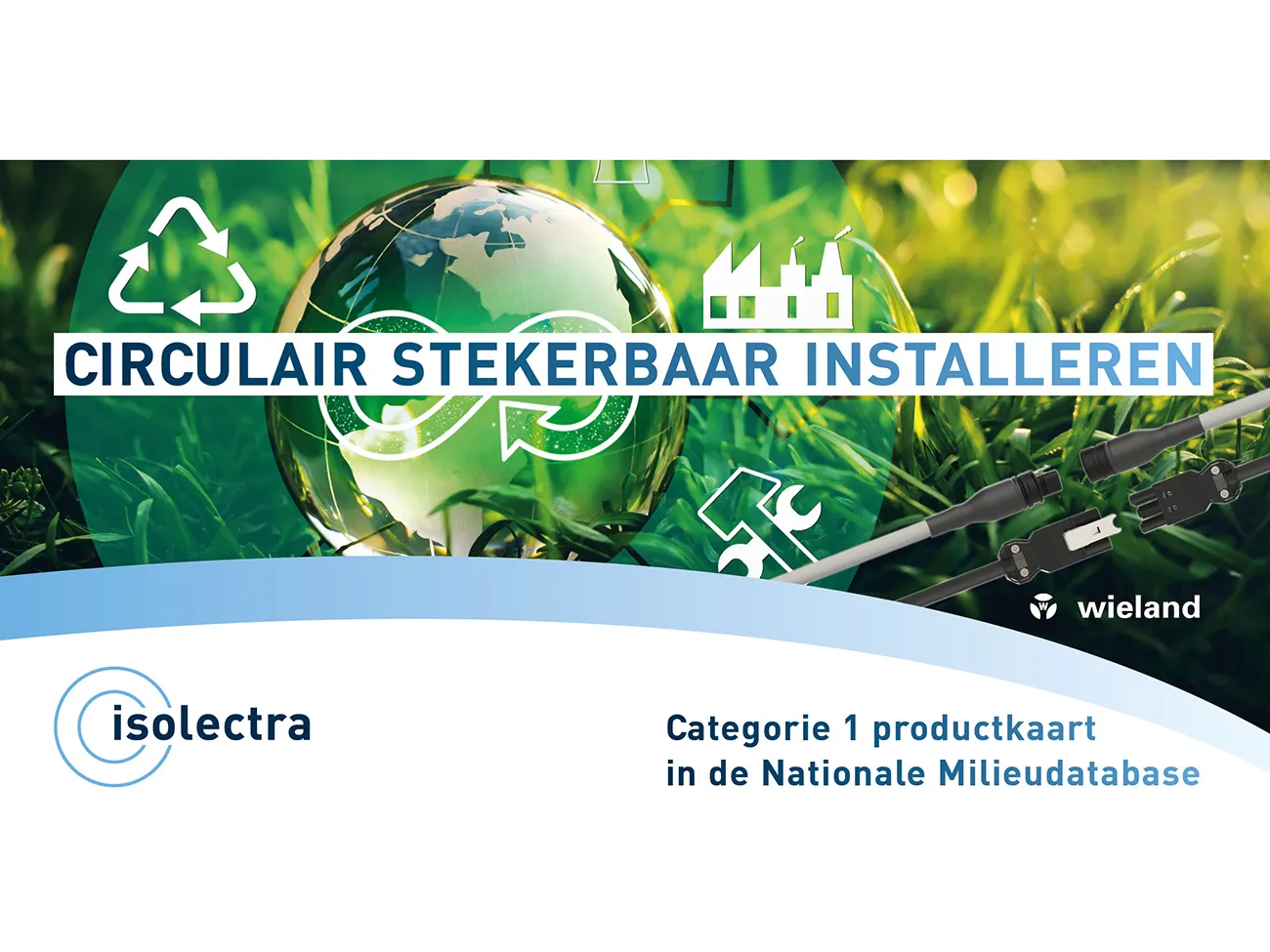
The National Environmental Database aims to provide a clear picture of the environmental performance and circularity of buildings. To this end, the database contains product cards with information on construction products and building services installations, from PV panels to window frames and insulation materials. Isolectra’s plug-in installations have recently been added to the National Environmental Database. Architects, consultants, installers and other stakeholders who specify and use the Wieland GST15®, GST18®, RST16®, RST20® and RST25® plug-in installation systems in their projects can use the data from the National Environmental Database to make meaningful product comparisons. They can also use it to calculate and even reduce the sustainability impact and environmental performance of their buildings.
ANOTHER STEP TOWARDS SUSTAINABILITY
Isolectra pioneered plug-in installation and has grown into a market leader with the Wieland brand over the past decades. “A key aim of plug-in installation is to assemble building services systems industrially, flexibly and so that they can be dismantled,” says Casper Bontenbal, marketing manager at Isolectra. “Because the systems can be fully adapted and reused immediately, the service life of the installations is significantly extended. This means we make an important contribution to the sustainability of buildings, closing the materials loop and achieving the government’s objective of significantly reducing the environmental impact of buildings. One example is making the Environmental Performance of Buildings (MPG) calculation mandatory when applying for environmental permits for residential or office use (>100 m2). The lower the MPG score, the more sustainable and environmentally friendly the materials used in buildings are.” As of 1 July, the MPG requirement for homes has been tightened from 1.0 to 0.8. The target for 2030 is to lower this score further, to 0.5. The threshold for offices remains 1.0 for now, but will also be tightened in the future.
How is environmental performance determined?
Every construction product has some impact on the environment. The combined impact of all the products used is known as a building’s environmental performance. “For product comparisons and to make the right choices, it is helpful for construction-sector parties to be able to carry out their calculations in the same way,” says Bontenbal. “That is why the government commissioned a method for determining the environmental performance of buildings that is clear, independent, comprehensive and reliable. The National Environmental Database (NMD) is central to this method, bringing together environmental data on construction products. The NMD also serves as a data source for the calculation tools used to determine the environmental performance of buildings. The method is based on a life cycle assessment (LCA) of a construction product, in other words, its total environmental impact from raw material extraction through to manufacture, and from demolition through to recycling.”
LCA study
Isolectra recently completed its LCA study successfully. Over a period of around two years, the environmental impact of its plug-in products was assessed. “This involved quantifying factors such as raw material and energy use, waste streams and toxic emissions. The results were verified by an independent, qualified LCA expert so they could be included in the National Environmental Database as a Category 1 product card,” says Bontenbal. Product data in the National Environmental Database is divided into 3 categories: (1) manufacturer data, (2) industry data and (3) generic data from Stichting NMD. “The Category 1 product card gives architects, consultants, installers and other stakeholders access to the most detailed product information. They can use it to select construction products with the lowest environmental impact.”
The Wieland GST15®, GST18®, RST16®, RST20® and RST25® systems can now be found in the NMD. The shadow costs of the environmental impact of these installations, from the distribution board to the switching devices, are significantly lower than those of a conventional installation.
MIA and VAMIL
To encourage investment in sustainable construction products and building services installations, the government has introduced several attractive options. Clients and investors may qualify for attractive tax incentives, such as the environmental investment allowance (MIA) and arbitrary depreciation of environmental investments (VAMIL), if they use five construction materials with a Category 1 product card in the NMD, or three construction materials and one appliance with a Category 1 product card. “One condition is that an agreement is made with the supplier to take the products back,” Bontenbal emphasises. “That is no problem for Isolectra, which is happy to take back plug-in installations at the end of their service life, test and recertify them so they can be put back on the market in good, reliable condition. This comprehensive approach is essential even for those who do not use these subsidy schemes, because it is the only way to guarantee the high quality of our technical products during their second, third or … life.” By extending the service life of its products (Re-use, Repair, Repurpose) and reducing material use wherever possible (Refuse, Rethink, Reduce), Isolectra is at the top of the circularity ladder.
Have a business enquiry for Isolectra BV? Get in touch
Companies in this story

Keep following this
Get an email when a new story is published. No account needed.
- ThemeSustainable refurbishment of existing buildings
- SubjectGeneral
- CompanyIsolectra BV







