











Noise barriers put an increasing focus on the environment and design
Text Desiree PenningsImage ModuBar

For years, ModuBar’s noise barriers have helped prevent noise nuisance. The company continues to innovate, developing better versions and refining their appearance. Their design can now be tailored to complement a building’s architecture.
The Noise-Reducer and Kokowall HA-Minwol noise barriers are now well-established products on the market. They reduce noise from heat pumps, air conditioning units and air handling units. The Noise-Reducer comprises an absorptive layer, rock wool and PE fleece, finished with a plastic separator in the required colour. The Kokowall HA-Minwol noise barrier is finished with coconut fibres, making it ideal for supporting climbing plants. It can also be used as a garden fence. Both the Noise-Reducer and Kokowall HA-Minwol are suitable for various substrates, including concrete roof structures, concrete bases and installation in the ground on foundations.
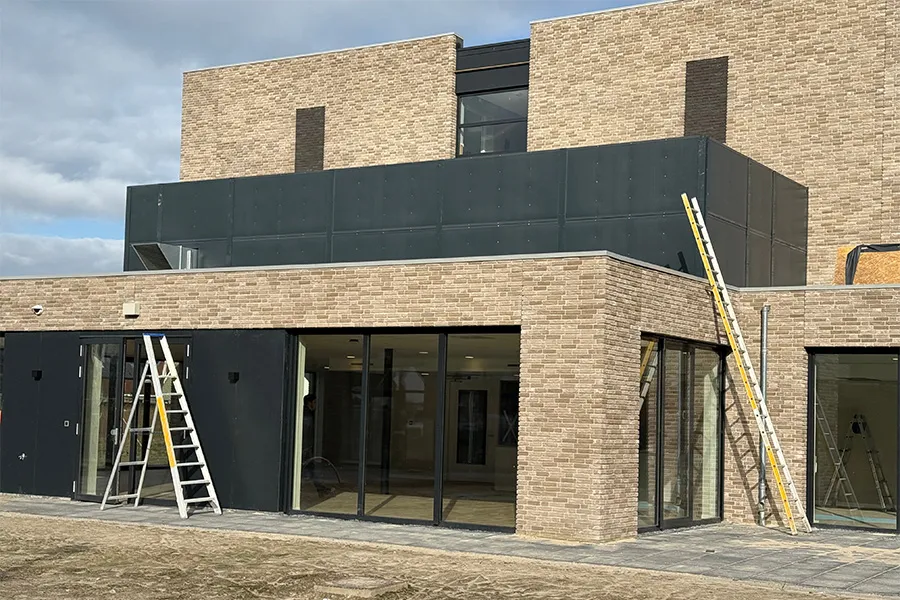
Blending into the building
Not long ago, ModuBar launched the Roof Panel, a barrier with a flat side available in any colour. It is ideally suited to architects looking to integrate barriers into their designs. The panels were developed specifically for roofs and can be stacked, offering enormous design freedom. Arjan Kick, project manager at ModuBar, explains: “Previously, the barriers had a more industrial appearance. Now we are paying more and more attention to design. Spinaker residential tower in Tilburg is a good example. We recently installed noise barriers there for Heijmans, in the same colour as the window frames. We are increasingly seeing the powder coating blend seamlessly with the building’s colour scheme. We can adapt flexibly to meet that demand.”
Dutch sheep
Rock wool is normally used as the insulation material. ModuBar can now replace it with sheep’s wool, as required. There is a surplus of this natural product in the Netherlands. By using it in noise panels, a valuable new application has been found for it. Kick says: “Producing mats from sheep’s wool requires less fossil energy, and wool absorbs sound just as well. Our acoustic tests have shown that it has high sound absorption properties.”
The idea of using sheep’s wool came from a student at TU Delft, who approached ModuBar to develop it further. “The wool comes from Dutch sheep. The thicker the layer, the higher the absorption value. You can vary the thickness, just as you can with rock wool. Like rock wool, sheep’s wool is a natural, circular product. Sheep’s wool is already being used in projects, particularly where there is demand for a circular solution,” says Kick.
Question about this story? Ask your question
Keep following this
Get an email when a new story is published. No account needed.
- ProjectSpinaker
- SubjectGeneral







