











“Noise limits for outdoor units are a short-sighted measure”
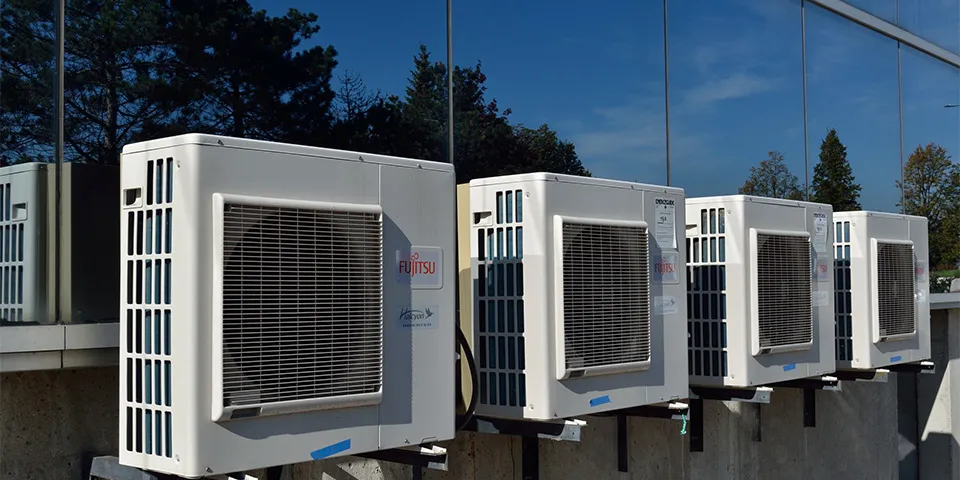
Heat pumps and air conditioning units installed outside homes will soon be allowed to produce no more than 40 dB of noise at neighbouring properties. This is one of the amendments to the Building Decree recently submitted to the House of Representatives by the Minister of the Interior and Kingdom Relations. She aims to prevent noise nuisance for people living nearby. Rudy Grevers, Residential Construction Manager at Alklima, an importer of heat pumps and air conditioning units, among other products, believes this measure is too simplistic and offers a different perspective.
“As so often, legislation follows current events, but policy on new themes is frequently developed (far) too late. The debate about noise from air-to-water heat pumps is a good example. As a result, time pressure threatens to lead to the wrong choices, hampering the progress of the energy transition and the achievement of its targets. I have a number of suggestions for ensuring this process is successful.
Yes, I work for a manufacturer of air-to-water heat pumps, among other products, so I have a vested interest. This is often given as a reason to stay out of discussions on issues like this, since contributions are quickly dismissed as ‘the butcher judging his own meat’. However, my day-to-day work, which involves close involvement in housing projects, makes me feel strongly that I should respond to the latest draft decree amending the 2012 Building Decree, sent to the House of Representatives by Minister Ollongren on 22 May 2019. Knowing the realities on the ground as a company gives you a good understanding of the issues at play, while also allowing you to highlight aspects from your own field that have so far received too little attention. I will not use arguments related to our products, but will simply set out our views on developments to date, the objections that can be raised and the changes that should be considered.
The problem is rarely a problem
Let us first take a closer look at ‘the problem’. Noise from an air-to-water heat pump’s outdoor unit is generated by two components: the fan and the compressor. The speed of both varies, and therefore so does the noise they produce, depending on outdoor conditions and the temperature inside the home. The system’s operating mode, whether space heating, cooling or domestic hot water, also plays a part. Finally, the system may be running a legionella prevention programme or a defrost cycle. Each of these different conditions, both outdoor conditions and operating modes, produces different noise levels, which in many cases cannot be simulated. A noise test carried out in April, for example, may produce a different result from the same test in November.
In short, an air-to-water heat pump works as follows: on a cold day, the system ramps up, while on a relatively warm day, which means anything above >5 degrees, it runs at low part load. When people are spending more time outdoors, the system runs only to a limited extent, for domestic hot water, and also at a very low noise level. That is exactly why we rarely encounter problems with this issue in practice, and the same is true of our fellow leading brands. The huge growth we have seen in the air-to-water heat pump market over the past ten years is proof of this. That growth would never have happened if noise problems were commonplace. This does, of course, depend on sufficient expertise being brought in during the preparatory phase on the various points to consider, such as system design, installation, product quality, the positioning of the outdoor unit and providing end users with the right information. The episode of Radar broadcast on Monday 25 February 2019 is a clear example of a situation in which none of these points were taken into account.
Larger outdoor units?
When developing a heat pump, manufacturers always seek a balance between energy efficiency, compactness and the lowest possible noise level within the given dimensions. Price is also an important factor, of course. To date, the established brands have complied with the European ErP requirements, although it should be noted that these requirements are outdated and due for an update, with stricter requirements a must. This is therefore an ideal opportunity to make that change and introduce a consistent European standard at the same time. Any such approach must take account of certain laws of physics, which means focusing not only on noise but also, for example, on energy performance and the service life of the components used. Enclosures are one possible solution and can work in a range of cases. However, their design and dimensions can prompt aesthetic debate and may also affect the heat pump’s efficiency by creating resistance. The list of other ways to reduce noise from an air-to-water heat pump is short: 1) increase the size of the heat exchanger (evaporator), 2) increase the fan diameter so it can move the same volume of air, from which heat can be extracted, at a lower speed, and finally 3) fit the compressor with sound insulation, for example by placing it in a separate section of the outdoor unit.
These measures make clear that developing outdoor units for ‘low noise’ also has aesthetic consequences, since the units simply become larger. However, before this can be factored into calculations and product development, the exact requirements and the conditions under which they must be met need to be established. Manufacturers can then continue developing their products through innovation to meet those requirements. It is clear that economies of scale are extremely important here. For that reason, it makes no sense, and is not feasible, for the Netherlands to draw up its own guidelines. This should really be organised at European level to achieve sufficient economies of scale.
Little clarity
The preliminary documents state that ‘because of the link with BENG, the noise requirements will only come into force once the Decree amending the 2012 Building Decree in connection with nearly zero-energy new buildings also comes into force’. Other documents, however, give 1 January 2020 as the date the requirements take effect, leaving little clarity. This is particularly concerning given that both the Senate and the House of Representatives still have to deliver their final verdict.
It is particularly striking that the BENG requirement is being postponed because the right calculation tool is not available, while the extensive research and development carried out by heat pump manufacturers worldwide is being ignored in the push to introduce noise requirements at short notice.
Another problem is how the requirement can be assessed. Noise is a specialist field, and the current standard for ground-level homes is set ‘at the property boundary’. Manufacturers cannot work with this, since conditions can vary from project to project, and even from one home to another, due to environmental factors, such as sound reflecting off an existing garden shed. This means every case will require a bespoke solution, leading to disputes and even noticeable differences between similar homes within the same project. This bespoke approach will needlessly increase costs.
It is also unclear under what conditions any measurements will be taken. The highest demand, and therefore the highest noise level, occurs at an outdoor temperature of -10 degrees, but as you know, temperatures that low are rare in the Netherlands. So how will this be tested in practice?
Manufacturers can readily design for a specific noise requirement, provided it is tested under conditions that can be simulated in a laboratory. For example, measurements could be taken at 1 metre in free-field conditions at a specified temperature.
Suggestions for a definitive policy
You might conclude that, as a market player, we foresee problems meeting certain requirements, or worse, that we oppose any guidelines on this issue. The opposite is true. We would very much like clarity on this issue, but it needs to be based on the right principles and framework, and introduced within a realistic timeframe.
In our view, the following points should therefore be taken into account when formulating the definitive policy:
- Legislation should be based on European policy, or at the very least aligned with existing policies, in Germany for example, so that we can gradually move towards a European approach. A month ago, much of the Dutch political establishment was still arguing for one Europe, yet now we seem intent on drawing up our own rules for this issue.
- Noise requirements should be set for different times of day, daytime, evening and night, on the understanding that background noise will be more noticeable during the day, and that the boiler could be heated or a legionella flush carried out during this period, for example. It could also be taken into account that capacity control can be applied based on temperature and/or time. Depending on the settings, the system can then be enabled to run at, for example, 50, 75 or 100 per cent capacity.
- The requirement should be set under standardised conditions that can be measured in a laboratory test. A requirement set ‘at the property boundary’ will lead to countless arbitration cases because conditions will vary each time.
- It must be clearly established how the requirement applies at the property boundary. Does it also apply to an installation above the roof, in a roof enclosure, or to a shed at the back of the garden?
- It must be clearly established which operating mode the requirement applies to, whether space heating, cooling, domestic hot water, a legionella programme or a defrost cycle, including the outdoor temperature below which the system is active. Consideration could also be given to allowing a ‘permitted exceedance period’. A particular mode, such as domestic hot water production or legionella prevention, does not last longer than sixty minutes, for example, and can be scheduled during the day. If such an exceedance is allowed, many additional measures could be unnecessary.
- Once the requirements have been finalised and adopted by the Senate and the House of Representatives, consideration will need to be given to the implementation date. As the points above make clear, specific product development can only begin at that stage.
In short, the market certainly needs clear legislation and regulations. They must provide guidance on the questions and uncertainties that exist today. The current proposal, however, raises more doubts than it resolves. By putting forward the right arguments now, we can establish better requirements that can be tested, and achieve sufficient economies of scale, enabling us to take the next step in the transition. Let us hope this perspective is heard and that it leads to a balanced discussion which also takes account of expertise in the heat pump market.”
Question about this story? Ask your question
Keep following this
Get an email when a new story is published. No account needed.
- ThemeGas-free heating and cooling
- SubjectGeneral







