











Pioneering with DC charging infrastructure
EVs as part of the DC installation
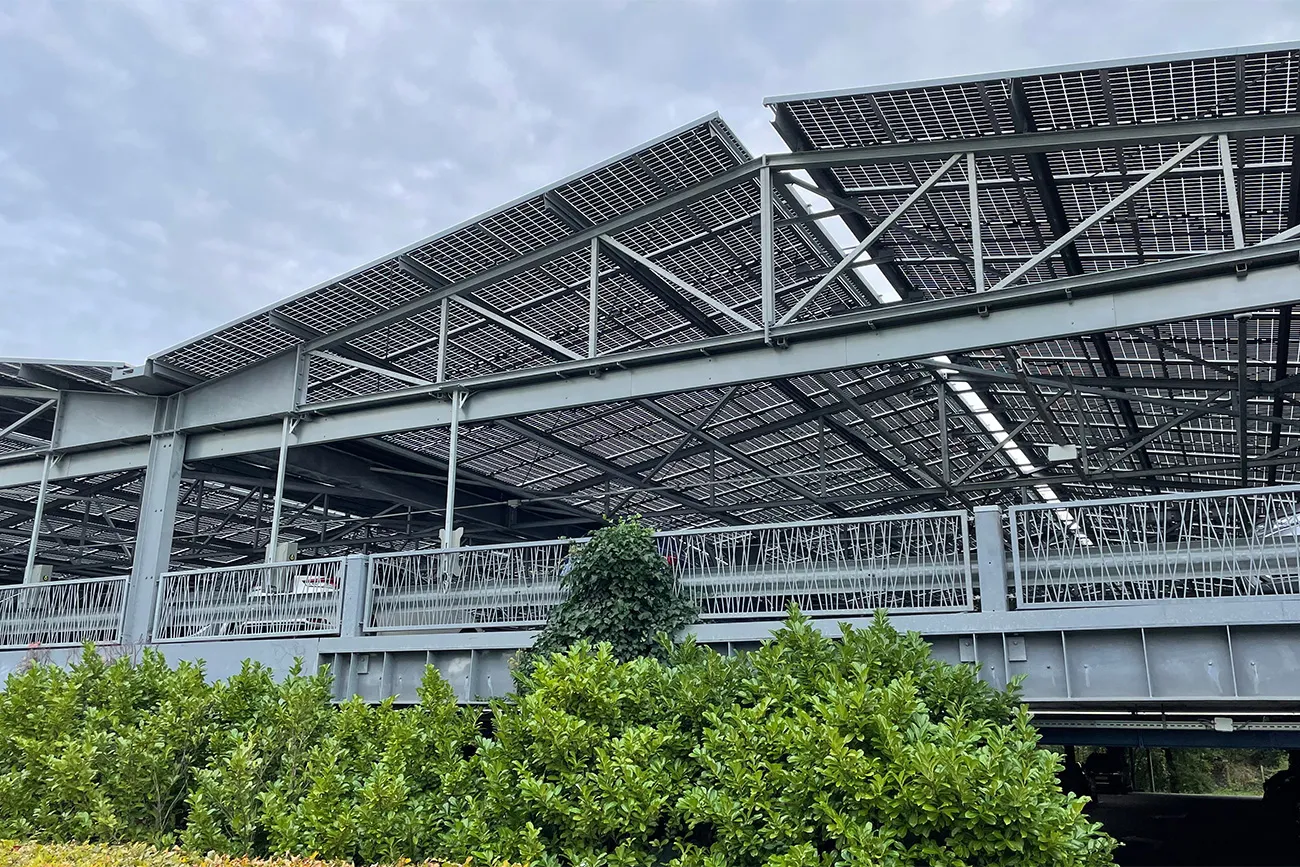
As part of a.s.r.’s ‘Green Parking’ charging hub project, which includes PV generation, energy storage and AC charging points, an ambitious plan was developed to create a safe, autonomous PV charging hub based on direct current. It is the first of its kind in the Netherlands. This prompted a number of parties to step up and RVO to subsidise research into the pioneering project.
Jos Ruijter oversaw the recent renovation of a.s.r.’s building in Utrecht to BREEAM ‘Excellent’ standard, including its disconnection from the gas grid. Ruijter: “The idea was that we would be CO2-neutral. But mobility is also part of our environmental footprint, and there was certainly room for improvement there. We want all our company cars to be fully electric by 2024. To get ahead of that, we covered the two-storey car park for 450 cars with more than 5,000 m2 of solar panels. My idea was to create a smart, actively controlled charging hub. Some of the charging facilities use AC and others DC. It is the first of its kind in the Netherlands. When cars are charged directly from the PV installation using direct current, we avoid two conversion steps, significantly reducing losses. 250 AC charging spaces and the first 3 DC charging spaces are now operational.”
Expertise
The development of the DC charging hub is being closely monitored and researched, with a subsidy from RVO, under the name VAP-DC: Safe, Autonomous PV Charging Hub with DC Distribution. It brings together parties that relish a challenge and want to be at the forefront of new developments in the energy market. Ruijter found these partners in Kropman Installatietechniek BV, Venema E-mobility and the Amsterdam University of Applied Sciences. Kropman carried out the electrical system design, engineering and installation in close collaboration with the project team. Product expertise and detailed engineering came from DC Systems (by Schneider Electric) and Elektro Internationaal. A strong line-up, with every partner making an important contribution to this pioneering work by bringing their expertise to the table.
Predictive control
That expertise has taken the charging hub project further than originally envisaged. The autonomous DC grid has been integrated into the building’s electrical installation, first and foremost thanks to earlier research at Kropman Installatietechniek’s Living Lab in Breda. Werner Verhelst, Adviser, Design & Technology, explains: “The Living Lab encompasses the building, all its building services and its staff. It was established in collaboration with, among others, Eindhoven University of Technology to conduct research under real-life conditions. Energy generation is forecast in advance in relation to demand from electric vehicle charging and the building. An optimal strategy for the battery system is then determined using predictive control, with the aim of adapting the load profile as much as possible so that peaks are eliminated. We applied that principle to the a.s.r. charging hub project and implemented it on a large scale.”
The benefits of VAP-DC
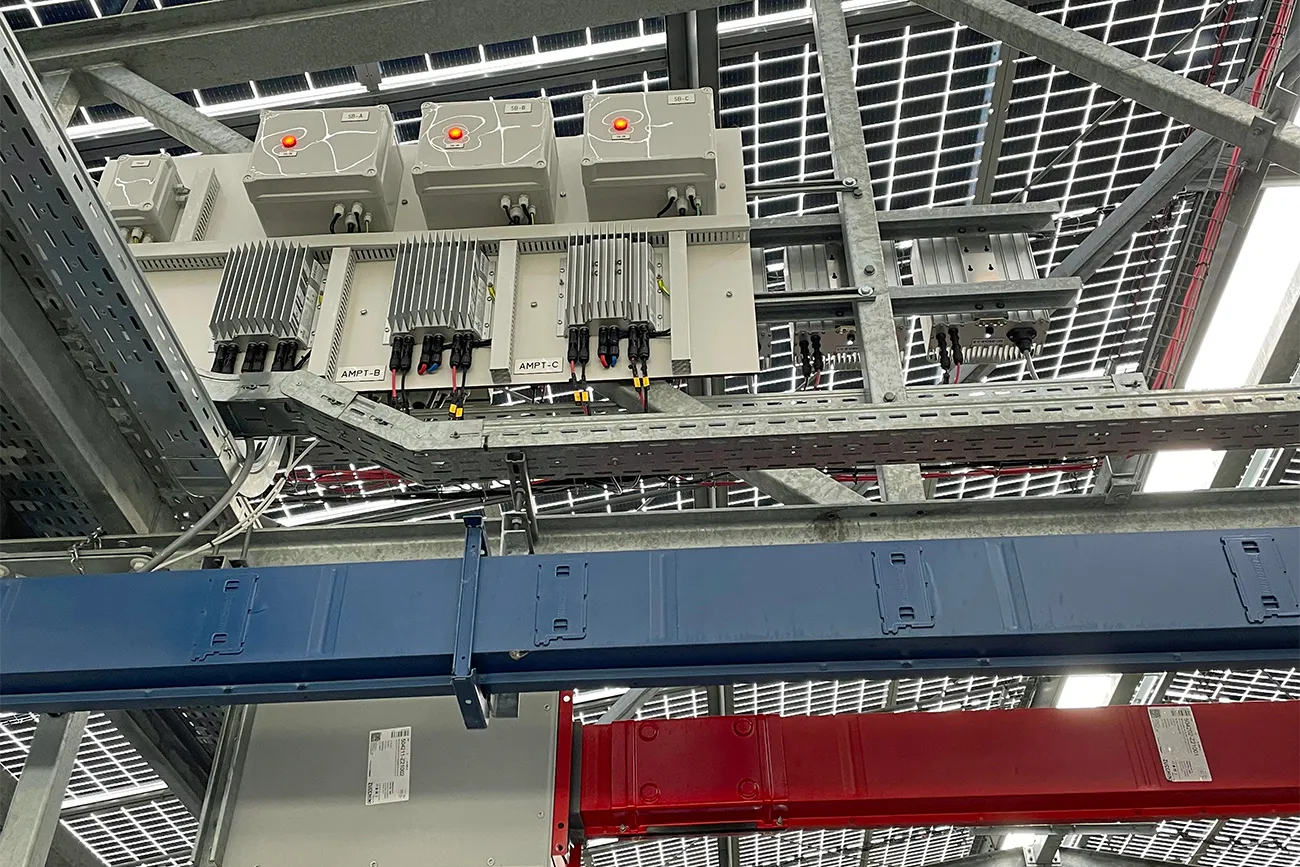
Ruijter: “For me, the main revelation was that the gas-free a.s.r. building, with its HVAC system and data centre, could form an integral part of energy generation. I also realised that everything could be connected up alongside the charging hub I had in mind. To do this, we separated 84 of the 2,100 PV panels from the standard system. We stabilised them using special DC/DC string optimisers, which are connected to the main DC distribution board. Three DC chargers and DC LED lighting are connected from there. The DC charging system operates autonomously using ‘droop-rate control’. It also starts up automatically as soon as the sun comes out. And because no conversion is needed, charging is not only faster but also involves very limited power losses. We are talking about efficiency gains of 15 to 20% compared with traditional AC/DC chargers. For a planned charging hub with 250 cars, that means around 50 additional cars can be charged.”
Vehicle-to-DC
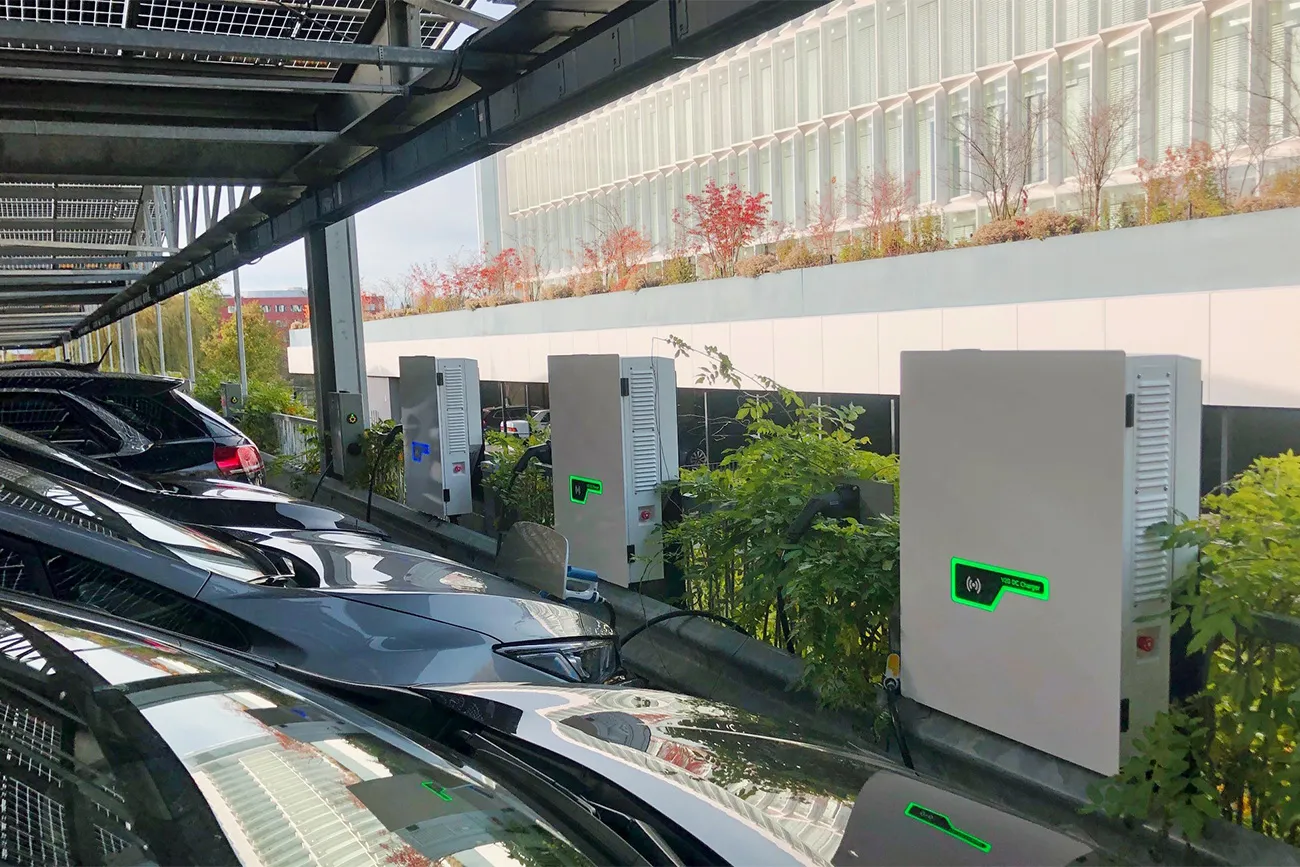
When the sun goes down, the power has to come from somewhere else. This was solved using V2DC (vehicle-to-DC) chargers supplied by Venema. They can charge the batteries of plugged-in cars, but the cars can also serve as ‘mobile batteries’ that can be discharged to a specified level. This means the system can operate in island mode, with autonomous control of supply and demand. It can also fall back on the grid. If necessary, the Active Front End (AFE) converts the grid’s alternating current into direct current for the DC grid. There are also countless situations in which the building could draw power from the DC grid to meet peak demand.
Bidirectional converter
This connection between energy systems is made possible by an Active Front End designed by DC-Systems (by Schneider Electric), which acts as a bidirectional converter. The AFE was further developed by Woerden-based panel builder Elektro Internationaal and manufactured within Schneider’s system. It is now installed between the DC grid and the low-voltage panels of the AC installation. Verhelst: “This project isn’t about a mass-production order. Instead, you seek out partners that are willing to take risks and can provide continuity in their engineering capabilities and knowledge of what is available on the market. As an installer, we think in terms of functionality and system integration to achieve the goal, while Elektro Internationaal focuses on the product specification required.” John Berkhof, Lead Engineer at Elektro Internationaal, agrees: “We already have experience with DC projects and mainly work with Schneider products, and they have developed quite a number of DC components by now. Drawing on that product knowledge, we helped develop the special DC main distribution board and further develop the AFE panel to meet the VAP-DC team’s requirements. Projects like this energise us.”
Research and standards
But where does that energy go? This is being investigated by the Amsterdam University of Applied Sciences under the direction of Jos Warmerdam and Rob Schaacke. “Direct current flows through structural components, which could cause changes in the material,” says Schaacke. “There is strong demand in the market for knowledge about this stray current behaviour, particularly in relation to PV generation and EV chargers. We hope this research will give us a clearer picture.” The project team also wants to provide answers to questions about the safety and standardisation of direct current. Verhelst: “There is no NEN standard for direct current yet, only a draft practice guideline (NPR 9090). The question is how to implement it in the system components and the installation connected to them. And how do we apply it to maintenance situations, with a DC equivalent of NEN 3140? That information simply isn’t available yet. You can tell that people in the installation industry are looking for it. By working through this process together and carefully documenting the behaviours we encounter in our DC system, we are laying the foundations for functional guidelines. In that sense, we are taking important steps together on several fronts.”
Een zakelijke vraag aan Elektro Internationaal? Get in touch
Who worked on it
Green Parking in Utrecht
- producttechnische kennis en detailengineeringSchneider
- paneelbouwer
 Elektro Internationaal
- installerKropman Installatietechniek BV
- V2DC-ladersVenema E-mobility
- onderzoekHogeschool van Amsterdam
Keep following this
Get an email when a new story is published. No account needed.
- ProjectGreen Parking
- ThemeEnergy generation and distribution
- SubjectGeneral
- CompanySchneider
- CompanyElektro Internationaal
- CompanyKropman Installatietechniek BV
- CompanyVenema E-mobility
- CompanyHogeschool van Amsterdam







