











Power distribution for the new RIVM and CBG building: Smart, lean and plug & play
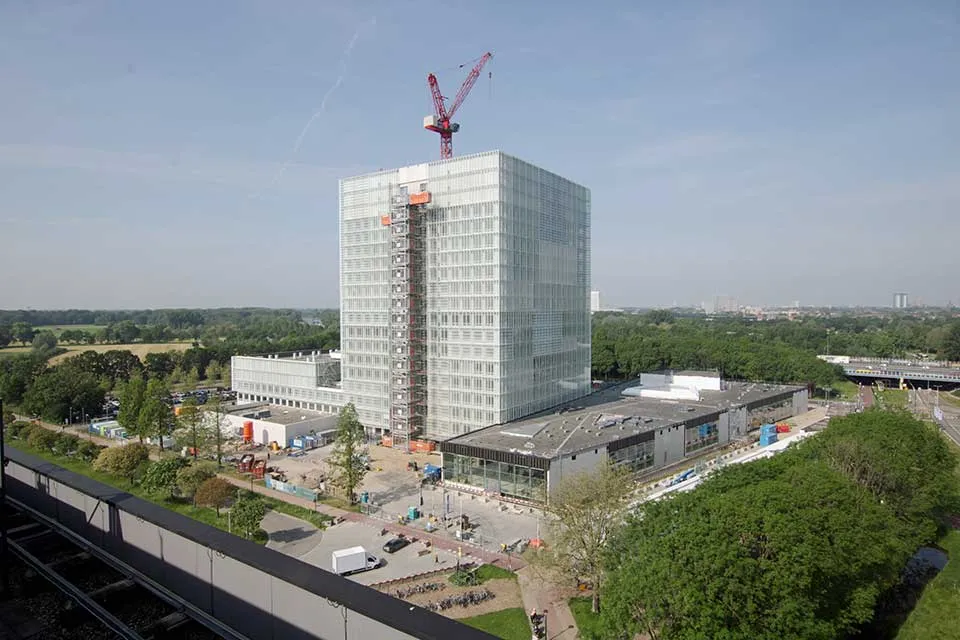
Construction of the new premises for RIVM and CBG on the Uithof, alongside the A27 in Utrecht, is progressing rapidly. The building is expected to come into use in 2022.
Under the name MEET, Strukton Worksphere has signed a DBFMO contract with the Dutch government for the design, construction, maintenance and operation of the building for a period of 25 years. MEET has awarded Elektro Internationaal the contract to supply smart distribution boards for the electrical installation serving the offices and laboratories.
Jeroen Dirkzwager, head of operations at Elektro Internationaal, explains what makes the project special: “We have experience supplying power distribution systems to the pharmaceutical sector. But this project is quite exceptional because of the conditions and requirements that apply to the research laboratories. Even the slightest changes in environmental factors can affect the tests carried out in the labs. Needless to say, years of research must not be invalidated as a result. That is why maintaining the voltage at the required level is a key focus of this project. The power must not fail, as that could also have disastrous consequences for RIVM’s important work. The aim, therefore, is continuous, trouble-free power distribution. For more than 40 years, this has been right up Elektro Internationaal’s street.”
Circuit-breaker selectivity study
In April 2020, Elektro Internationaal was officially awarded the contract for the low-voltage components required for the electrical installation. Dirkzwager: “We then began the engineering process with MEET to find the best solution. This meant going back to the drawing board on the initial concept we had based our calculations on. We drew on all our experience and expertise to deliver a top-quality product that meets every requirement. Given the demonstrable advantages, we replaced the original fuse-based design with circuit breakers. Schneider Electric then carried out a selectivity study. Based on the new design, we began producing the main and sub-distribution boards for the building services installations. The same applies to the distribution boards for the laboratories, which are spread across 5 floors. Each floor is divided into 4 quadrants, with 10 labs in each. Every lab will have a low-voltage distribution board made in our workshop.”
Smart distribution boards
“Everything about the boards we build is smart. The incoming and outgoing high-current supplies, including the Masterpacts, on the main distribution boards can be monitored over Ethernet for switch position, status, the current condition of the circuit breakers and energy consumption. If the emergency power system needs to be used and the generator starts up, the non-essential circuits are disconnected to prevent the generator from being subjected to the full load all at once. When the system switches back to transformer supply, these circuits are reconnected. This is controlled over the network by the smart main distribution boards.”
Status signalling and power monitoring
The 215 laboratory distribution boards being built using the Prisma GK system are smart in more than one way. “First, they are divided into three sections,” says Dirkzwager. “As well as a non-essential section that can be disconnected in the event of a power failure, there is an NKO (emergency supply with a short interruption), after which the generator starts up and takes over the supply. There is also an NZKO (emergency supply without a short interruption), which is backed by the UPS. Building the boards in this way guarantees continuity of the power supply.” Second, all circuit statuses on these boards are communicated to the network via PLCs, as is the kWh metering. “All status signals and power monitoring data will ultimately be displayed on the dashboard, which is being set up within Schneider Electric’s EcoXpert platform.”
These cabinets are supplied from the main distribution boards via a Canalis busbar trunking system, supplied and installed by Schneider Electric. Elektro Internationaal is manufacturing the 150 tap-off boxes for the busbar. Dirkzwager: “The tap-off boxes supply the sub-distribution boards, and there are further sub-distribution boards between those boards and the laboratory cabinets. Each of these supplies two quadrants, so we are supplying 10 in total. They are being built using Schneider Electric Prisma P.”
A standard unit as the starting point
“Given the complex layout and large number of laboratory cabinets, we looked at how to make production more efficient,” Dirkzwager continues. “We built a standard unit specifically for this purpose. We measured all the wire lengths so that every wire could be prepared in advance. This made the process as lean as possible. Finally, we also fitted the Wieland connector cables to the cabinets in advance, so MEET can easily install the boards using plug-in connections during the final phase. Smart, lean and fast: this project is enough to make any modern panel builder’s heart beat faster.”
Een zakelijke vraag aan Elektro Internationaal? Get in touch
Who worked on it
RIVM and CBG in Utrecht
- low-voltage components
 Elektro Internationaal
- DBFMO contractStrukton Worksphere
Keep following this
Get an email when a new story is published. No account needed.
- ProjectRIVM and CBG
- SubjectGeneral
- CompanyElektro Internationaal
- CompanyStrukton Worksphere
- CompanySchneider







