











Prevent efficiency losses and breakdowns caused by corrosion, limescale and dirt deposits
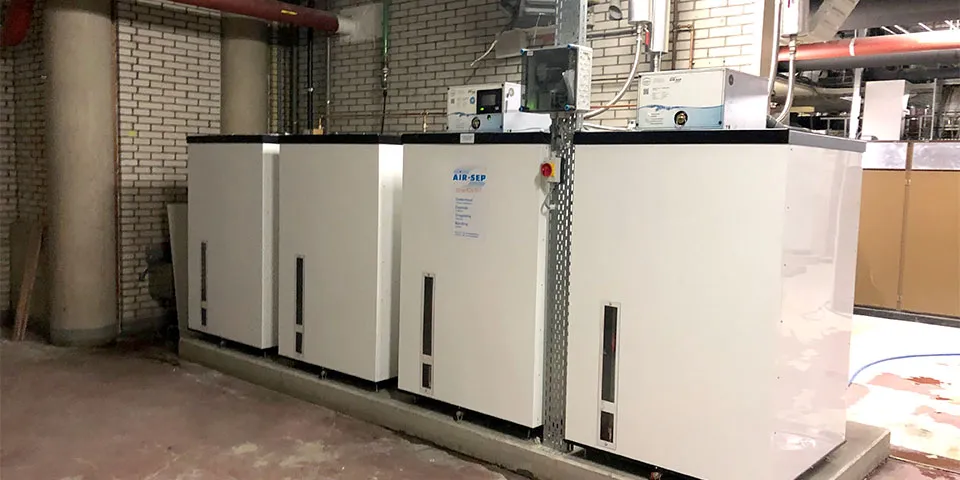
Tap water is pH-neutral and ideal for drinking. However, its quality makes it less suitable for use in heating, cooling and refrigeration systems. Corrosion is a constant risk. To prevent this problem, the water in the system must be made low in oxygen as quickly as possible.
‘Make the water in your heating, cooling and refrigeration systems low in oxygen as soon as possible’
During the so-called degassing process, the water’s pH level rises, preventing limescale particles from dissolving. The released limescale particles settle at the bottom of the system, resulting in substantial sludge build-up, efficiency losses and faults and failures in valves, shut-off valves, controllers, pumps and other advanced components. To prevent this, KOREX Benelux recommends that installers connect an AIR-SEP® pressurisation unit to heating, cooling and refrigeration systems as soon as possible.
Use in central heating systems
AIR-SEP® pressurisation units make it possible to carry out all the key water-treatment processes in your central heating system with a single unit. These include fully automatic pressure maintenance and venting, vacuum degassing, expansion, dirt separation, cleaning and top-up with vacuum-degassed water. AIR-SEP® units are suitable for hot-water temperatures up to 110°C. Each unit can accommodate an expansion volume of up to 2,400 litres of water. “However, because AIR-SEP® units can be connected in an unlimited cascade, higher capacities are also possible,” says Mr M.G. van Gorsel, director of KOREX Benelux. “They can be tailored precisely to the size of the heating system. This is particularly useful for district heating systems, for example.”
Chemicals are still widely used in the market to deactivate the oxygen present in heating systems. This often leads to an unstable system, where dirt build-up and corrosion are constant risks. AIR-SEP® offers a definitive solution, says Van Gorsel. “AIR-SEP® consists of an expansion vessel with an inlet valve, air vent valve, automatic top-up unit and pressurisation pump, which removes air bubbles from the pipework. The pressurisation pump repeatedly draws 5 to 20 litres from the system, then returns the water to the AIR-SEP® vessel through the inlet valve. The pressure here is reduced to a vacuum of up to -0.3 bar. A patented vacuum technology reduces the air content by 28 to 40 mg/litre compared with system water that is 100% saturated. This raises the pH level, preserves the protective oxide layers in the system and prevents air and dirt from separating out. Continuous pressure monitoring keeps the system pressure at an optimum level and, as a result, maintains the elevated pH. Rather than degassing the water periodically, the degassing intervals and cycle duration are adjusted to the system’s current operating status.”
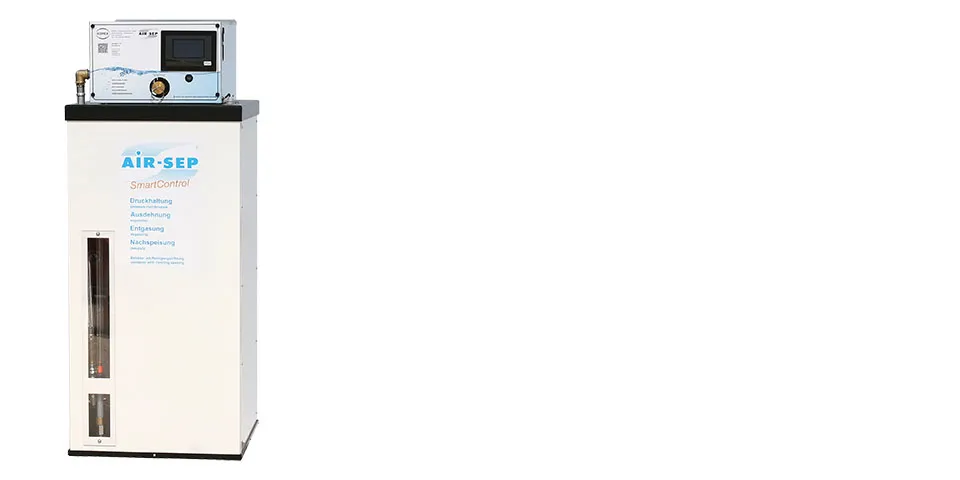
AIR-SEP® pressurisation units make it possible to carry out all the key water-treatment processes in your central heating system with a single unit.
Connection to cooling and refrigeration systems
Up to 30% air can dissolve in cooling and refrigeration systems, increasing corrosion pressure and causing rust, dirt build-up and substantial efficiency losses. “AIR-SEP® pressurisation units also offer a suitable solution for this. The units can be fully vapour-insulated, with high-grade vapour insulation fitted to all AIR-SEP® components that come into contact with the cooling water. Installers can choose between two grades: ISO 1 (18 mm vapour insulation, suitable for water temperatures down to 6°C) or ISO 2 (39 mm vapour insulation, suitable for water temperatures down to -10°C). The vapour insulation prevents corrosion caused by condensation inside the unit.”
Cooling and refrigeration systems are often filled with glycol (antifreeze), Van Gorsel notes. “Our AIR-SEP® pressurisation units are fully compatible with this. The units can be fitted with an automatic glycol/brine filling unit if required.”
Integration in combined systems
To ensure an even pressure distribution between your heating and cooling systems, prevent overflow at user level and minimise energy losses, it is advisable to connect an AIR-SEP® to your heating and cooling systems. AIR-SEP® ensures efficient degassing and pressure maintenance across the combined system. Two pairs of pressure sensors and separate ball valves are installed between the AIR-SEP®, the high- or low-temperature network (HT/LT) and the chilled-water system (GKW). “The ball valves are controlled by a freely programmable microprocessor control system, which also fully automatically regulates and monitors pressure maintenance and venting, vacuum degassing, expansion, dirt separation, cleaning and top-up with vacuum-degassed water in both systems,” says Van Gorsel. “The pressure sensors continuously measure the pressure in the systems. If there is a deviation, meaning the pressure is too high or too low, the ball valves are actuated automatically and the system pressure is restored.”
KOREX Benelux AIR-SEP® pressurisation units have been used successfully for more than 30 years in heating, cooling and refrigeration systems throughout Europe. Applications include apartment buildings, hotels, hospitals, schools, cultural centres, office buildings, district heating projects and industrial projects.
Een zakelijke vraag aan KOREX Benelux? Get in touch
Companies in this story
Keep following this
Get an email when a new story is published. No account needed.
- ThemeFuture-proof water and sanitary systems
- SubjectGeneral
- CompanyKOREX Benelux







