Bringing structure to the BIM process
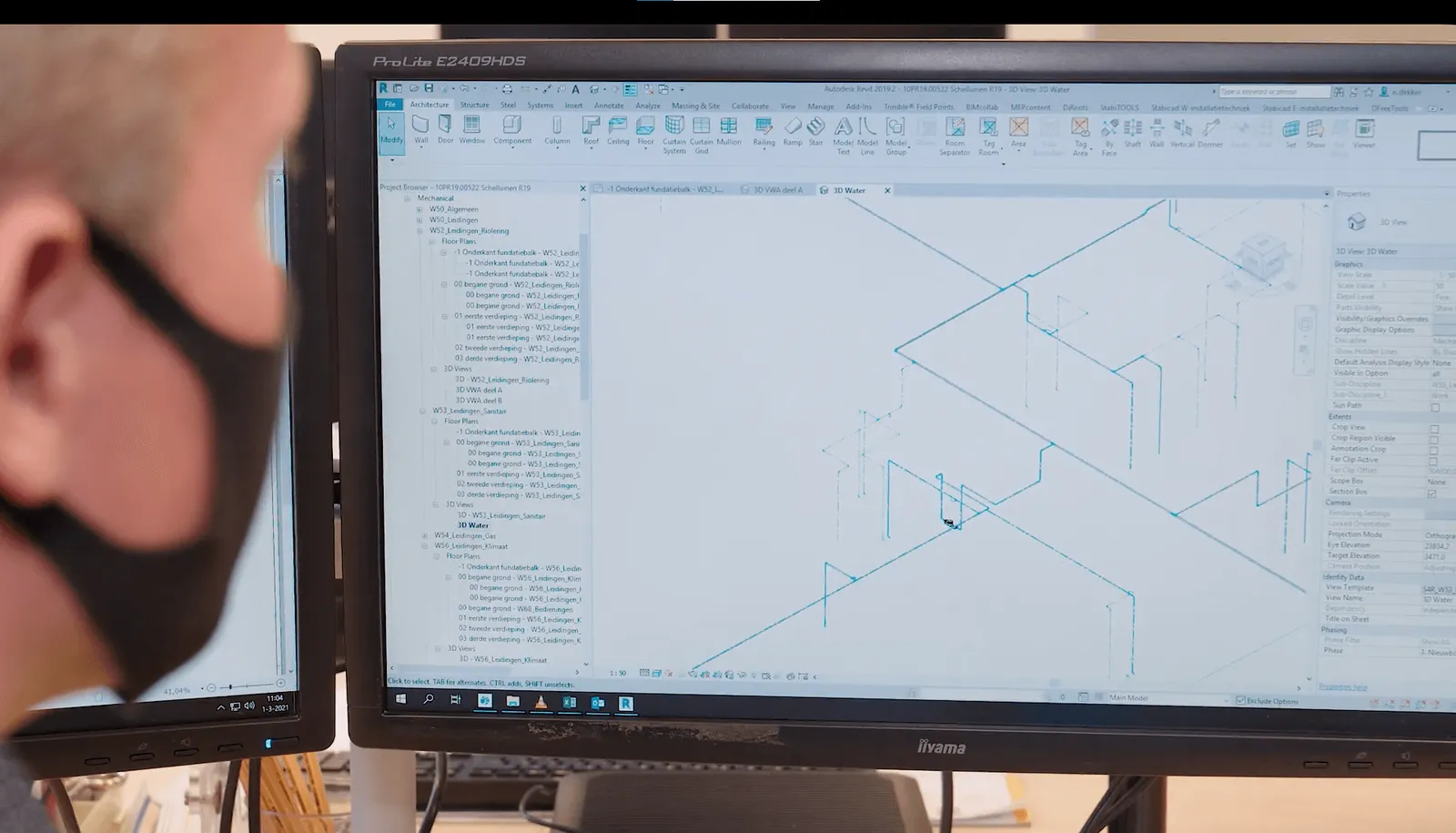
Standards make successful collaboration possible in all kinds of fields. It is no surprise, then, that standards have also attracted considerable attention with the rise of Building Information Modelling (BIM).
Growing BIM adoption and an increasing need for uniformity in the construction sector around the world have led to various public and private initiatives. These include efforts to align construction companies on how they manage digital construction information processes.
The benefits are clear: ensuring that BIM objects in 3D models meet certain standards means that files can be interpreted quickly and clearly by all parties. Everyone knows what is expected of them and of the other parties in the supply chain. Well-known standards in the Netherlands include ETIM and ETIM MC (a supply chain standard), as well as the uniform GTIN code, also known as EAN/UPC and issued by GS1.
As well as geometry and dimensional data, commercial data has also been standardised. But the process does not stop there: the BIM process is constantly evolving. New data is added or requested every month, even every week, and new possibilities and applications for BIM continue to emerge. This applies not only during the planning and design stages, but also during construction, for example in prefabrication and logistics. The BIM process is particularly well suited to exchanging data in a structured way. However, its popularity also brings the risk of uncontrolled growth. And where abbreviations have taken on a life of their own, as with Level of Information (LOI) and Level of Detail (LOD), clarity and agreed definitions become essential once again. Trimble also recognises this need for clarity and incorporates widely accepted standards into its workflows, such as the ETIM standard mentioned above.
Content is key
Content plays a central role in collaboration on BIM projects. After all, content provides the ‘I’ in BIM: Information. BIM content is a digital 3D representation of a product, its ‘digital twin’, enriched with data such as size, length, weight and article number. BIM content therefore adds value to a BIM model at every project stage: it is useful for designing, calculating, ordering and building a project. To ensure that content is valuable to all project partners, consistency and quality are vital. This is why standardisation matters.
Work processes increasingly cross national borders, and BIM does too. As globalisation continues, the number of international projects and teams is growing. What is more, BIM objects and experience gained in one country can be put to good use in another. However, the fact that each country has its own standards and regulations, alongside internationally agreed ones, makes it difficult to establish European or even global BIM standards. For BIM to succeed internationally, agreements must therefore be made in a language everyone understands. This challenge is being accelerated by extensive digitalisation, the growing acceptance of working in the cloud and the expanding capabilities of BIM. Despite these challenges, international organisations such as ISO (International Organization for Standardization) are making substantial progress, with standards including EN ISO 19650, EN ISO 12006-3:2016 and EN ISO 16757.
BIM across borders
By adopting international standards from organisations including ISO, CEN and ETIM, content from MEPcontent.com, for example, can be used universally in all BIM designs. Applying standards also ensures interoperability. The library now contains more than 8 million components from over 5,000 manufacturers. MEPcontent.com gives engineers access to the content they need for their designs, while a great deal of content is also available in ‘standard’ Trimble software, such as Stabicad for Revit and Trimble Nova. Content provided through the Trimble platform for SysQue, Tekla, SketchUp, Stabicad and Nova, as well as for subsequent stages of the process, is guaranteed to be of high quality. Data such as parametric information, commercial data, usage requirements, installation instructions and, of course, geometric information together make up the ‘Information’. Manufacturers and engineers alike can benefit from this, enabling the best possible collaboration. In theory, this allows the ‘I’ in BIM to realise its full potential.
By aligning with international, platform-independent standards that meet the need for high-quality, consistent content, such as ETIM, ISO, VDI and COBie, while also adapting to national or even local standards, such as Germany’s VDI 3805 and Italy’s UNI 11337, Trimble enables flexible and reliable data exchange. For its internal processes and to comply with ISO 9001, Trimble uses, among other things, the Extended MEPcontent Standard (EMCS). This standard not only describes how BIM objects are structured, but can also be used in projects around the world. MEP engineers thus have access to high-quality, consistent content, enabling efficient collaboration on global BIM projects.
Profit = revenue minus costs
The term ‘supply chain standard’ says it all: standardisation has the greatest impact when the entire supply chain is involved. Yet a chain is only as strong as its weakest link. The question, then, is how to bring the whole supply chain on board, particularly on an international scale. There is still considerable room for improvement, especially with the future in mind. One key to success is that interoperability and standardisation help reduce costs. Standards can certainly help prevent errors and the costs of failure. Take the ordering process, for example: once the estimate has been prepared and the contract awarded, the actual work begins. How efficiently can we prepare the documentation? Which products are needed? And how does the ordering process work? Agreeing on these points and applying standards will make the process more efficient. It will also bring greater clarity, provided everyone is involved, including manufacturers and wholesalers. For example, if the engineering team specifies a cable with a cable support system, with a total required cable length of 500 metres, how should the required length be ordered from a particular manufacturer? Is the standard unit of supply 1 x 500 metres on a reel, or must you order 500 x 1 metre? Flow rates in an air distribution unit can be adjusted using restrictor rings. But are these rings supplied as standard with the unit, or do they need to be ordered separately? Ordering and delivery units must be properly aligned. Manufacturers and wholesalers can no longer rely on one another to present products and ordering information consistently in catalogues and on portals.
Checks are still needed
As long as the entire supply chain does not share the same understanding of standardisation and standards, there is too much room for miscommunication. And yet everyone ultimately wants the same thing: optimal coordination to save costs and, above all, avoid the costs of failure. They also want a more efficient workflow. That is why efforts have been under way for years to automate more of the entire construction process. This is achievable: once the engineer has correctly entered the requirements and specifications into the system, there are significant benefits to be gained. These include automatically generating order lists based on the design and placing orders electronically. Does this mean people are being sidelined? Certainly not. Human checks of designed and ordered components remain desirable, at least for now. In fact, the more we standardise, the more we need human creativity.
Question about this story? Ask your question
Companies in this story
Keep following this
Get an email when a new story is published. No account needed.
- ThemeIntegrated construction and building services
- SubjectProduct information
- CompanyTrimble