Infrared thermal imaging equipment: a logical choice for electricians
New technology helps pinpoint problems and guides professionals through repairs By John H. Waggoner, Senior Instructor at the Infrared Training Center.
Heat is a by-product of every electrical circuit in operation, regardless of its size. Most problems with electrical systems manifest themselves as heat. Electricians need to be able to classify a circuit as normal when it is under load. If a circuit shows anomalies, they need to be able to identify existing problems and locate hot spots requiring attention. In recent years, a new method has entered the market: infrared thermography, also known as thermal imaging. With this non-contact method, electricians and maintenance technicians use cameras, among other tools, to find and resolve problems more quickly and safely. The latest cameras combine thermal imaging and electrical measurement functions in a single instrument for inspections, troubleshooting and diagnostics, significantly speeding up the process and enabling repair work to be based on much better information.
Methods for inspecting and analysing electrical systems
Previously, electricians could inspect and analyse electrical systems only by carrying out physical tests. These were usually performed after the power had been switched off, to ensure the system was electrically safe. Electricians typically use test equipment and instruments connected via test leads to determine whether there are any problems. Many contact measurement techniques use thermocouples. These produce a temperature-dependent voltage, which can then be interpreted to measure heat.
With these traditional inspection and maintenance methods, electricians cannot see every potential problem, and there is often an element of guesswork, with connections having to be checked one by one. They also cannot be sure that a heat-related problem has been properly resolved, since the load disappears as soon as the power is switched off. It is possible to measure whether a circuit is overloaded, but once the power is off, it is not always clear whether the problem has been resolved.
In recent years, electricians have also been making more use of spot radiometers: small, handheld, non-contact devices aimed at a target to obtain a temperature reading. Radiometers can provide acceptable measurements within certain limits. Unfortunately, however, they do not produce visual images.
A major advance over direct measurements and spot radiometry is the use of thermal imaging, which detects the infrared energy emitted by an object. This energy is then converted into a temperature and displayed as a so-called thermogram, a graphical image of the temperature distribution. Since all objects above absolute zero emit infrared radiation, thermography makes it possible to see an area with or without visible lighting.
Thermal imaging enables electricians to carry out much better analyses, make recommendations and diagnose problems. For example, a camera can be aimed at a circuit breaker to determine whether connections are loose, whether the breaker is overloaded and whether there may be problems with the contacts. Electricians can locate the problem, resolve it and then use the thermal imaging camera to confirm that the work has actually fixed it. In the past, it was difficult to reassure customers that the work had resolved a problem. Electricians now regularly provide customers with ‘before’ and ‘after’ images. Thermal imaging equipment can be used to inspect a wide range of electrical equipment, including transformers, switchgear components, breakers, fuses, conductors, terminals, contacts, control wiring, busways (open and enclosed), distribution and branch circuit panels, and motors.
Benefits of thermal imaging
In effect, thermal imaging enables electricians and electrical engineers to visualise heat that is invisible to the naked eye. This offers three major benefits. First, it is a non-contact method, so electricians do not have to touch electrical equipment to determine whether its heat is within or outside the normal operating temperature range.
Second, electricians can use thermal imaging cameras as a visual aid to show customers the severity of electrical problems. Infrared cameras produce an image of a target, similar to a visual photograph. Many cameras also produce a visual image, which can be placed alongside the thermal image to compare the two. This allows electricians to show customers the exact location and nature of potential faults.
The third benefit is that thermal imaging can be used in real time. Over the past ten years, video recording technology for infrared cameras has improved significantly. This means electricians can now observe and analyse electrical equipment as it heats up and is switched on, operates under normal conditions, and cools down again. Fast-moving targets can also be tracked more easily, because recording speed, or the number of frames per second (fps), has improved. Cameras that record at a higher frame rate make it possible to observe targets that change temperature or move very quickly. This equipment now lets us clearly see those rapid temperature changes or movements.
Main applications of thermal imaging
Thermal imaging is used in three broad application areas. Utilities rely heavily on the technology for medium- and high-voltage installations, for example
(overhead lines and connections), and substation components (breakers, switchgear, transformers, capacitors and voltage regulators).
Thermal imaging is also used at voltages below 1000 Volt, particularly for installed equipment supporting industrial and commercial operations.
The third and most recent application area is the residential sector. Home inspectors and electrical and HVAC maintenance companies are increasingly buying and using thermographic equipment to inspect residential electrical systems and troubleshoot problems. Growth in this sector is largely due to IR cameras becoming more affordable over the past ten years.
Thermal imaging equipment available to electricians
Electricians can choose from a wide range of thermal imaging equipment, from low-resolution cameras costing around €400 to high-resolution cameras priced at more than €40,000. The different resolutions determine how close a user needs to be to capture an image of a target. Various accessories are also available to adapt the camera and the temperature measurement.
Those looking for an entry-level model could, for example, choose a smartphone attachment
(for both iOS and Android), such as the FLIR ONE Pro: an instrument with a long-wave infrared (LWIR) Lepton camera and a resolution of 80 x 60 pixels.
Higher-end thermal imaging equipment, such as the FLIR T1K, can produce images of up to 1024 x 768 pixels. Dynamic focusing, continuous autofocus and a user-friendly interface, ergonomic design and rotating optical block make it easier to carry out multiple inspections in a single day and scan in hard-to-reach areas.
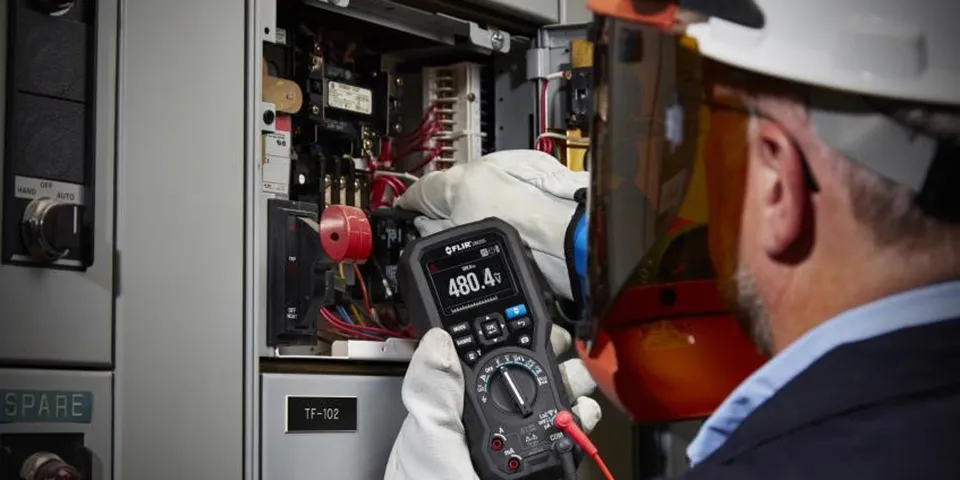
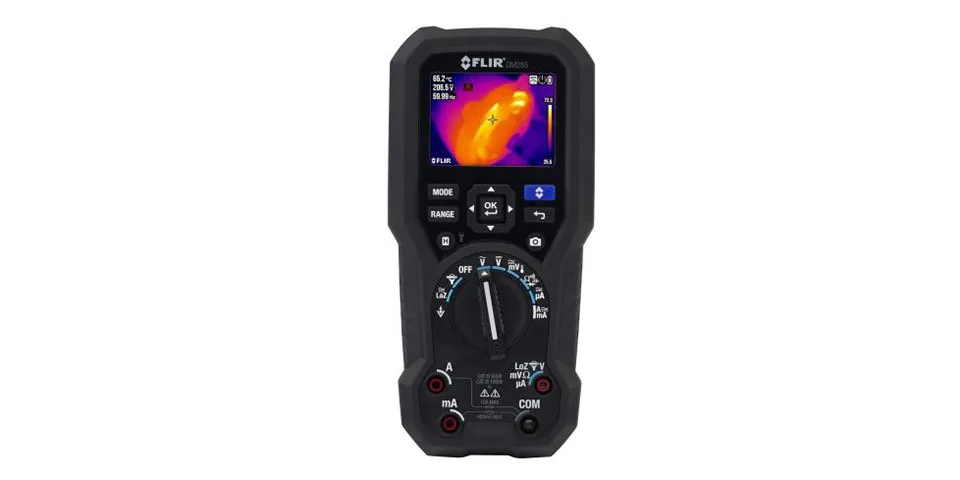
Another option recently introduced to the market is meters that combine thermal imaging and electrical measurement functions in a single instrument for inspections, troubleshooting and diagnostics. These new meters can take voltage, current and millivolt measurements while also capturing an infrared image, all with the same device. This gives an electrician or technician more information on which to base a decision, allows an electrician’s diagnosis to be confirmed with images and provides evidence of the problem location. Combining several instruments into one saves time when diagnosing faults and enables technicians to work faster. It also puts them in a better position to troubleshoot problems and carry out repair or maintenance work.
One example is the FLIR DM285, with no fewer than 18 measurement functions, including true RMS
(root mean square), LoZ (low impedance) and non-contact voltage (NCV). The device also has a thermocouple input and allows users to display thermal and electrical measurements simultaneously. This combination meter uses IGM™ (Infrared Guided Measurement) thermal imaging technology to guide users visually to the exact location of a problem.
Thermal imaging helps resolve real problems
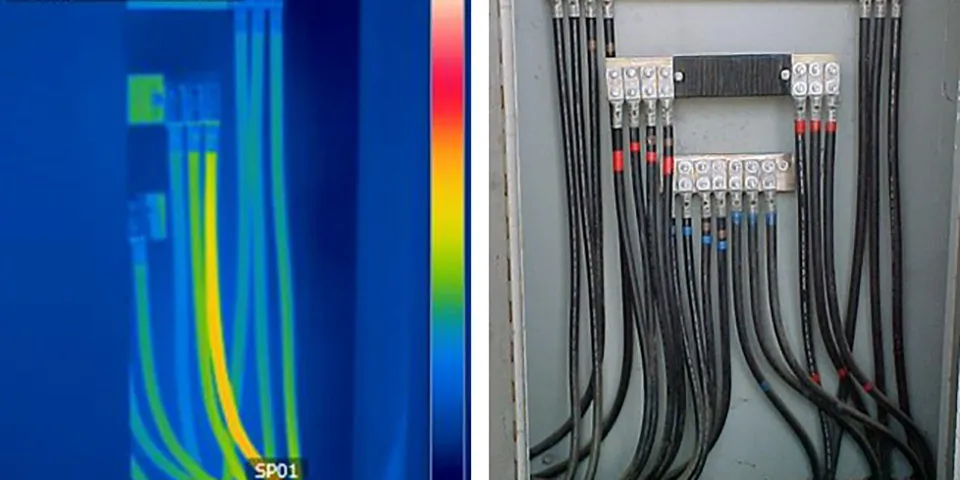
Thermal imaging is used around the world to diagnose and resolve problems with electrical systems. The image below shows a large junction box in which one conductor was hotter than the other eight. Thanks to the thermal imaging camera used, technicians were able to identify the problem without having to inspect the inside of the box, from a distance of 45 metres. Moreover, there was no other way to detect this serious problem.
Electricians benefit from being able to visualise heat
Electricians can gain a great deal from being able to ‘see’ heat with the latest thermal imaging equipment, which enables them to pinpoint exactly what the problem is, where it is occurring and how best to resolve it.
Question about this story? Ask your question
Keep following this
Get an email when a new story is published. No account needed.
- SubjectProduct information