Installatie & Bouw Nederland is part of Louwers Mediagroep: 45+ trade platforms in the Netherlands, Flanders and Wallonia. Trade magazines, websites, newsletters, video and podcasts, since 1987.
The 2015 Climate Agreement is helping to create a more sustainable world by 2050. The way we live, work, travel and produce food is changing profoundly. It is not a straightforward process, but a realistic approach opens up a wealth of possibilities. It calls for insight, perseverance, innovative solutions, courage and solidarity.
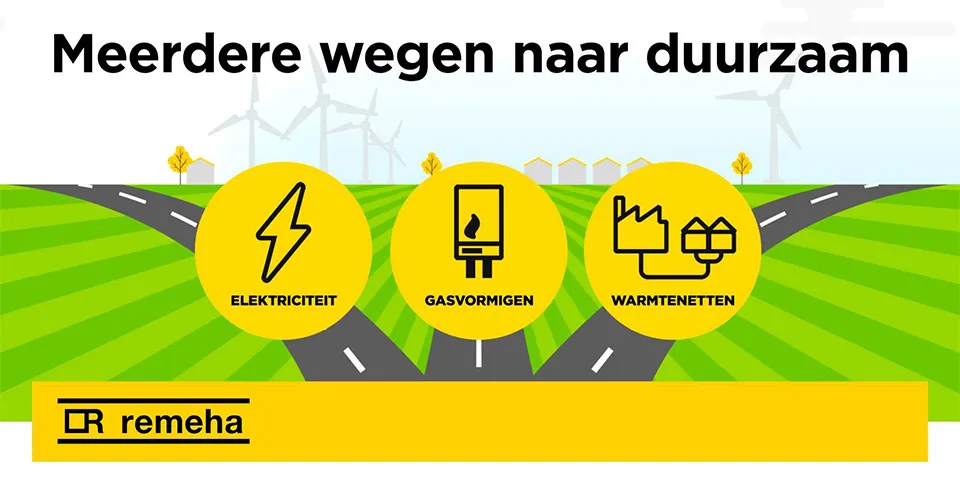
Multiple routes to sustainability
The Climate Agreement and our living environment
The Paris Climate Agreement aims to reduce CO2 emissions to zero by 2050. In the Netherlands, the debate is often not about CO2, but about natural gas. We recognise that natural gas is a finite resource, but that does not alter the fact that reducing CO2 emissions is at the heart of policy. With every measure we take, we must ask ourselves whether it contributes to the goal of cutting CO2 emissions. Ultimately, we will move away from fossil fuels, but only if we make smart use of the alternatives available. In 2018, CO2 emissions amounted to 5,000 kg per Dutch household per year, and this figure covers housing-related emissions only. When considering the challenge of making existing homes more sustainable, it is worth noting that 85% of the housing stock in 2050 is already here today. Only 15% of the total housing stock will therefore be built between now and 2050. For all homes and everyone, CO2 emissions can also be reduced through insulation and lower energy consumption. We must also investigate which measures work best for which homes, and it is essential to generate energy from sustainable sources such as sunlight, wind and water.
De video laadt pas als je op afspelen klikt.
A combination of solutions
By using different energy carriers, such as gaseous fuels, electricity and heat networks, we can deliver viable and affordable solutions. The right solution depends on the specific home. Combining different options offers the best opportunities and is a realistic approach. While it is relatively easy to apply the best solution in new-build homes, existing homes require us to seek tailored solutions. By making smart use of electricity, heat and gaseous fuel infrastructure, we can make the most of solar and wind energy. Transport and storage are crucial here, as transporting and storing electricity is more difficult than with gaseous solutions.
Gaseous fuels
The end of the central heating boiler is not imminent. Gaseous fuels are an interesting energy carrier because they are easy to store and transport. We are convinced that natural gas use will disappear in the long term, but sustainable alternatives are available: hydrogen, biogas and synthetic gas. Hydrogen is playing an increasingly important role in both industry and mobility. It is possible to produce hydrogen from water. Crucially, generating and burning hydrogen produces no CO2 emissions. Generating hydrogen requires electricity, and if that electricity comes from solar panels and wind turbines, it provides a sustainable alternative. Hydrogen and other gaseous fuels are also easy to store, and the existing natural gas network can be used to transport them. The Netherlands is the only country in the world with such a network. Gaseous solutions, including hydrogen, can play an important role in both new and existing buildings. We also recognise that the existing network and installations will need to be adapted, but this is entirely achievable.
Electricity
Electricity is an excellent energy carrier, as it offers good options for new-build homes. It also gives people the opportunity to become partly self-sufficient by using solar and wind energy. New-build projects allow us to implement solutions that work optimally. A heat pump combined with sustainably generated electricity is ideal for new-build homes. There are opportunities for existing homes too, but a number of challenges need to be addressed, particularly in terms of insulation and installations. For example, heat pumps cannot work directly with existing radiators. A hybrid system is an excellent alternative for existing homes. An all-electric Netherlands? No, we are convinced that this is not the answer. We face a generation shortfall, a major logistical challenge and insufficient grid capacity to meet the electricity demand of the entire country. But there is no doubt that electricity is a valuable energy carrier and one of the solutions.
Heat networks
Neighbourhoods with district heating, for example, are connected to a heat network. This is an underground network of pipes carrying hot water, which is used to heat homes, offices and other buildings. Homes in these neighbourhoods benefit from waste heat. At present, this heat comes from industry, biomass combustion, geothermal energy, surface water heat and wastewater. Ideally, there is no need for additional heating from a central heating boiler. Heat networks work best when the waste heat source is nearby, so that no heat is lost during transport. Heat networks are a highly attractive solution, provided we continue to use sustainable waste heat.
A sustainable society
We do not believe in a single solution. We are realistic: in our view, there are multiple routes to sustainability. Remeha believes that our energy supply should be a mix that accommodates different energy carriers. We do not rule out any technologies, believe in multiple energy carriers and encourage innovation. This will enable us to meet the targets of the Climate Agreement and work towards a sustainable society. Gaseous fuels, electricity and heat networks all contribute to making the Netherlands more sustainable and reducing CO2 emissions. That is what Remeha stands for, and this is the realistic vision we promote.
Find the right company in the sectorSearch by product, specialism, region or project in the company directory and across all Installatie & Bouw Nederland articles.
We use cookies to keep the site working properly. With your consent, we also use cookies for statistics and third-party banners. Read more in our privacy and cookie statement.