











Renewed focus on lift use in the event of fire
Amendment to the Building Decree in the works
The study by the Ministry of the Interior and Kingdom Relations into the potential use of lifts for evacuation in the event of fire, and the Liftinstituut conference at which the findings were presented and discussed, have been developed further by those involved over the past year. This has resulted in a proposed amendment to the Building Decree, due to take effect in 2021.
The government intends to improve escape options for older people and vulnerable people in newly constructed buildings. The use of lifts, in addition to the existing escape routes already required, is also covered, along with how this should be addressed. The Ministry of the Interior and Kingdom Relations has indicated that this does not mean a fire-fighting lift. The intention is for the new rules to take effect on 1 January 2021. This
article provides further information on the subject, taken from the ministry’s website.
Fire safety in complexes for older people
As older people may be slower to leave a building in an emergency, the Minister of the Interior and Kingdom Relations commissioned a study into whether complexes for older people could be included as a separate category in the Environment and Planning Decree for Buildings. This would allow additional fire safety and escape route requirements to apply to these buildings. The study found that this would be difficult to implement in practice. It was therefore proposed that escape route requirements be tightened for all newly built residential buildings. These new rules are intended to take effect on 1 January 2021 (source: www.tweedekamer.nl).
Users’ priorities
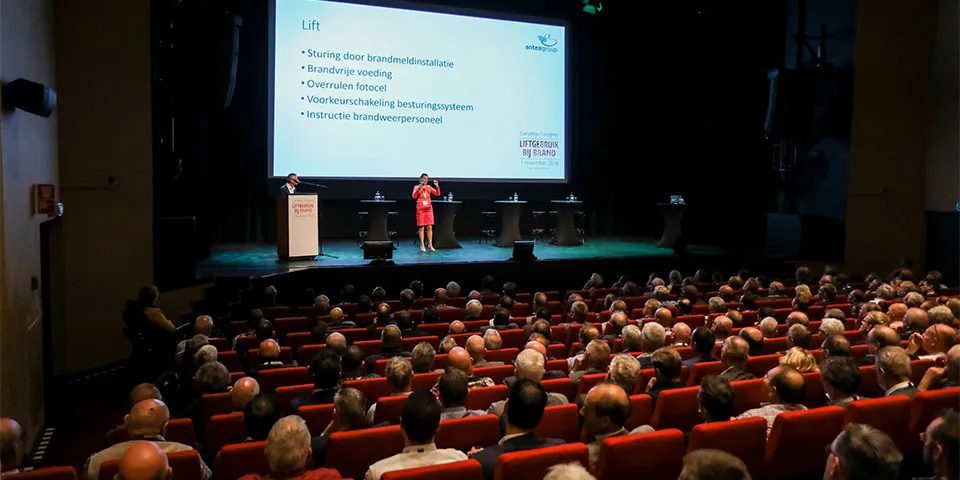
As part of the decision-making process on these additional fire safety provisions, an SME consultation was held at the Ministry of the Interior and Kingdom Relations on 27 November 2019. This is a discussion with users. The care sector raised the following points, among others:
Using a lift in the event of fire? Yes, but keep it simple
It was emphasised, among other things, that this is not a fire-fighting lift. The fire service switch also needs to be ‘switched over’ by the fire service on arrival. The aim, however, is for evacuation to begin before the fire service arrives. The purpose of this measure in the Building Decree is to ensure that evacuation, including of people who are less able to evacuate independently, takes place as far as possible before the fire service arrives.
The fire-resistant lobby in front of the lift also serves immediately as a holding area for people waiting to escape from the floor (holding capacity, horizontal evacuation). This could, for example, be achieved with a lift lobby in front of the lift.
The aim is to use the lift, if necessary, to evacuate as many people as possible before the fire service arrives. This requires, among other things:
a fire-resistant power supply, separate from other compartments;
a simple modification to a lift so that it shuts itself down if smoke is detected in the lobby. A local smoke detector linked to the lift controls may be suitable, so that the lift is sent to a floor free of smoke and fire if smoke or fire is detected in a lift lobby;
an additional out-of-service indicator on the lift on each floor (red light) when the lift is unavailable, so that people do not wait unnecessarily in a hazardous area;
clear instructions for residents. International research into high-rise buildings shows that evacuation is fastest when people able to evacuate independently use the stairs and those who are not able to do so use the lift.
Minor modifications to a standard lift
The care sector says the starting point should be to make a standard lift suitable for use in the event of fire with a few minor modifications. This should apply not only to new buildings, but also to existing ones. Installing a fire-resistant lobby would be the most extensive intervention in existing buildings.
Smoke detector as part of the lift
The property sector adds that the smoke detector mentioned above should be part of the lift installation. However, residential buildings do not have a fire alarm system (BMC) that can control the lift via smoke detectors and the BMC. Care buildings do have such a system. From this perspective, Liftinstituut considers it understandable that the forthcoming amendment to the Building Decree applies only to new buildings. We see it as a good first step. Hopefully, wherever possible, all those involved will also take this approach into account during major refurbishments of existing residential buildings.
Question about this story? Ask your question
Keep following this
Get an email when a new story is published. No account needed.
- SubjectGeneral







