











School playground transformed into a green play area for Paschalis primary school pupils in The Hague
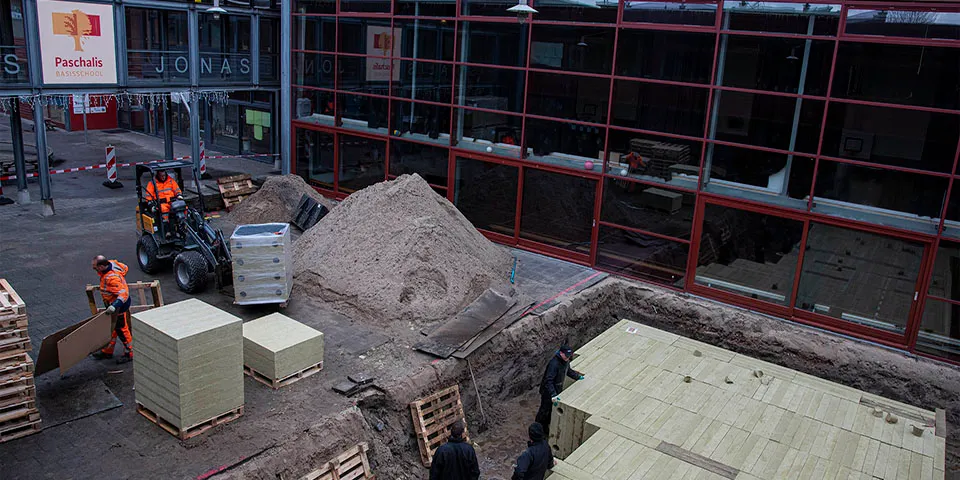
Recyclable Rockflow infiltration buffer: a practical, sustainable, complete solution for maintaining water balance in paved urban areas
The Rockflow water management system from Lapinus (part of ROCKWOOL Group) has been installed beneath the playground at Paschalis primary school, in the heart of a residential neighbourhood in The Hague. The Rockflow infiltration buffer is a practical, sustainable, complete solution for reducing flooding on playgrounds and paved surfaces after heavy rainfall. An added benefit is that the fully recyclable infiltration buffer stores rainwater and allows it to infiltrate into the ground, maintaining water levels beneath and around the school playground. “This made it possible to make the playground much greener as part of its redesign,” says Margo van Holthe, deputy head of Paschalis primary school. Bureau RIS from Gouda designed the new playground, and Hovenier van der Heijden from Den Hoorn is transforming it into a child-friendly private urban park. The new school playground was completed in May 2020.
Van Holthe says that flooding on the school playground had been a problem for many years. The school, founded in 1923, was rebuilt and extended in 2004. During this renovation, the playground was completely paved with concrete slabs. “The children could really only play football on the playground,” says Van Holthe. “We had a lot of flooding. Even after a normal shower, we could go boating on the playground because the rainwater did not drain away through the sewer system.” Van Holthe says that Hoogheemraadschap Delfland gave her ideas on how to tackle the flooding. Hoogheemraadschap Delfland was keen to help determine how to put climate adaptation measures into practice. The water authority also wanted to investigate how rainwater could be managed and collected in this paved area in the middle of the city. “When we had to break up the playground to deal with the sewer problem, we saw an opportunity to redesign the entire area sustainably. This was based on the climate adaptation proposals from Hoogheemraadschap Delfland and the Municipality of The Hague’s water management department,” explains Van Holthe.
Bureau RIS from Gouda designed the new layout of the Paschalis primary school playground. Bureau RIS is a design and consultancy firm specialising in green outdoor spaces. It focuses in particular on nature play areas for childcare centres, schools and recreational parks, with the aim of strengthening the relationship between children and nature. “Children are the future, and sustainable climate action is closely linked to that,” says Donny Thieme, co-owner of the firm. “Children growing up in an urban environment often lack a connection with nature, and schools cannot always provide it,” says Thieme. The Paschalis school playground and the adjacent childcare centre, which shares the playground, are in the middle of a residential neighbourhood with little space for trees and plants. “The school and childcare centre each need a specific place to play,” says Thieme. The playground was not a particularly pleasant place to play, with nothing but paving slabs that made it very hot in summer. “We improved it by removing paving, adding extra shade and introducing stimulating play features. The playground has been planted with a variety of trees and perennials. It will naturally take a few years for them to grow and for the school playground to become greener. We monitor how the greenery develops and also look at which insects it attracts. The school has a gardening team that looks after the greenery together with the pupils.” According to Thieme, you do not need much space to create a small biotope.
Bureau RIS, the Municipality of The Hague and Hoogheemraadschap Delfland investigated how much rainwater could be stored and infiltrated on the playground. “The playground is on a sandy ridge and the groundwater is one and a half metres deep, leaving plenty of space between ground level and the groundwater for a water storage system,” explains Thieme. Thieme and Hovenier van der Heijden looked at a suitable infiltration system. Aarnoud van ’t Hof, managing director of Hovenier van der Heijden, explains that Lapinus’s Rockflow infiltration buffer is a practical and 2 sustainable solution to flooding. “For the redesign of this school playground in The Hague, this water management system helps create a green-blue space that incorporates climate adaptation measures,” says Van ’t Hof. The underground Rockflow system is easy to install. The old concrete slabs have been replaced with permeable concrete paving slabs with wide joints, allowing rainwater to soak easily into the ground. “The key themes in the playground design are depaving and greening. Fewer hard surfaces and more greenery in the city help cool things down in summer,” explains Van ’t Hof. Rainwater falling on the paved part of the playground flows through channel drains and gully pots to the infiltration buffer system. Water falling on the panna courts infiltrates directly into the water buffer beneath them. Calculations based on heavy peak rainfall show that an underground water storage capacity of 75 cubic metres is more than sufficient to quickly store rainwater during heavy downpours and then allow it to infiltrate gradually into the ground. “This keeps the water balance in this paved area at the right level,” says Van ’t Hof. Daan Los is a technical water management adviser at Lapinus. “The infiltration buffer is made of stone wool, which is fully recyclable. This was a major consideration for all the parties involved when choosing this system instead of, for example, a plastic crate system,” says Los. Our complete solution does not require geotextile, which can become clogged over time. This also means the bottom of the buffer remains available for water to infiltrate into the ground. Los explains that the system consists of modules, making it easy to install, adapt and work with on site. “This Rockflow system has high permeability and a high absorption rate. It can absorb 95% of its own volume in water.” The system requires virtually no maintenance. “You bury it and then you don’t have to worry about it,” adds Los.
Manita Koop is an executive board member at Hoogheemraadschap Delfland in Delft. Her portfolio includes water quantity and climate adaptation. She explains that water authorities have been dealing with the climate for centuries. “In recent decades, the Netherlands has experienced periods of extreme drought and heavy downpours,” says Koop. Paved surfaces around buildings and greenhouses, such as those in the Westland, require extra effort to retain water in the area for longer. “Clean rainwater from heavy downpours goes almost entirely into the sewer. It is better to retain it for longer to help cope with dry periods. That is healthier for people, nature and the soil. Storing and infiltrating water prevents the sewer system from becoming overloaded,” says Koop. As part of the Klimaatkrachtig Delfland programme, Hoogheemraadschap Delfland is one of the funders of the school playground redesign. “We are involved in this project because of the new measures to collect, store and infiltrate heavy rainfall into the ground. This excellent system from Lapinus makes it possible to retain water for longer in an urbanised area,” says Koop.
The new school playground was completed in May 2020.
Lapinus is an innovative partner offering sustainable solutions based on stone wool. A leading global supplier, it identifies trends and challenges and develops products and systems to address them. Its solutions have a positive impact on quality of life by improving safety, reducing emissions, noise and vibration, and optimising urban water management. Lapinus has an extensive research department with its own laboratories, where innovation and customer focus go hand in hand. Lapinus is part of Danish company ROCKWOOL International A/S, the world’s largest producer of stone wool solutions for fire-safe insulation in residential and non-residential construction, the process and petrochemical industries, and the marine and offshore industries. The group also develops and manufactures façade cladding, acoustic ceiling systems, growing media systems for horticulture, and fibre solutions for reducing noise and vibration. ROCKWOOL has 11,000 employees in 39 countries and is listed on the NASDAQ OMX Nordic Exchange in Copenhagen. For more information: www.lapinus.com/rockflow
Question about this story? Ask your question
Keep following this
Get an email when a new story is published. No account needed.
- SubjectGeneral







