











‘Technology and design come together in a unique climate ceiling’
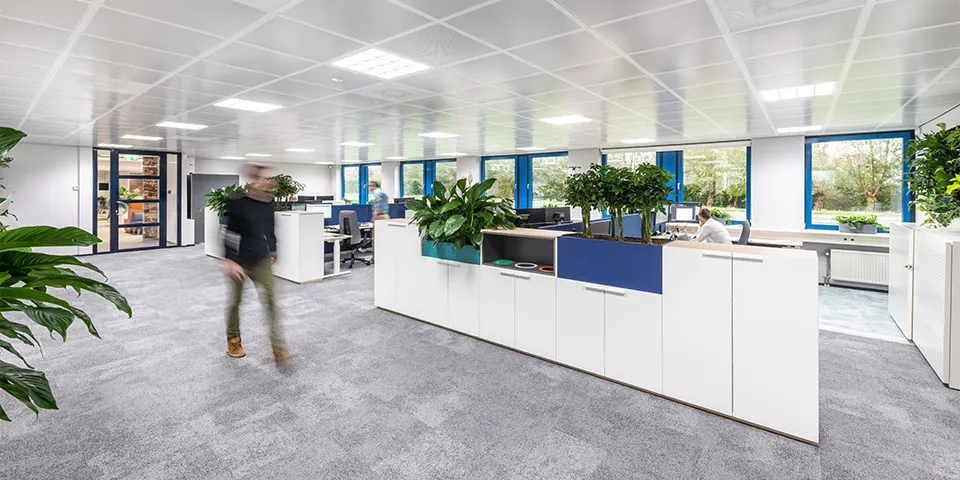
OC Autarkis and Hunter Douglas Architectural’s Crystal Climate Ceilings (C3) PCM climate ceilings not only make buildings more energy-efficient, but also improve comfort and aesthetics. These complete climate ceiling systems use advanced phase change material to transform basic climate installations into fully energy-efficient, fully automated climate control systems. Double the capacity of your existing chiller(s) today, without modifying the pipework!
Thanks to their construction and building mass, older buildings have a high capacity to store heat. Outdoor temperatures have little effect on the indoor climate, making it easy to keep rooms at the right temperature in winter while they stay pleasantly cool in summer. However, shorter construction times and high prices per square metre mean that today’s buildings are largely made of glass, steel and aluminium. These modern, lightweight structures have no capacity to store heat, so room temperatures can rise considerably under the influence of occupants, computers and solar radiation. “Until recently, this problem was addressed using advanced air-conditioning systems and/or water-based climate ceilings, but these systems consume a lot of energy,” says Arnold Bal, Business Unit Manager Utiliteit at OC Autarkis. The developer of Phase Changing Materials (PCM) solutions, which is part of Orange Climate, worked with Hunter Douglas Architectural to create C3 PCM climate ceilings. They combine PCM’s excellent technical properties with superior design. These innovative climate ceilings maintain a constant room temperature throughout the year, without water or pipework and with minimal energy consumption.

C3 PCM climate ceiling (panel ceiling)
at Flora Holland.
Building owners and architects can choose from three types of C3 PCM climate ceiling, each with a different fixing system: a tile ceiling, a panel ceiling and a wide-panel ceiling. PCM elements are fitted on top of the metal ceilings, where they function as thermal batteries, storing and releasing heat and cold. “One kilogram of PCM is roughly equivalent to 30 to 40 kg of concrete, allowing us to simulate the building mass of the past,” says Bal. “The PCM elements are filled with environmentally friendly salts, which are programmed to a desired transition temperature using a specific blend. When the PCM absorbs heat, it changes phase from solid to liquid. As it melts, the material absorbs large amounts of heat, cooling the surrounding area. When the temperature drops below the transition temperature, the material solidifies and releases the heat again. Natural ventilation and temperature differences efficiently discharge the heat stored in the PCM elements overnight. This enables building owners to save up to 50% on cooling and heating capacity and around 30% on energy costs.” The ceiling panels are supplied in standard module sizes, ensuring straightforward installation. The climate ceilings can also earn valuable BREEAM and BENG points.
Question about this story? Ask your question
Keep following this
Get an email when a new story is published. No account needed.
- ThemeGas-free heating and cooling
- SubjectGeneral







