











The airborne spread of SARS-CoV-2: risk of secondary infection
By Dr Yasin Toparlar and Dr Paul van Gent, senior experts, Deerns Nederland B.V.
Introduction
After months of an intelligent lockdown, many companies are inviting their employees back to work. Handshakes have long since disappeared. A 1.5-metre distancing policy is also in place, often alongside a strict cleaning protocol. Are all these measures enough to prevent the transmission of SARS-CoV-2? Keeping your distance certainly helps prevent infection from relatively heavy droplets released when coughing and sneezing, which then fall to the ground. But people also spread much smaller droplets that remain suspended in the air. According to the WHO and RIVM, it seems that airborne droplets do not contain enough virus to infect someone, and that ventilation systems therefore play no role in its spread. An article in Nature , however, states that there is no clear scientific consensus on the so-called airborne transmission of SARS-CoV-2.[1] If this proves to be a real risk, it is vital to provide indoor spaces with more than adequate fresh air and minimise the recirculation of used air.[2],[3] Our experts have already translated these general recommendations into practical advice for specific situations, depending on the building services design and ventilation concept. This article does not cover the technical measures in any further detail. Instead, we seek to find a (provisional) answer to the question: how high is the risk of secondary infection indoors?
Calculating the risk of secondary infection
To determine the risk of secondary infection, we use the concept of ‘quanta’. Quanta emission can be regarded as the infectiousness produced by an infected person. A recent study estimates the quanta emission of a SARS-CoV-2 carrier based on the (measured) typical virus concentration in the mouths of infected people, the quantity of droplets produced by a person (depending on their level of exertion and how much they speak) and the infectiousness of an earlier coronavirus (SARS-CoV-1).[4] Using an estimate of quanta emission, we calculate how the quanta concentration in a space changes over time, assuming that 1 person in the space carries the SARS-CoV-2 virus and that the air in the space is fully mixed. Key factors in this calculation are the dimensions of the space and the air change and recirculation rates. We also account for some of the virus becoming inactive and settling on surfaces. Finally, we determine the risk of secondary infection using the Wells-Riley equation.[5]
Results for a 28 m2 meeting room
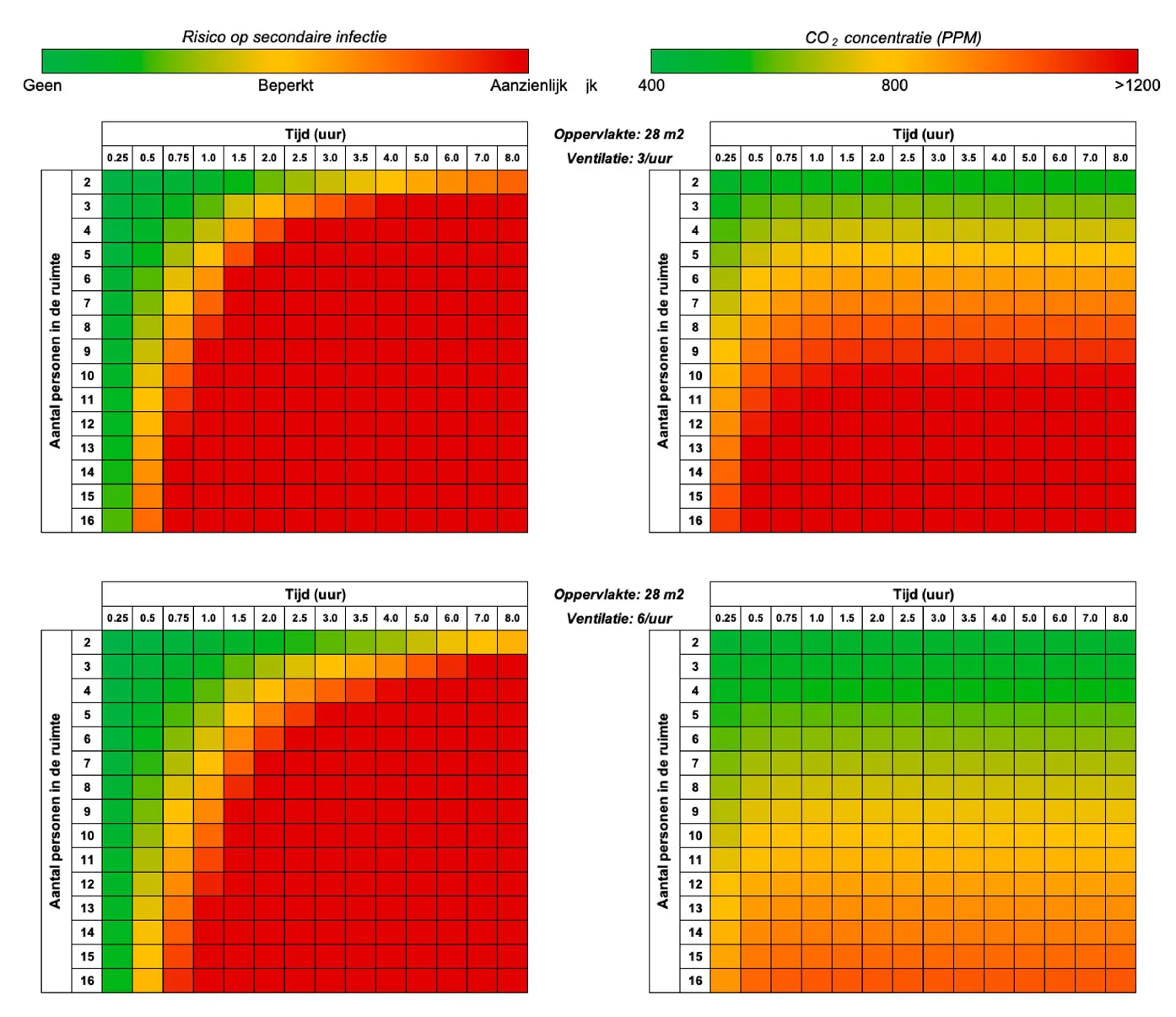
We calculated the risk of secondary infection through airborne transmission for a 28 m2 meeting room at two common air change rates: 3 per hour and 6 per hour. We assume that one person at the meeting carries the virus and speaks extensively, for example, giving a presentation. The figures on the next page show the results according to the ‘number of people’ in the room and the ‘meeting duration’. The graphs on the left show the risk of secondary infection on a scale from 0 (green) to 1 and above (red). The graphs on the right show the CO2 concentration on a scale from 400 ppm (approximately outdoor air) to 1,200 ppm and above (characteristic of poor air quality).
The graph at the top left shows that, at an air change rate of 3 per hour, secondary infection is likely when 4 people meet for 2 hours, even though the air quality, based on the CO2 concentration (graph at the top right), is still more than adequate at that point. At an air change rate of 6, infection only becomes likely after more than 3 hours (graph at the bottom left), further underlining the importance of good ventilation. In this case, the air quality based on CO2 concentration is still excellent.
Discussion
Our calculations assume that airborne transmission is a real risk for SARS-CoV-2, which may prove to be the case once sufficient research has been carried out. Unfortunately, many important questions about the SARS-CoV-2 virus remain unanswered. The parameters and assumptions used in our model are therefore subject to change as our understanding develops. The results should be viewed in that context. They provide insight into potential risks, but are not a sufficient basis for final design decisions, and certainly not for medical recommendations. Nevertheless, the results suggest that there may be a high risk of secondary infection even when indoor CO2 levels are low and good. The CO2 concentration in a room is therefore not a good indicator of the risk of secondary infection. This may come as a “surprise”: surely a low CO2 level is healthy? That is true when considering discomfort and the risk of headaches and fatigue, but not when considering the risk of secondary infection. The results do show, however, that increasing ventilation, mechanically or by opening windows, is an effective measure against potential secondary infections. The following operational measures can also reduce the potential risk:
- limit the length of meetings;
- limit the number of people in meeting rooms;
- take regular breaks and leave the room, allowing the concentration of suspended droplets to decrease.
Next steps
We are updating and refining the model as more information about the SARS-CoV-2 virus becomes available. We will also combine the model with measured data. CO2 sensors will allow us to accurately determine the increase in exhaled air in a specific space, an important factor in calculating infection risk because it gives us a better understanding of how many people are in the space and how long they are there. In spaces without CO2 sensors, we can temporarily use mobile CO2 sensors. We can gain further insight by simulating airflow in a space using Computational Fluid Dynamics (CFD). This shows us which seats are exposed to high concentrations of suspended droplets and which seats can be screened off. In this way, we can determine the ideal seating arrangement in relation to the ventilation and protect people from unfavourable airflows.
Returning to work in a 1.5-metre society is an unusual experience. Much remains unknown about the virus, so it is impossible to accurately determine the risk of secondary infection. More scientific research is needed. But by combining the best information available at present with our knowledge of ventilation, we can already define safety guidelines and reduce potential risks.
If you are interested in an analysis of your situation and would like to know how you can reduce potential risks, we would be happy to advise you. The analysis above uses a meeting room as an example, but the same type of analysis can also be carried out for, for instance, a theatre or outpatient clinic. For more information, contact Yasin Toparlar ([email protected]) or Paul van Gent ([email protected]).
[1] Lewis D (2020) Is the coronavirus airborne? Experts can’t agree. Nature 580, pp. 175.
[2] Morawska et al. (2020) How can airborne transmission of COVID-19 indoors be minimised? Environment International 142,
[3] Somsen GA et al. (2020) Small droplet aerosols in poorly ventilated spaces and SARS-CoV-2 transmission. The Lancet Resp. Med.
[4] Buonanno et al. (2020) Estimation of airborne viral emission: Quanta emission rate of SARS-CoV-2 for infection risk assessment. Env. Int. 141
[5] Riley et al. (1978) Airborne spread of measles in a suburban elementary school. Amer. Jour. of Epidemiology 107, pp. 421-423
Question about this story? Ask your question
Keep following this
Get an email when a new story is published. No account needed.
- SubjectGeneral







