











The benefits and necessity of Next Generation Growing
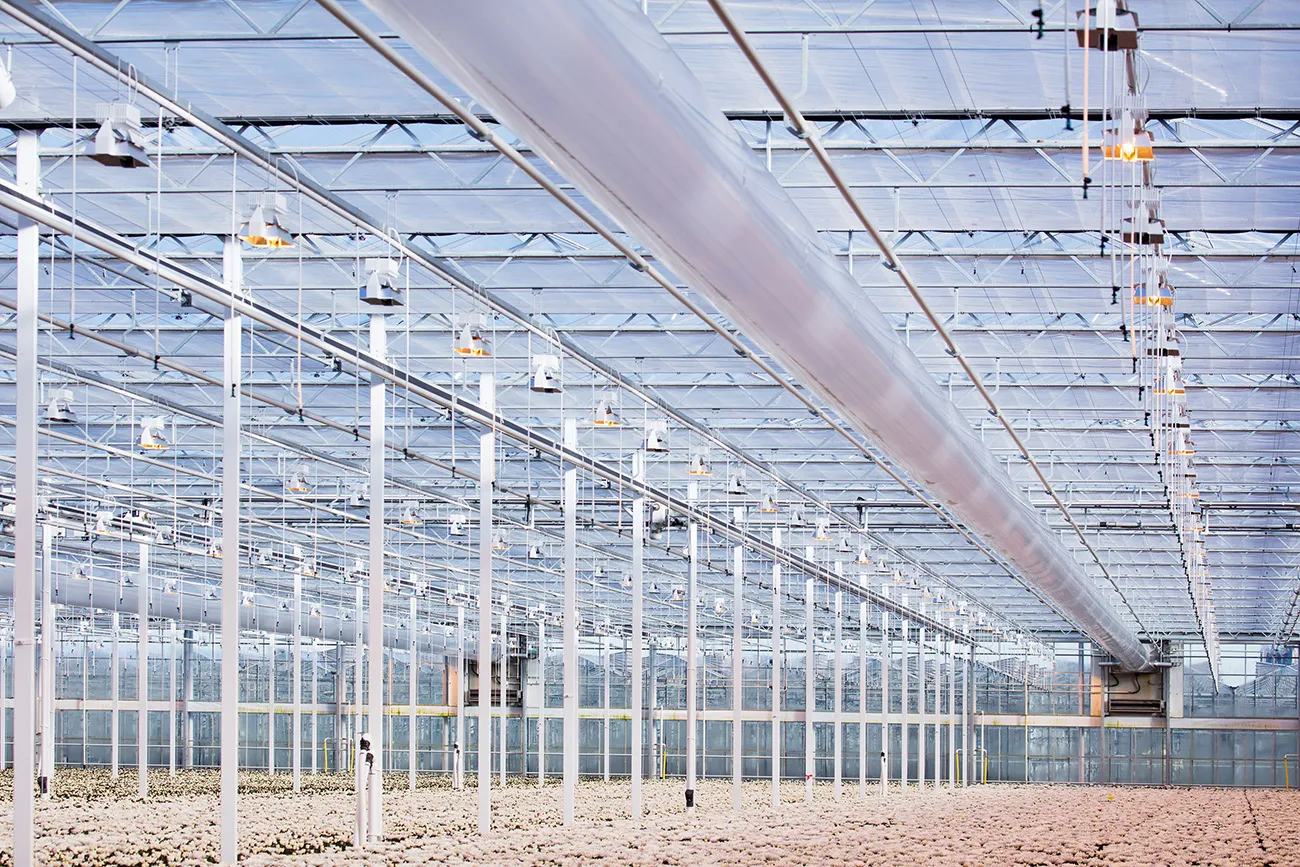
This year, the government is allocating €77 million in energy subsidies for greenhouse horticulture. The subsidies are intended to encourage businesses in the sector to save energy and invest in sustainable technologies. Under the Climate Agreement, the greenhouse horticulture sector has committed to reducing its CO2 emissions to 2.2 megatonnes a year by 2030. To achieve this target, 300 ha of greenhouses will need to be modernised each year. This presents a great opportunity for Technokas’s Next Generation Growing concept and Smitsair Luchttechniek’s damper assemblies.
An optimum greenhouse climate with minimal energy consumption
Technokas designs and delivers complete greenhouse construction projects, climate control systems and business premises for entrepreneurs throughout the Netherlands, from design to handover. “We started out as a greenhouse builder, but we have also been working in climate control systems for greenhouse horticulture for 30 years,” says Freek Batist, project engineer at Technokas. “From our base in De Lier, we serve many customers in the Westland, also known as the ‘Glass City’. One example is our Next Generation Growing concept.”
Next Generation Growing
Next Generation Growing was introduced around ten years ago to reduce energy consumption in greenhouse horticulture. “Screening systems are commonly used to control temperature, CO2 concentrations and humidity in a greenhouse,” Batist explains. “In a nutshell, the idea behind Next Generation Growing is to keep the screens closed for longer, so the energy, or heat, stays in the greenhouse. This sounds very simple, but it does create a risk. The humidity in the greenhouse can rise considerably as the crop transpires. To keep humidity under control, we have designed an efficient and effective dehumidification system with air handling units, fans and transparent air distribution ducts.”
Controlled dehumidification
“To keep the humidity in their greenhouses at the right level, many growers still choose to open their screens slightly,” says Batist. “Although this does lower the humidity, this approach to climate control also has significant drawbacks. Dry, cold air from above the screen flows in uncontrollably, wasting valuable energy. With today’s energy prices, that can add up to a substantial cost. What’s more, the uncontrolled airflow creates temperature differences in the greenhouse, which also have a negative effect on crop yields. We tackle this problem by bringing the dry, cold outside air in under controlled conditions.”
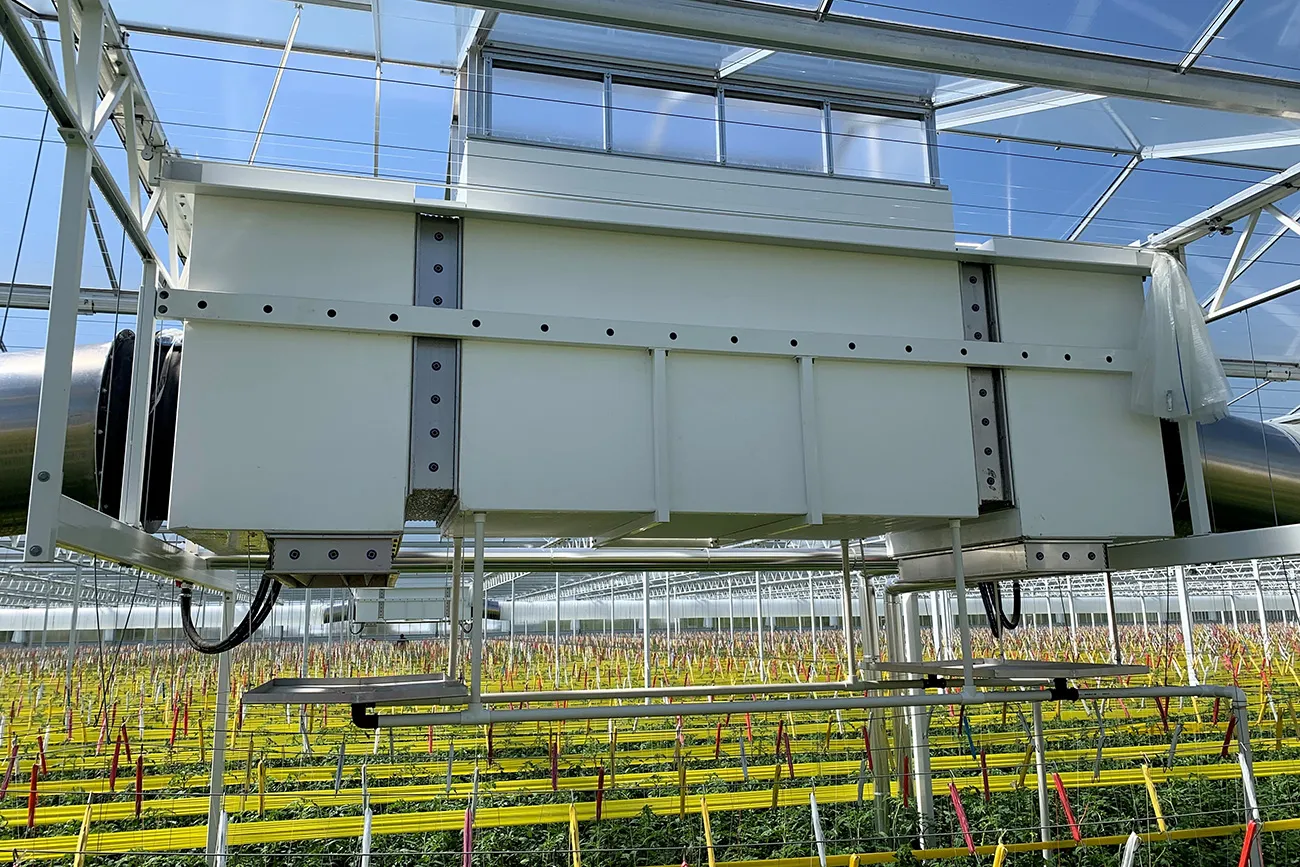
He explains that the dehumidification, or air handling, system for each project is designed to meet its exact requirements. “The basic principle is the same, though: an air handling unit draws in dry outside air, which is usually colder, through the outside air dampers, and heats it to the required temperature if necessary. Fans then blow the air into the greenhouse in a controlled manner through air distribution ducts. The clean, dry air mixes with the humid air inside, lowering the humidity.” Inside air can also be drawn in through the recirculation dampers. “Thanks to the damper assemblies from
Smitsair Luchttechniek, airflow can be regulated fully continuously, from 100% outside air to 100% recirculated air, and anything in between.”
Counter-rotating linkage
Smitsair Luchttechniek’s damper assemblies are installed in the outside and recirculated air intake ducts of the air handling unit, Batist explains. “Because the dampers are linked to rotate in opposite directions, they are ideally suited to regulating air volumes, mixing airflows and/or completely shutting off airflows.”
Smitsair Luchttechniek manufactures and supplies robust damper assemblies in steel, stainless steel and aluminium. “Technokas mainly uses our aluminium damper assemblies,” says Rolf Langeweg, commercial director at Smitsair Luchttechniek and Smitsair Jetsystemen. “That’s no surprise, because the environment in which the dampers are used can become very humid. In most cases, the outside and recirculated air intake ducts are not insulated. Aluminium is highly resistant to these conditions and is very corrosion-resistant.”
Unique bearings and adjustment mechanism
Smitsair Luchttechniek’s damper assemblies comprise a casing and aerodynamic blades. “We have developed a special product for the blade bearings,” says Langeweg. “Instead of standard metal bearings, we deliberately chose plastic bearings in 2 grades of hardness, which ensure high levels of air tightness and low leakage.” Another unique feature is that the blade linkage is located on the outside of the casing. This makes it very easy for customers to fit a servomotor. “We are happy to help customers select the right motor, and to answer any other questions or discuss challenges or project-specific requirements. This is one of the reasons Technokas chose Smitsair Luchttechniek many years ago, including for Next Generation Growing.”
Minimal energy consumption, maximum crop yields
With Technokas’s Next Generation Growing system, growers can keep their greenhouse screens closed. “This means no more wasted energy, while the humidity problem is also effectively resolved,” says Batist. “This results in significant energy and cost savings, while growers also gain better control over their climate conditions.”
Schenkeveld Tomaten
Technokas recently implemented Next Generation Growing in a new development for Schenkeveld Tomaten, one of the largest tomato growers in the Netherlands. “Schenkeveld’s tomato nursery in Rijsenhout, near Schiphol, comprises 4 greenhouses, each covering 10 hectares. The last 2 were built in 2021 and 2022,” says Batist. “To control the climate in these latest greenhouses, we installed an air handling system that draws in outside air through the roof. This reduced the length of air distribution ducts required compared with a system installed on the façade.
We supplied and connected a total of 64 air handling units, each with 2 damper assemblies from Smitsair Luchttechniek.”
U GRAND
Another excellent reference is the new chrysanthemum nursery for U GRAND. As well as vegetable growing, Technokas is also a popular partner in ornamental horticulture. “We built a 10-hectare high-tech chrysanthemum greenhouse on a 12-hectare plot, with diffused glass, integrated ventilation windows with insect screens, high-pressure misting, LED lighting and 35 air handling units,” says Batist. “Following the example of the ventilation windows, the air handling units are also fitted with insect screen boxes on the outside, effectively keeping insects out. Our solution therefore helps growers save on energy and crop protection products, while enabling them to grow crops more sustainably.” The 35 air handling units are mounted in the façade and fitted with a total of 70 damper assemblies from Smitsair Luchttechniek.
Koppert Biological Systems
Koppert Biological Systems in Berkel en Rodenrijs is also focused on healthy, safe and productive growing. Smitsair Jetsystemen designed an air curtain specifically for this international market leader in natural pollination and biological crop protection. It prevents small flying insects from moving between rooms. “The air curtain was installed between 2 greenhouse compartments and designed entirely to meet the requirements,” says Langeweg. “Taking into account factors such as the area of the opening, the situation, inside to inside, and Koppert Biological Systems’ objective, we calculated the exact airflow required per square metre. We then selected the right fan and control system, before completing the air curtain design.”
Aerodynamic jet nozzles
The air curtain is typically built from ductwork or plenum sections, combined with high-induction grilles with jet nozzles. “Our jet nozzles are distinguished by their excellent adjustability,” says Langeweg. “Their aerodynamic properties also deliver high discharge velocities at relatively low inlet pressures, as well as exceptionally low noise levels. If required, we can carry out a smoke test or simulation before handover to demonstrate their excellent performance.”
In addition to horticulture, Smitsair Jetsystemen’s jet systems are also highly suitable for data centres, shops, showrooms, hospitality venues, exhibition halls and concert halls, sports and leisure facilities, distribution centres, schools, indoor playgrounds and play parks, churches and the food industry.
A business enquiry for Smitsair? Get in touch
Companies in this story
Keep following this
Get an email when a new story is published. No account needed.
- SubjectGeneral
- CompanySmitsair







