











Virtual Classroom on Power Networks: “A completely different approach from what I was used to!”
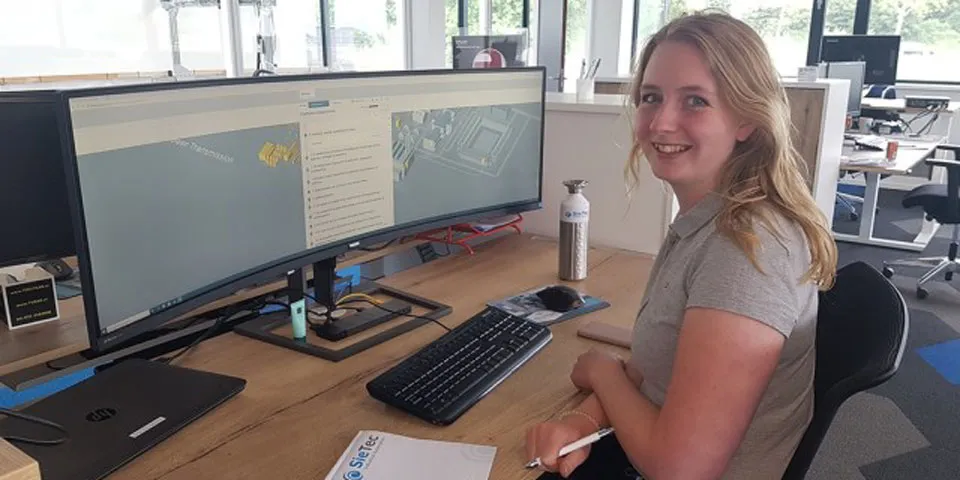
In response to Covid-19 measures, Siemens Power Academy has moved its Blended Learning on Power Networks course entirely online. Electrical engineering student Maud van der Weegen is taking the course alongside her studies. “The course’s practical focus is a valuable addition to the more theoretical approach at university.”
The Siemens Power Academy provides training for everyone who works professionally with high, medium and low voltage. The Blended Learning on Power Networks course combines three classroom sessions with 15 e-learning modules to complete at home. Around 5 of the 15 modules are covered in each classroom session. Between sessions, participants work through the corresponding e-learning modules themselves.
We believe the Virtual Classroom is better suited to today’s training needs: just on time, just enough and just for me.
Sander Smit, Siemens Power Academy
In response to the coronavirus measures, the classroom sessions have been converted into 15 Virtual Classrooms delivered via Microsoft Teams. They take place weekly, last 60 minutes and each cover one module. This makes the course manageable for participants. Sander Smit of Siemens Power Academy says: “A classroom session lasts a whole day and can be quite demanding. However varied and engaging our trainer makes it, most people’s concentration is bound to flag at some point in the afternoon. Between classroom sessions, participants have to complete three to five e-learning modules alongside their normal work. With the Virtual Classroom format, you train more regularly, which helps you stay on top of the material. After the online session, you only have one e-learning module to complete. You have no travel costs and don’t lose a whole day to training. We believe the Virtual Classroom is better suited to today’s training needs: just on time, just enough and just for me.”
A physics-based approach
Maud van der Weegen, a third-year electrical engineering student at Avans Hogeschool in Breda, has completed the first Virtual Classroom module on Power Networks and is looking forward to the next one. “It’s a completely different approach from what I was used to! At school, a lot of material is covered in a short time using abstract formulas. The Power Networks course takes a physics-based approach and is structured in an engaging way. Trainer Nils Dobbe gets you actively involved in the lesson and shows you all kinds of objects. For example, a power supply with a small lamp to explain alternating voltage and negative voltage. The practical applications give you a good understanding of exactly how everything works. The e-learning modules are clear and well designed. You complete the exercises with the help of short videos.”
Career changers
As a third-year electrical engineering student, Maud already knows a lot about the subject. Even so, she finds the course enlightening. “For example, I’d never realised that voltage is a measure of the energy carried by an electron. I’ve recommended that my fellow students try an online lesson too. But this course could also be very suitable for career changers. Everything is explained so visually that I think you can follow it even without any background in electrical engineering.” The technical sector needs enthusiastic career changers, as electrically trained staff are becoming scarce.
A passion for innovation
The engineering sector is still male-dominated, too. Maud has just one female fellow student. “I have noticed that gradually more girls are choosing to study engineering. Perhaps that’s also because various campaigns are encouraging them to do so?” In October 2018, Maud took part in a panel discussion at the World Class Maintenance Congress for women in engineering. Her interest in technology was instilled from an early age. Her mother is a process operator and her father is the founder and director of system integrator and Siemens partner SieTec in Terneuzen. Four years ago, she started an MBO course in mechanical engineering at Scalda in Vlissingen. After graduating, she moved on to an HBO degree in electrical engineering. “At first I was torn between mechatronics and electrical engineering, but I’m a little less interested in materials science. What’s more, electrical engineering skills are in high demand in the market. It’s the ideal choice of degree for me! We have dedicated lecturers at school who are passionate about their subject.” For her graduation project, she wants to work on an innovative topic such as Industry 4.0, Digital Twins or the energy transition. After completing her degree, she plans to take a master’s in Information Studies, specialising in Data Science, in Amsterdam. “I find the combination of data and electrical engineering very interesting. Perhaps I’ll work in wind energy later on, or in another industrial sector. As long as it’s innovative!”
Free Virtual Classroom
Want to find out whether the Virtual Classroom on Power Networks is right for you? Take a free lesson and give it a try! If you’re studying electrical engineering at HBO level, you may gain new insights. And if you’re a career changer with an HBO qualification, we’ll give you a solid grounding in electrical engineering. The course is also open to anyone who wants to contribute to the energy transition through electrification. Click here for more information and dates for our free Virtual Classroom sessions.
A business enquiry for Siemens? Get in touch
Companies in this story
Keep following this
Get an email when a new story is published. No account needed.
- ThemeBuilding electrical systems
- SubjectGeneral
- CompanySiemens







