











Waste-to-energy heat makes Arnhem and Nijmegen’s district heating networks more sustainable
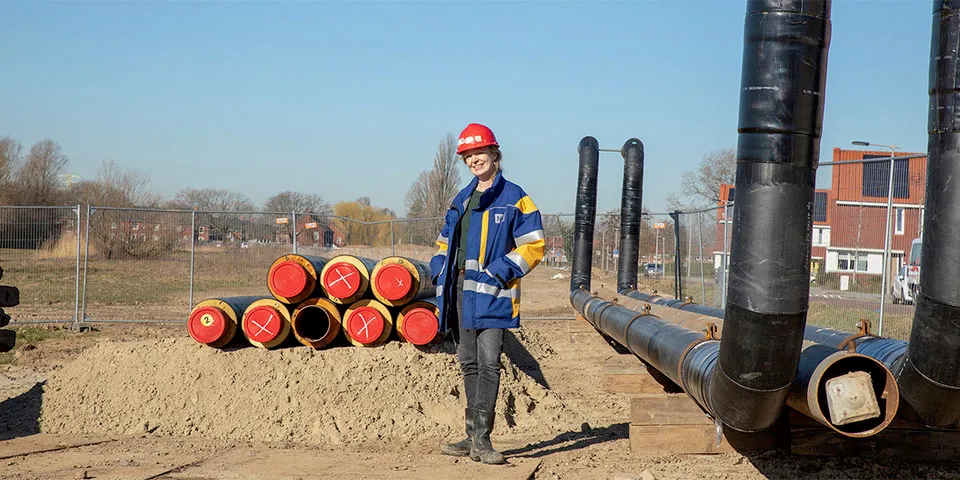
Waste-to-energy heat plays an important role in making the Dutch built environment more sustainable. Two new projects in Arnhem and Nijmegen offer a glimpse of the technical challenges involved in developing and expanding district heating networks in urban areas.
Since connecting to the district heating network in autumn 2019, waste management company Dar’s headquarters in Nijmegen has been fully gas-free, saving 70 per cent in CO2 emissions compared with a gas-fired central heating system. ‘Together with the surrounding municipalities, we aim to collect as much waste as possible separately. If we do that well, a large proportion can be reused as a raw material,’ says Bart de Bruin, director of Dar. ‘Ultimately, only a small amount of residual waste is left, which is incinerated at Afvalverbranding Regio Nijmegen (ARN). By connecting to the district heating network, we are even making good use of the residual waste.’
According to Harrie van der Wielen, business manager at Vattenfall Heat, Dar’s connection even creates a circular system. ‘Dar’s buildings are heated using waste collected by the company itself.’
Flexwell drilling
Because Dar’s headquarters is located on a busy road, a relatively new technology known as Flexwell drilling was used to connect it to the district heating network. The borehole was drilled beneath the road with a tight bend radius, avoiding the need to excavate deep, wide underpasses. Innovations like these play an important role in the construction and expansion of district heating networks, which will be taking place in many busy city centres and urban areas in the coming years as part of the energy transition.
Communal heating for apartment blocks
As in Nijmegen, residual heat is also helping to make the built environment in Arnhem more sustainable and gas-free. The district heating network, which supplies heat to Arnhem, Westervoort and Duiven, is fed by residual heat from waste processor AVR in Duiven. More and more housing associations are opting for this district heating to put their sustainability ambitions into practice.
In the Immerloo district, housing associations Vivare and Volkshuisvesting recently replaced the gas-fired central heating system in six social housing blocks with a connection to district heating. ‘The communal heating system did not necessarily need replacing, but there was a strong desire to make it more sustainable,’ says Femke Steenbergen, property project manager at Vivare. Vivare’s sustainability work also includes insulating the roofs and façades, replacing the radiators with a more efficient type, and installing solar panels. Steenbergen says: ‘Vivare’s two blocks, comprising 228 homes in total, will be completed in spring 2020. In time, we also want to replace the gas-fired water heaters with electric ones. The blocks will then be entirely gas-free.’
The six blocks share a boiler house, where the gas-fired central heating system has been replaced with heat transfer stations. As before, the homes are connected to a communal system. Vattenfall carried out the necessary modifications to the various transfer stations, says Van der Wielen. ‘If Vivare and Volkshuisvesting had also chosen to supply domestic hot water via district heating, the changes to all the pipework and systems in the blocks would have been far more extensive. The investment would also have been considerably higher.’
Supporting tenants
To connect the six blocks in Immerloo, Vattenfall extended the existing district heating network by 1.8 kilometres. According to Steenbergen, the key principle was that tenants should not face higher costs. ‘Tenants pay the same per gigajoule as they did before. We also want to help tenants reduce their energy bills. For example, we provide advice on energy use and supply new thermostats. Because the blocks are connected to a communal system, the homes do not have programmable thermostats.’
CO2 savings
By switching to district heating, the housing associations and their tenants will cut CO2 emissions by 82 per cent compared with gas-fired high-efficiency boilers. Van der Wielen points out that the high CO2 savings are also linked to the special (TCI) installation used by AVR Duiven. It produces a lime-based binder from old paper fibres, which is used in products such as cement. Vattenfall also aims to feed heat from other sustainable sources into the district heating network in future. Veolia’s biomass plant, at the Kleefsewaard industrial estate in Arnhem, has already been connected.
According to Steenbergen, further improvements to the sustainability of district heating networks remain an important priority. ‘You can also see that the range of solutions is constantly evolving. A few years ago, when we replaced the open-flue water heaters in these blocks with room-sealed ones, electric water heaters were not even being considered. We therefore see clear opportunities for new, sustainable heat sources for the district heating network in the near future.’
Question about this story? Ask your question
Keep following this
Get an email when a new story is published. No account needed.
- ThemeGas-free heating and cooling
- SubjectGeneral







