Bespoke air handling units built from standard components and modules
Text Lieke BousemaImage Ned Air
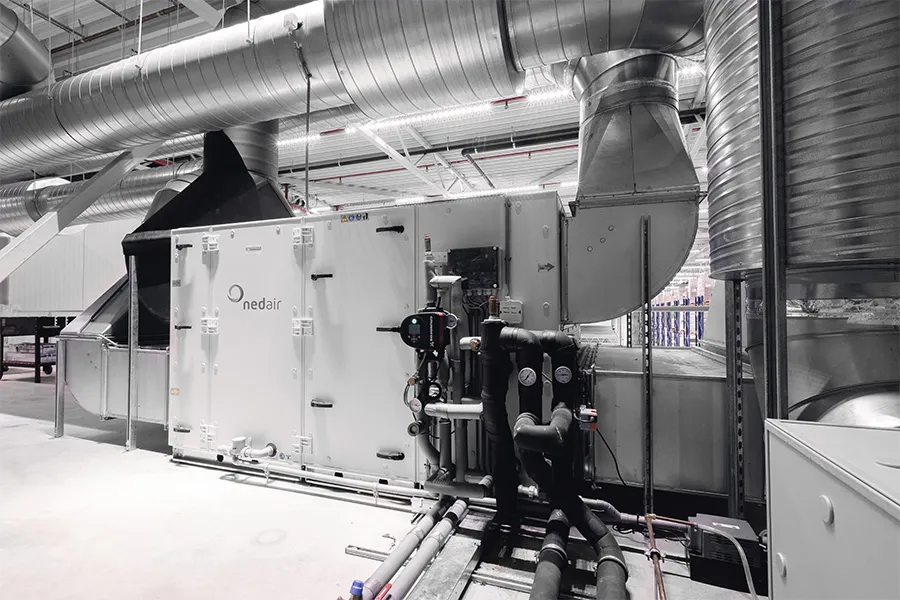
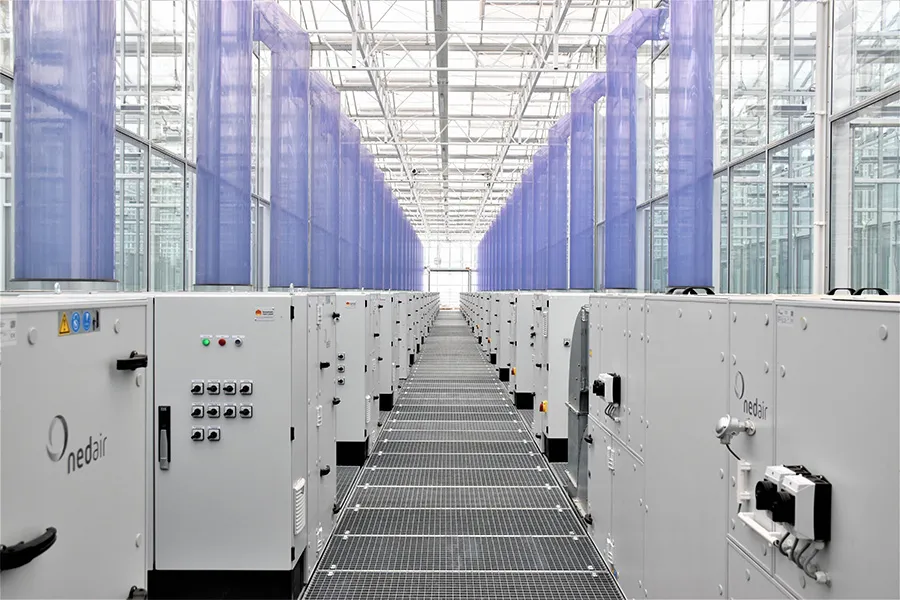
From office buildings to schools and theatres, from small to large, and from new-build to replacement projects: whatever a building’s function, requirements and technical challenges, Ned Air can supply a suitable air handling unit. “We have an extensive range of standardised air handling units that can be configured entirely to the customer’s requirements and scaled up as needed,” says commercial director Hans Robben. “We can easily integrate customer-specific features such as humidification, dehumidification, fine-dust and HEPA filters, adiabatic cooling, sound attenuation and more. Since no two projects are the same, all our air handling units are built on a modular basis. We work with standard components and modules while retaining customer-specific options. This allows us to deliver high-quality, affordable bespoke solutions, and means our air handling units can be selected easily and manufactured quickly.”
“The design principles for our air handling units are always the same,” says Robben. “For example, this applies to the choice and size of the panels. The starting point is 35-centimetre panels, which allow us to create air handling units in any size in precise increments, in terms of height, length and width. Based on the selected heat exchanger, either a rotary heat exchanger or a counterflow heat exchanger, we put together a basic air handling unit, which can then be extended lengthwise with heating, cooling and changeover coils, sound attenuators and other functions as required. Naturally, all our units comply with the ErP Directive (Ecodesign). We are also happy to take additional subsidy, noise and other requirements into account.”

An energy-efficient starting point
With EveryLine, Ned Air offers a range of energy-efficient air handling units with heat recovery, in which the heat exchanger and fans have already been preselected. “A unique feature of these air handling units is the patented air separation module (LSM), which combines two counterflow plate heat exchangers in a single compact unit and transfers heat from the outgoing air stream to the incoming (fresh) air stream even more effectively,” says Robben. “Low internal resistance prevents unnecessary airflow noise and has a positive effect on energy consumption. The LSM comes as standard with a bypass face damper, making summer night ventilation (free cooling) possible too.” EveryLine is particularly suitable for spaces with high occupancy where control is based on CO2, pressure and/or relative humidity. “Nine standardised models are available, with airflow rates from 350 to 12,500 m3/h.”
Higher airflow rates, cooling and/or moisture recovery
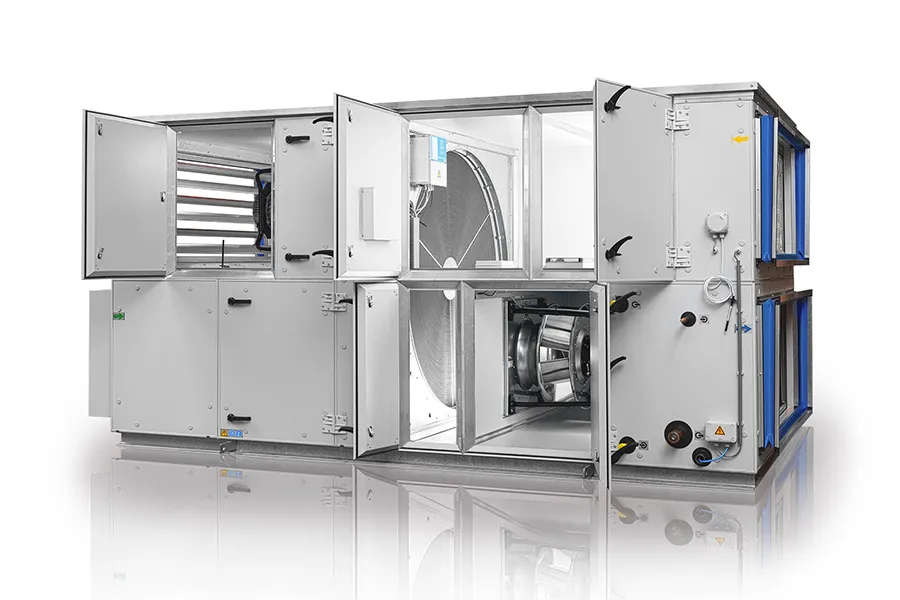
Where higher airflow rates, cooling and/or moisture recovery are required, RotorLine is the answer. This range includes eight models from Ned Air, with airflow rates from 2,400 to 44,000 m3/h. “When purchasing, installers and clients can choose from a selection of fans, heating, cooling and changeover coils, and three energy-saving rotary heat exchangers: a condensing wheel, an enthalpy wheel or a sorption wheel,” says Robben. “All rotary heat exchangers are fitted with sealing strips to minimise air leakage. The design of the aluminium fins is also unique, optimising heat and moisture transfer. In addition to a heat recovery efficiency of 85%, RotorLine can achieve moisture recovery efficiency of as much as 90%, allowing significant savings on installed cooling capacity.”
Standardised or 100% bespoke
By using preselected products, the technical specifications and performance are already established. “This is an advantage, for example, on projects where the Total Cost of Ownership needs to be calculated in advance,” says Robben. “It is also useful when applying for subsidies, such as the Energy Investment Allowance (EIA).” Where standardised solutions are not possible, for example on renovation and conversion projects, Ned Air can also provide a 100% bespoke solution, with the unit dimensions, fans, heat exchangers and coils all selected individually. “This enables us to offer the best possible functional and energy-efficient solution for every building and every requirement.”
Training and knowledge sessions
As well as supporting installers with the selection and engineering of air handling units, Ned Air provides a range of training courses and knowledge sessions on air technology, both on site and in its new training room in Kampen. “Alongside information about our concepts and the available options, we share general information about air handling,” says Robben. “For example, what happens to fresh outdoor air as it passes through an air handling unit? What are the functions of the heat exchanger, fan, coil and other components? And how do they affect temperature and humidity? We use the Mollier diagram, for example, to help map the indoor climate and select the right climate control systems. In sessions on control technology, we explain which parameters can be adjusted remotely, as well as how potential faults can be viewed and resolved remotely. Our training room in Kampen also has a working air handling unit, which we use to show installers the finer points of maintenance and servicing. Installers interested in this can arrange a training session through their Ned Air area manager. We will, of course, take any specific requirements into account. That means we can tailor our training too.”
A business enquiry for Ned Air? Get in touch
Companies in this story
Keep following this
Get an email when a new story is published. No account needed.
- ThemeHealthy indoor air
- SubjectHVAC
- CompanyNed Air