











Cementitious liquid screeds combined with underfloor heating: the optimum in comfort, energy efficiency and appearance

From new-build projects to renovations, and from homes to commercial buildings, Woodstock specialises in flooring. “We supply and install both finished floors (polished concrete, parquet and laminate) and screeds (magnesite, anhydrite and sand-cement)”, says managing director Jos Gilein.
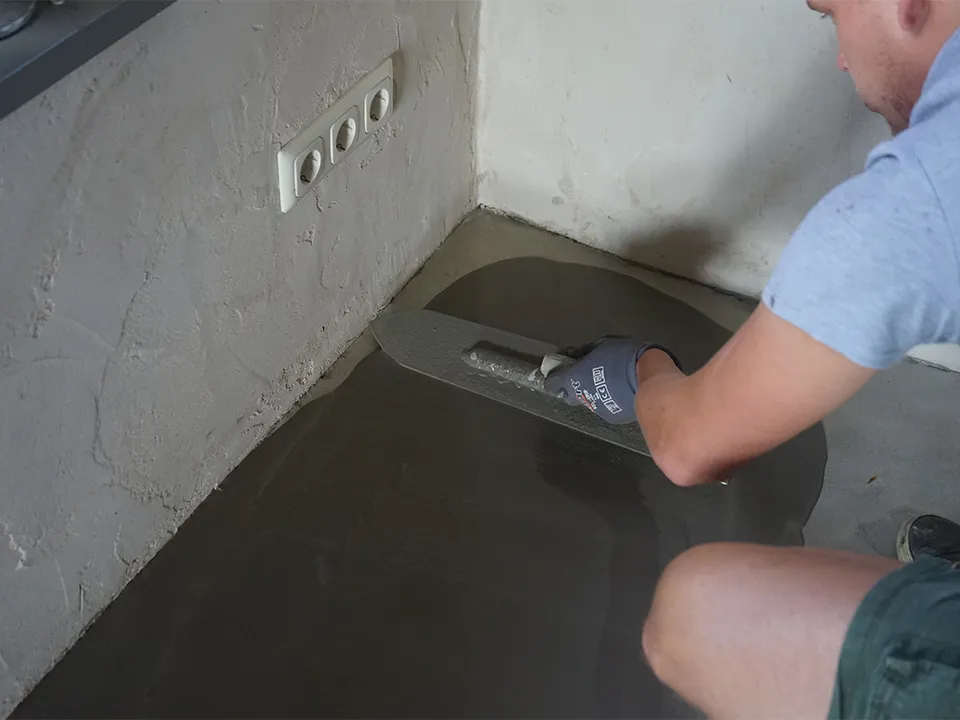
“Our cementitious liquid screeds are very popular, and are often installed in combination with underfloor heating. The liquid screed fully and evenly encloses the underfloor heating pipes, resulting in highly energy-efficient performance and comfortable heat output.” This can be enhanced further by insulating any existing crawl space with foam concrete, he says. “The foam concrete eliminates draughts and rising damp. It also prevents heat escaping downwards and means residents no longer have to worry about pests under their home.”
In most rooms in the Netherlands, traditional underfloor heating with pipes is still the preferred option, combined with a heat source. This may be a gas-fired central heating boiler, a solar water heater or a heat pump. It is also possible to supply the underfloor heating from the heat exchanger. “Underfloor heating can heat a room at low temperatures, up to around 35°C”, says Gilein. “This delivers significant energy savings compared with radiators, which require a flow temperature of around 70°C. As underfloor heating emits radiant heat, there is little air movement, so dust is hardly disturbed. Removing the radiators also gives occupants much greater freedom to arrange the space. Underfloor heating can easily be divided into zones and controlled separately, and users can even opt to control it via a smartphone.”
End-to-end service
Building owners receive support at every stage of the installation of the liquid screed and underfloor heating, Gilein emphasises. “In renovation projects, the existing timber joist floor is often removed because it provides very poor insulation. We then inspect the drainage and other pipes in the crawl space. We level the crawl space and lay a special building membrane to prevent moisture from the foam concrete penetrating the home. We also install marker stakes to clearly indicate the maximum height of the foam concrete and the underside of the liquid screed.” The foam concrete is poured using a specialist concrete pump. “Depending on the required floor thickness, we install a layer between 25 and 50 centimetres thick, which must cure for several days. We then lay the studded panels on top of the foam concrete and clip the underfloor heating pipes into place. Once the system has been pressure-tested, the liquid screed is poured.”

As well as a cementitious liquid screed, clients can choose a liquid sand-cement screed, an anhydrite screed or a polished concrete floor. “For the latter, once the concrete has cured, the floor is power-floated and finished with a protective coating to prevent dirt from penetrating the surface.” On upper floors, a magnesite screed with underfloor heating is often chosen, finished with a self-levelling compound.
Infrared underfloor heating
Alongside traditional underfloor heating, Woodstock regularly installs electric underfloor heating, which has made a major comeback. “Infrared underfloor heating is very popular and can make excellent use of surplus power from solar panels”, says Gilein. “It is highly energy-efficient because it requires a lower temperature to produce the same sensation of warmth. Infrared heating also warms up much faster than water-based underfloor heating. The ultra-thin 0.38 mm film can be laid directly on the insulated floor, keeping the floor build-up to a minimum.”
For more information, visit: https://andoxis.com/nl/bedrijven/woodstock-vloeren
Question about this story? Ask your question
Keep following this
Get an email when a new story is published. No account needed.
- ThemeGas-free heating and cooling
- SubjectHVAC







