Heat pump with an ultra-compact indoor unit

Hybrids are the future
The new hybrid heat pump from Intergas was already on show at the VSK trade fair in May, and the first Xtend units will be available from wholesalers in a few months. With relatively low investment per home, the Netherlands’ largest central-heating boiler manufacturer aims to make a major contribution to reducing CO2 emissions.
“We need to move away from gas,” says Ralf Jansen, marketing and communications manager at Intergas Verwarming. “But isn’t the main climate objective to limit CO2 emissions? There are ambitious plans for major investment in new heat networks and hydrogen networks, but not only will they cost an enormous amount, it will also be many years before the Netherlands sees the benefits and can make use of them. For a fraction of that cost, you could upgrade 70 to 80 per cent of homes much sooner. That won’t take them off gas, but it will ensure that their heating systems can also run on biogas or green gas. And hybrid technology doesn’t have to be a transitional step: it can also be a long-term solution using hydrogen or green gas.”
Gas savings of up to 80 per cent
“New-build homes are already gas-free, of course, and newer homes are suitable for all-electric heating,” Jansen explains. “It’s more challenging with older homes. But if you get started straight away with a compact hybrid system, the potential reach is enormous and the impact on CO2 reduction is significant. Our affordable hybrid solutions can save up to 80 per cent on gas, making them a highly socially responsible solution too. Especially with current gas prices, which are driving many households to despair. It’s also a solution that can be implemented quickly. With a service life of 15 to 20 years, it can easily bridge the time society needs to make major infrastructure changes, such as building a hydrogen network.”
Hydrogen
To prepare for this, most central-heating boilers can be adapted to run on biogas, green gas and, in part, hydrogen, with only minor modifications. Jansen says: “Running on 100% hydrogen requires more significant modifications. Because the hydrogen molecule is smaller, finer detection is needed to identify ignition. Hydrogen is the fuel of the future, used in a hybrid system with solar panels to generate your own electricity. In the future, you would need to be able to store surplus electricity, for example in a battery. We already have appliances that can run on 100% hydrogen, by the way.”
Ultra-compact indoor unit
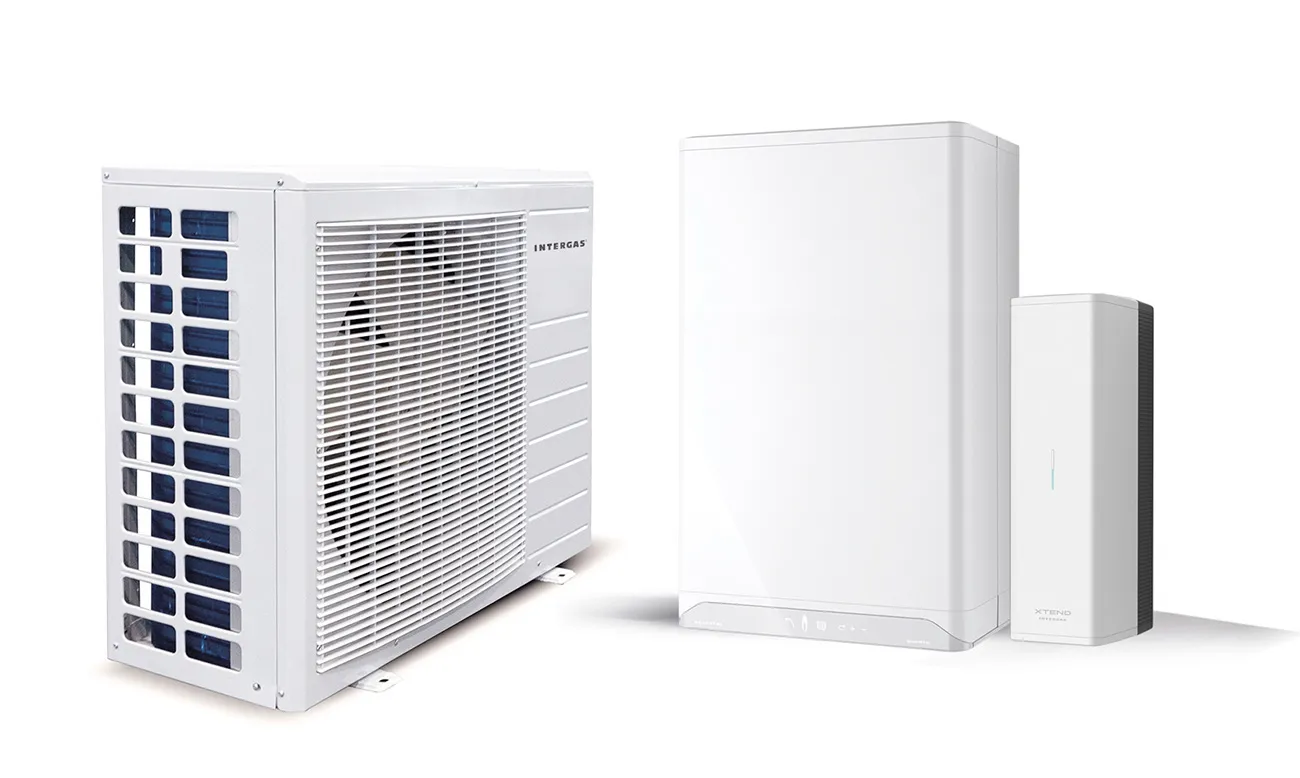
“We developed the Xtend as a hybrid solution. It’s an air-to-water heat pump that can be combined with all conventional central-heating boilers, although it naturally works best with our own high-efficiency boilers, such as the HRE, the Xtreme series and the HREco. The Xtend consists of an ultra-compact indoor unit, just 16.8 centimetres wide and just over 55 centimetres high, so it can be fitted into almost any installation. A low-loss header means the indoor unit can also be installed elsewhere, although it is better to position it as close as possible to the central-heating boiler. The system also has an outdoor unit, which must be installed no more than 25 metres from the indoor unit. The Xtend has an output of 5 kW, a COP of 4.5 and a maximum system temperature of 55°C, enough to take over 85 to 90 per cent of the boiler’s heating load.”
Housing associations
Hybrid solutions are also well suited to housing associations looking to upgrade homes as a group. Jansen says: “For example, you can install a high-output outdoor unit on each floor and equip the homes themselves with small indoor units and an efficient boiler. This requires relatively few structural modifications, and because the central-heating boiler remains in place, residents retain the same sense of comfort. All-electric heating and older homes are still not a good match, because low-temperature heating is often not possible and there is less scope for insulation. Just think how long it takes to raise the temperature in a home by 2 degrees. It can take days.”
The benefits for installers are clear. Jansen concludes: “It’s all familiar Intergas technology, and the compact design makes it very easy to install. It fits almost everywhere. Commissioning is also a breeze. There is a QR code on the underside of the Xtend indoor unit, which installers can scan to follow the Xtend commissioning process in six simple steps. Residents can then control the system using a Comfort Touch thermostat or the Comfort Touch App on their phone. I think this complete solution can help us take an important step towards reducing CO2 emissions. That’s what it’s all about for us.”
Question about this story? Ask your question
Companies in this story
Keep following this
Get an email when a new story is published. No account needed.
- ThemeGas-free heating and cooling
- SubjectHVAC
- CompanyVSK