‘The refrigerant of the future’
Text Lieke van ZuilekomImage Western Airconditioning
Propane makes a successful comeback in chillers and heat pumps
In recent years, European regulations on synthetic refrigerants such as (H)CFCs and HFCs have been significantly tightened, severely restricting or even banning their use. Further tightening is on the horizon, with an update to the F-gas Regulation currently under discussion. In this context, propane, one of the first natural refrigerants ever used, has emerged as a smart replacement option for current and future HVAC applications. However, industry knowledge of using propane as a refrigerant remains limited. Western Airconditioning is keen to change that. The supplier of complete heat pump, chiller, air conditioning and air handling solutions sees propane as a long-term option that is unlikely to be displaced any time soon.
“Propane (R290) is a natural refrigerant with a low Global Warming Potential (GWP) of 3,” says Anton Dijksma, Product & Quality Manager at Western Airconditioning. “While propane makes only a minimal contribution to global warming, HFCs such as R410a, R134a and R32 have a far greater impact, with GWPs of 2,088, 1,430 and 675 respectively. From an environmental perspective, propane is therefore an obvious choice. It also has much better thermodynamic properties, so you can transport the same amount of heat or cooling with considerably less refrigerant.”
The refrigerant transition
Because of their harmful environmental effects, the European Commission is increasingly restricting the use of synthetic refrigerants in heat pumps and chillers. The current F-gas Regulation, for example, phases down HFCs from 100% of the 2015 CO2-equivalent baseline to 21% in 2030. “A revision to this legislation is now in the pipeline, accelerating the phase-down to 5% by 2030,” says Arnoud Kerkhove, Account Manager at Western Airconditioning. “This means that low-GWP refrigerants, particularly natural refrigerants, are gaining ground. Our broad range of propane heat pumps and chillers means we are already prepared for this.” Dijksma adds: “Synthetic refrigerants will be subject to a CO2 tax in the future, while propane will remain largely exempt. This is making propane increasingly attractive financially, too.”
Ready for use
When it comes to environmentally friendly refrigerants, propane appears to have two alternatives: ammonia (GWP=0) and HFOs/fluoroolefins (GWP=<1). “Ammonia presents barriers to adoption because it is highly toxic, while there are also growing concerns about the potentially harmful effects of HFOs,” says Dijksma. “When HFOs break down in the atmosphere, they form PFAS compounds that are highly harmful to aquatic animals and plants. Propane has none of these problems. It is already present in nature and ready for use. In our view, that makes propane the refrigerant of the future.”
High temperatures
Propane is an excellent choice for existing buildings, too, he says. “Propane heat pumps can supply hot water at 70°C when the outside temperature is -10°C. This makes them particularly suitable for existing buildings where the gas-fired boiler needs to be replaced, as the existing heat emitters can be retained. Propane’s properties are also ideal for new-build projects. It is no coincidence that more and more companies, consultants and public authorities are specifying natural refrigerants such as propane in their projects.”
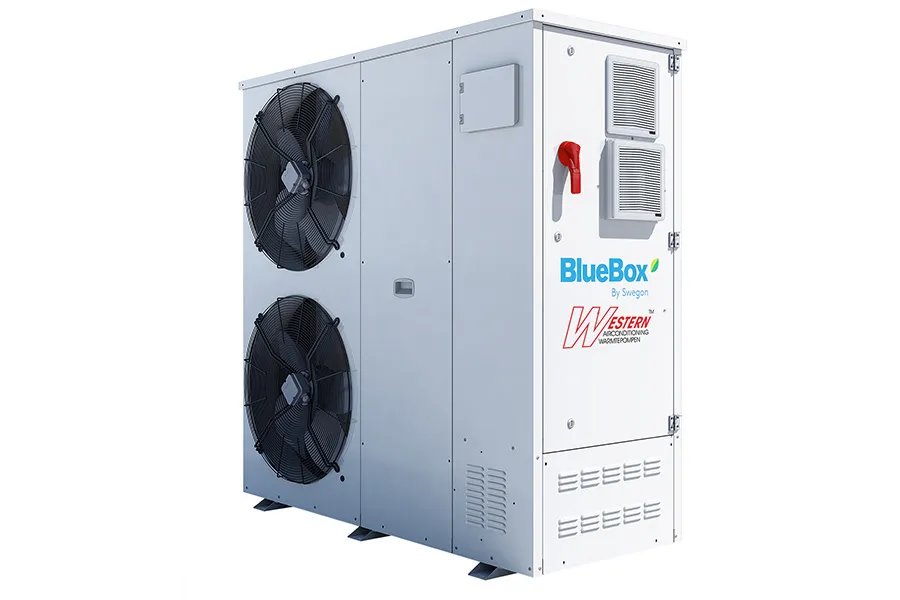
A solution for every situation…
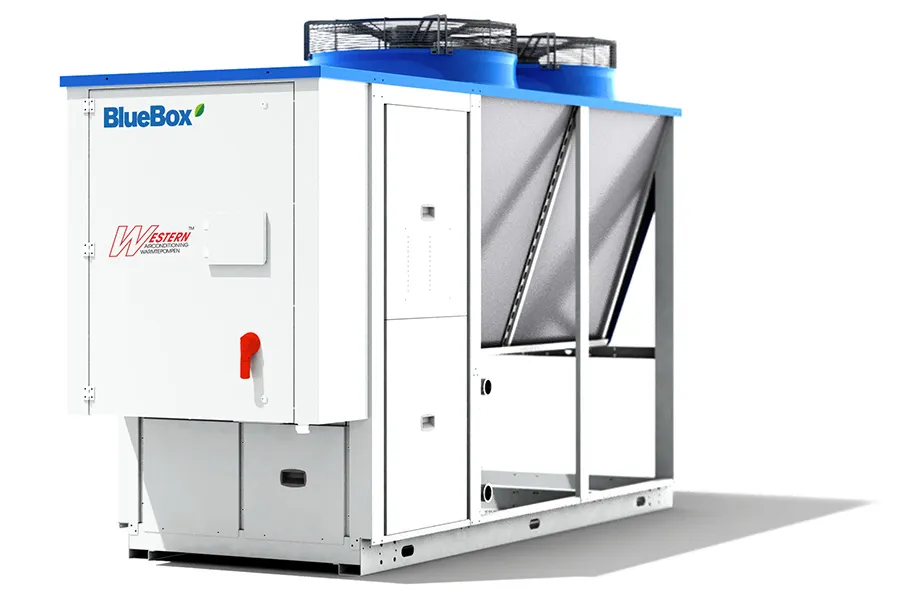
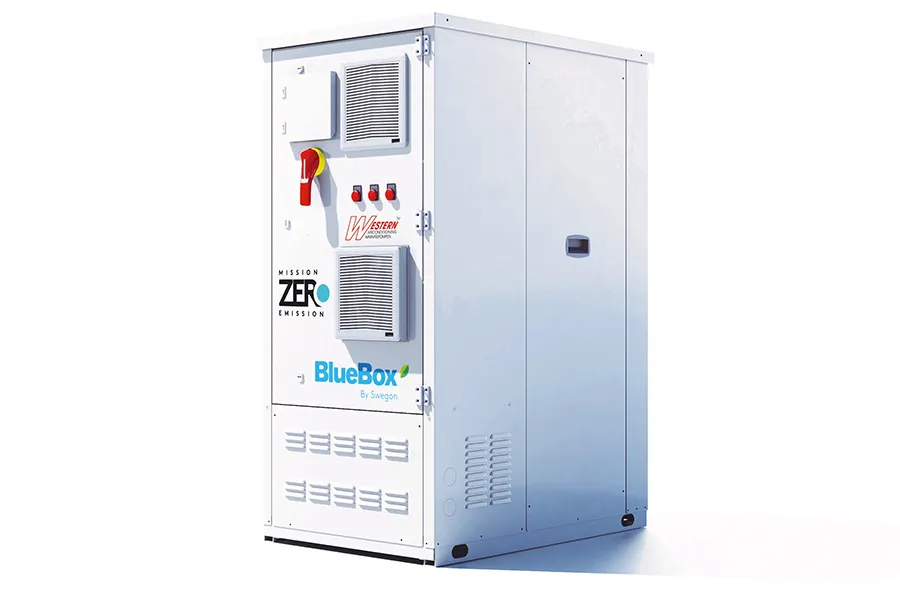
Those choosing Western Airconditioning’s propane heat pumps and chillers can now select from fifteen (!) products, in a range of configurations and designs, all Eurovent-certified. The range includes air-to-water and water-to-water heat pumps with heating capacities from 6 to 120 kW, as well as air-to-water and water-to-water chillers with cooling capacities from 16 to 200 kW. “Our water-to-water heat pumps for indoor installation are also unique, and can be installed outdoors if required,” says Dijksma. “This means we can offer a suitable propane solution for every situation.”
Overcoming the challenges
Switching to propane is not straightforward, stresses Hans van Nes, Account Manager at Western Airconditioning. “First, you have to consider the flammability of the refrigerant. However, because propane is safely contained within the HVAC equipment, users have nothing to worry about. Carefully engineered component designs and leak detection systems reduce the risk of fire or explosion to an absolute minimum. However, measures do need to be taken when manufacturing, installing and servicing propane heat pumps and chillers. A separate production line must be set up for propane units, and service and maintenance technicians must be trained to work with natural refrigerants (ACB certification). We took on this challenge 5-6 years ago, so we are now well placed to provide customers with comprehensive support in this area.” The final challenge with propane is component availability, Dijksma concludes. “The market for R290 compressors is still small. Fortunately, that is changing too, allowing us to build increasingly impressive product ranges.”
Question about this story? Ask your question
Keep following this
Get an email when a new story is published. No account needed.
- ThemeGas-free heating and cooling
- SubjectHeat pumps