‘Ingenious climate system at IKC Triade makes optimal use of waste heat’
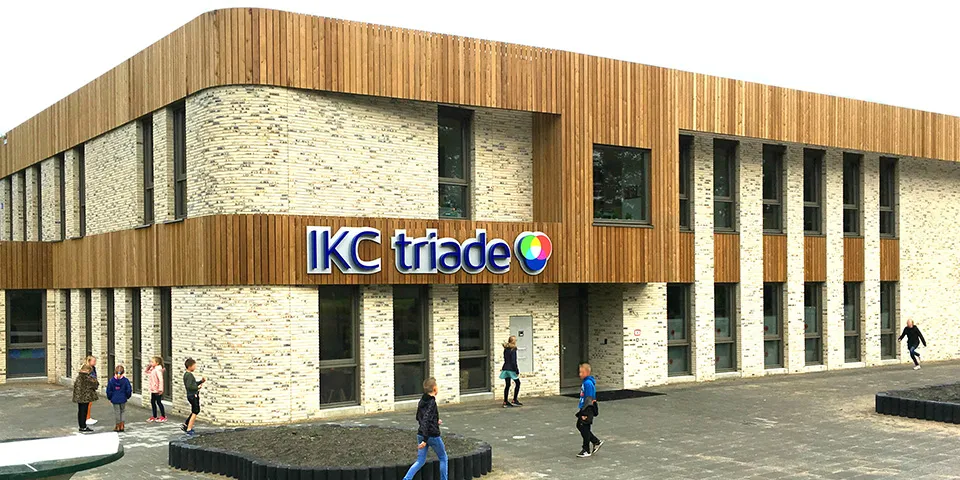
Triade is the new education and childcare centre for children aged 0 to 12. Since 22 August 2019, the Integrated Child Centre (IKC) has been housed in a completely new building on Dreef in Aalsmeer, which is also the municipality’s most sustainable school building. This is thanks not only to the installation of solar panels and LED lighting, but above all to its ingenious heating system, which uses waste heat from the nearby NLDC datacenter Aalsmeer (formerly KPN).
The IKC brings together primary school Triade, run by the Jong Leren foundation, and Solidoe Kinderopvang, offering education and childcare under one roof. Alongside classrooms with flexible workspaces, the building has large areas where children can collaborate, work independently, learn through discovery and play. A large kitchen and studio workspaces are also provided to encourage the children’s creativity. Extensive glazing creates an optimal visual connection between the different spaces and gives the building an open, transparent character.
Architect Huub Frencken from Maastricht designed the new building. Curvers Raadgevende Ingenieurs was responsible for the building services design. “The tender called for a high-quality new building in accordance with the Building Decree (general areas) and the Programme of Requirements for Fresh Schools, class B (classrooms),” says Marco Severens, Building Services Project Manager at Curvers Raadgevende Ingenieurs. “We added cooling to this. To meet the required energy performance, schools are increasingly well insulated nowadays. This can lead to classrooms overheating, not only those with extensive glazing, but also when a ventilation system blows warm outside air indoors during the summer months.”
Connection to the district heating network
Curvers Raadgevende Ingenieurs investigated various options for supplying heat and cooling, including connecting to the district heating network. “The municipality of Aalsmeer planned to build a district heating network using waste heat from the NLDC datacenter Aalsmeer,” says Severens. “Last year, a closed-loop pipe network was installed in the district, connecting the datacenter, IKC Triade, swimming pool de Waterlelie and potted plant exporter Fertiplant. While the IKC uses the datacenter’s waste heat during the winter months, in summer it supplies additional heating capacity. This heat is used to heat the swimming pool. Any surplus heat is removed by the datacenter’s cooling system.”
He emphasises that the district heating network is highly sustainable. “The system operates steadily throughout the year and has a very high source temperature. This means the IKC can be heated in winter using very little electricity, while only a small amount of energy is needed to cool the building in summer. The system is highly efficient and, as the district heating network was a pilot project, it was also very attractive financially.” Severens expects such systems to become increasingly common in the future. “It is one of the few solutions that can help us meet our climate targets.”
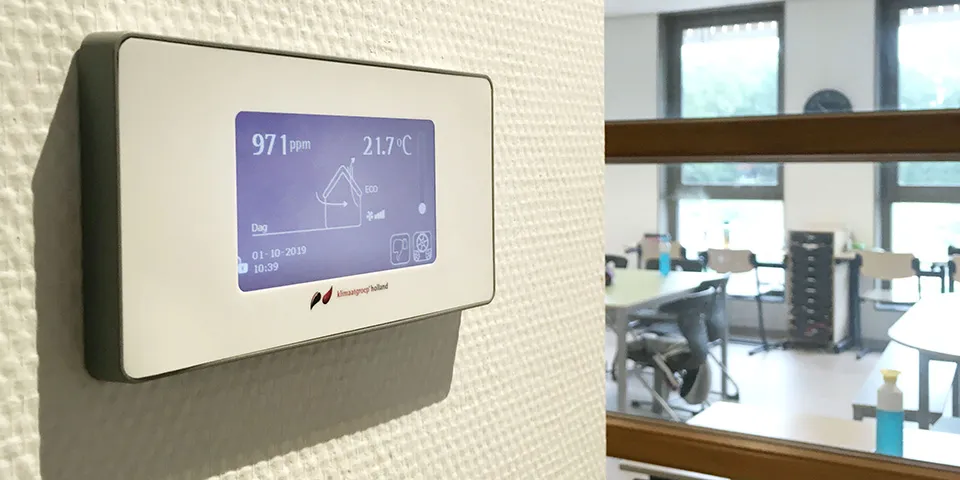
All Comfort˚Plus units are easy to operate using a wall-mounted control panel.
Indirect heat exchange
“Heat and cooling are exchanged in a counterflow heat exchanger (TSA) on the ground floor,” says Janwillem Kooij, Project Manager at Schulte & Lestraden. “A plate heat exchanger was chosen to ensure efficient heat exchange, without the water flows in the heating network and internal distribution network coming into contact with each other.”
The total building services contractor from Lisse was responsible for the design and installation of the complete climate control system, from the TSA through to the internal distribution systems, heating, cooling and ventilation systems, and their associated controls and regulation. “We fitted out a plant room on the school’s rooftop, with two water-to-water heat pumps and their associated reversing units. The heat distribution system comprises air handling, underfloor heating and floor cooling in the communal areas, combined with Klimaatgroep Holland’s lightweight, decentralised Comfort˚Plus Scholen°Concept in the classrooms. These all-in-one units integrate ventilation, cooling, heating, dynamic heat recovery and free night cooling. In addition, each classroom can be climate-controlled independently, fully on demand and based on CO2 levels and temperature.”
Klimaatgroep Holland supplied a total of 26 units, says director Harry Vaatstra. “Fresh outdoor air is drawn in through various façade grilles, concealed behind the timber façade louvres. As well as providing ventilation, this outside air is also used to cool the rooms for free. Active cooling is only switched on when the outside temperature rises above the indoor temperature, helping to significantly reduce energy consumption.”
Efficient and quiet in operation
According to Kooij, choosing the Comfort˚Plus Scholen°Concept was an easy decision. “The climate concept was not only specified in the tender documents, it is also highly energy-efficient.” Severens adds: “The Programme of Requirements for Fresh Schools, class B, targets a CO2 level of around 800 ppm. This requires approximately 1,000 m³/h of air in each classroom, which the Comfort˚Plus Scholen°Concept provides perfectly. As the spaces are climate-controlled using positive pressure, the temperature is also distributed evenly. A pressure relief damper in the system ensures that only excess, used air is discharged outside. This makes it possible to guarantee an airflow of 1,000 m³/h with very low electrical power consumption. With just one supply fan per unit, they are not only very quiet in operation but also highly energy-efficient. The units are also very compact, making them easy to install within the building.”
All Comfort˚Plus units are easy to operate using a wall-mounted control panel. Klimaatgroep Holland’s control centre continuously monitors and manages the current status of the units.
The climate control system was connected to the heat network in early September. Before then, IKC Triade had already been using the heat pumps and ventilation units to cool the building. “This went without a hitch,” says Tom Houtkamp, Facilities Officer at the Jong Leren foundation. “After all, we had no heating demand at the time. The system proved its worth during the extreme heat last summer. We are therefore looking forward to the coming winter, when we will also be able to test the heating of the spaces thoroughly.”
Have a business enquiry for Klimaatgroep Holland? Get in touch
Who worked on it
Triade in Aalsmeer
- Comfort˚Plus units
 Klimaatgroep Holland
- architectHuub Frencken
- installatieontwerpCurvers Raadgevende Ingenieurs
- full-service installerSchulte & Lestraden
Keep following this
Get an email when a new story is published. No account needed.
- ProjectTriade
- SubjectHVAC
- CompanyKlimaatgroep Holland
- CompanyHuub Frencken
- CompanyCurvers Raadgevende Ingenieurs
- CompanySchulte & Lestraden