











‘Prevent contamination in your heating, cooling and refrigeration systems’
Tap water is pH-neutral and ideal for drinking. However, its quality makes it less suitable for use in heating, cooling and refrigeration systems. Corrosion is a real risk. To prevent this problem, the tap water in the system must be deoxygenated as quickly as possible.
During the so-called deaeration process, the water’s pH value rises, meaning that lime particles can no longer dissolve. The released lime particles settle at the bottom of the system, resulting in extensive sludge formation. This can lead to a significant loss of efficiency, as well as faults and failures in valves, regulators, pumps and other advanced components. To prevent this, KOREX Benelux advises installers to connect an AIR-SEP® pressurisation unit to heating, cooling and refrigeration systems as soon as possible.
Use in central heating systems
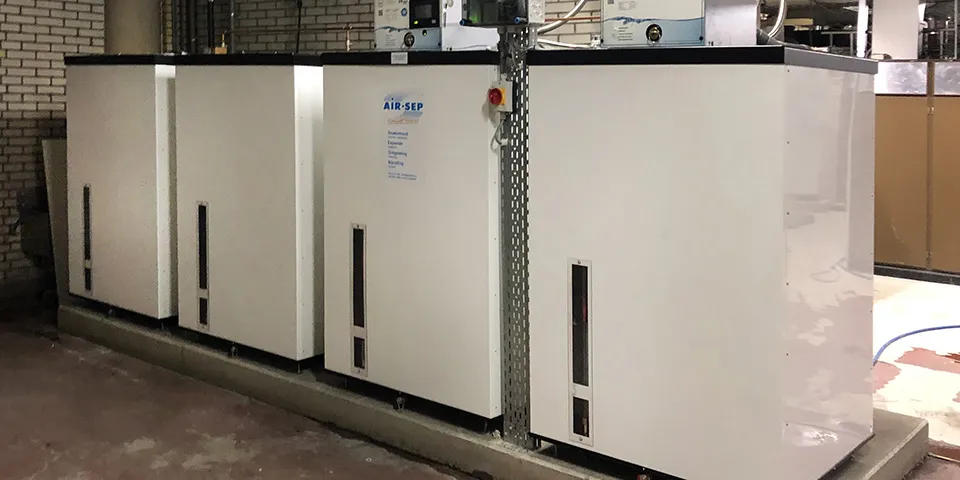
AIR-SEP® pressurisation units enable all the key water treatment processes in your central heating system to be carried out with a single unit. These include fully automatic pressurisation and air venting, vacuum degassing, expansion, dirt collection, cleaning and topping up with vacuum-degassed water. AIR-SEP® units are suitable for hot-water temperatures up to 110°C. Each unit can accommodate an expansion volume of up to 2,400 litres of water. “However, as AIR-SEP® units can be linked indefinitely in a cascade, higher capacities are also possible,” says M.G. van Gorsel, Managing Director of KOREX Benelux. “The system can be tailored precisely to the size of the central heating installation. This is particularly useful for district heating systems, for example.”
Chemicals are still widely used in the industry to neutralise the oxygen present in central heating systems. This often results in an unstable system, with dirt build-up and corrosion posing a risk. According to Van Gorsel, AIR-SEP® tackles this problem once and for all. “AIR-SEP® consists of an expansion tank with an inlet valve, air vent valve, automatic filling unit and pressurisation pump, which removes air bubbles from the pipework. The pressurisation pump draws between 5 and 20 litres from the system at a time, then returns it to the AIR-SEP® vessel through the inlet valve. The pressure is reduced here to a vacuum of up to -0.3 bar. A patented vacuum technology reduces the air content by 28 to 40 mg/litre compared with installation water that is 100% saturated. This raises the pH value, keeps the protective oxide layers in the system intact and prevents air and dirt from separating out. Continuous pressure monitoring keeps the system pressure at the optimum level and, as a result, maintains the higher pH. Instead of degassing the water periodically, the degassing intervals and run times are adjusted to the current status of the system.”
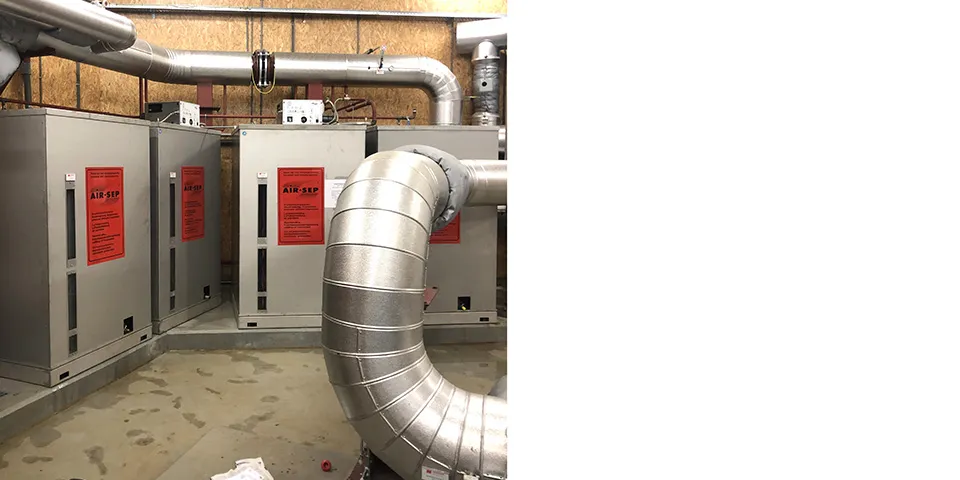
AIR-SEP® pressurisation units enable all the key water treatment processes in your central heating system to be carried out with a single unit.
Connection to cooling and refrigeration systems
In cooling and refrigeration systems, up to 30% air can dissolve in the water, leading to increased corrosion pressure, rust and dirt build-up, and substantial efficiency losses. “AIR-SEP® pressurisation units provide a suitable solution here too. The units can be supplied with full vapour-proof insulation, with high-quality vapour insulation fitted to all AIR-SEP® components that come into contact with the cooling water. Installers can choose between two grades: ISO 1 (18 mm vapour insulation, suitable for water temperatures down to 6°C) or ISO 2 (39 mm vapour insulation, suitable for water temperatures down to -10°C). The vapour insulation prevents corrosion caused by condensation inside the unit.”
Cooling and refrigeration systems are regularly filled with glycol (antifreeze), Van Gorsel notes. “Our AIR-SEP® pressurisation units are fully compatible with it. The units can also be fitted with an automatic glycol/brine filling unit, if required.”
Integration into combined systems
To ensure an even pressure distribution between your heating and cooling systems, prevent overflow at user level and minimise energy losses, it is advisable to connect an AIR-SEP® to your heating and cooling systems. AIR-SEP® provides efficient degassing and pressure maintenance for the combined system. Two pairs of pressure sensors and separate ball valves are installed between the AIR-SEP®, the high- or low-temperature network (HT/LT) and the chilled-water system (GKW). “The ball valves are controlled by a freely programmable microprocessor control system, which also fully automatically regulates and monitors pressure maintenance and air venting, vacuum degassing, expansion, dirt collection, cleaning and topping up with vacuum-degassed water in both systems,” says Van Gorsel. “The pressure sensors continuously measure the pressure in the systems. If there are any deviations, when the pressure is too high or too low, the ball valves are activated automatically and the system pressure is restored.”
KOREX Benelux AIR-SEP® pressurisation units have been used successfully in heating, cooling and refrigeration systems throughout Europe for more than 30 years. Applications include apartment buildings, hotels, hospitals, schools, cultural centres, office buildings, district heating projects and industrial projects.
Een zakelijke vraag aan KOREX Benelux? Get in touch
Companies in this story
Keep following this
Get an email when a new story is published. No account needed.
- ThemeFuture-proof water and sanitary systems
- SubjectHVAC
- CompanyKOREX Benelux







