Remeha takes part in first project using 100% hydrogen-fired boilers
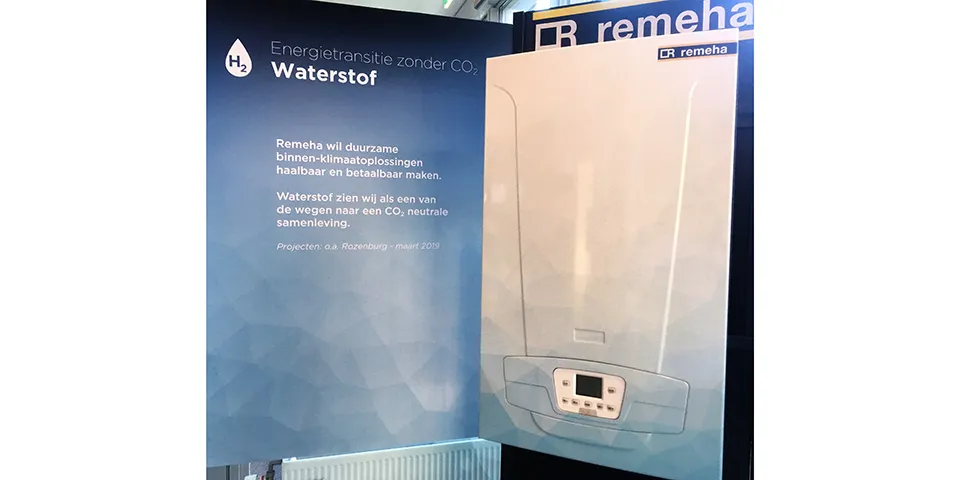
Soon, a number of households in the Rotterdam sub-municipality of Rozenburg will heat their homes with hydrogen instead of natural gas. The trial will be the first in the Netherlands to test boilers running on pure hydrogen. Remeha is one of the project partners and is supplying a boiler with a specially designed burner that can use hydrogen as fuel.
The energy supply in the Netherlands will change dramatically over the coming years. As we ultimately phase out the use of fossil fuels entirely, we will need to switch to sustainable energy sources. Alongside sustainably generated electricity, sustainably produced hydrogen and synthetic gas also offer excellent potential. To explore that potential, a trial of boilers running on 100% hydrogen is starting in Rozenburg. The project was initiated by network operator Stedin and is supported by Remeha, Bekaert Heating, DNV GL, the municipality of Rotterdam and housing association Ressort Wonen.
No CO2 emissions
This is the first time high-efficiency boilers running on 100% hydrogen have been used in the Netherlands. The partners involved will test them in practice, working together with residents. If the trial is successful, hydrogen-fired heating systems could make an important contribution to the country’s climate targets. Unlike natural gas, burning hydrogen produces no CO2. The by-products of a hydrogen-fired boiler are oxygen and water.
Expansion of an earlier pilot
The hydrogen trial builds on the existing Power2Gas project in Rozenburg. To date, synthetic natural gas has been produced here to heat an apartment block owned by Ressort Wonen. From May, the partners plan to use green electricity to produce hydrogen locally. Stedin will transport this hydrogen through a separate gas network to the apartment block’s boiler house. From there, appliances supplied by Remeha and Bekaert Heating will heat some of the homes. DNV GL is responsible for the safety of the installations and infrastructure being installed.
Collaborative research
There is as yet no experience of producing, distributing and using hydrogen on a large scale. For this reason, the network operators in the Netherlands want to run a number of pilot projects, inviting market players such as Remeha to take part. Remeha believes that the future energy supply will comprise a mix that accommodates different energy carriers. Hydrogen could play a significant role, particularly in existing buildings. Together with sustainably produced synthetic gas, hydrogen has the potential to make homes and buildings more sustainable in a highly cost-effective way.
Making energy carriers more sustainable
According to Marco Bijkerk, manager of innovative technologies at Remeha, the question of sustainability is not about whether to use electricity, gas or heat. “It is about choosing the technologies that deliver the greatest CO2 reduction. At times, it seems as though we are arguing about the energy carrier, the lorry. But we are not looking at what the lorry is carrying. It does not matter which carrier supplies our energy, because we can make all of them clean.”
Making use of our gas network
“The major challenge is storage. Can we store energy for a season or six months? That is only possible with molecules. Hydrogen is one option, but synthetic gas is another. One major advantage is that we already have a highly efficient gas infrastructure in place. It is so extensive that scrapping it would be a waste, especially if that meant having to invest heavily in upgrading our electricity network. Transporting energy via the electricity network is ten times as expensive as transporting it via the gas network. The gas network is our greatest asset. We just need to make sure that hydrogen or gas is produced using sustainable sources.” Research by Kiwa has already shown that the existing natural gas distribution network can be adapted to transport hydrogen. Historic city centres, with their many listed buildings that are difficult to insulate and therefore far less suitable for all-electric systems or connection to a heat network, are obvious applications.
Grey, blue and green hydrogen
Hydrogen is not an energy source but an energy carrier. Industry already produces thousands of tonnes of hydrogen by splitting natural gas, a process that releases CO2. This hydrogen is known as ‘grey’ hydrogen.
If the CO2 released in this process is captured and stored underground, it is known as blue hydrogen. Industry has put forward this variant at the Climate Tables, as it is a method that could be implemented in the short term. However, many civil society organisations have doubts about whether underground CO2 storage is desirable or feasible. The best method is to produce hydrogen using wind or solar power, in which case it is known as green hydrogen. In a hydrogen wind turbine, a modified turbine uses sustainably generated electricity to split water into hydrogen and oxygen through electrolysis. Thanks to the different characteristics of this type of turbine, it can produce more hydrogen for economic reasons than a conventional wind turbine can supply in electricity. Green hydrogen is essentially wind and solar energy in gaseous form.
Have a business enquiry for Remeha BV? Get in touch
Companies in this story

Keep following this
Get an email when a new story is published. No account needed.
- SubjectHVAC
- CompanyRemeha BV