











Rules of thumb for choosing the right heat pump
Choosing between a boiler and a heat pump is not straightforward for many installers. So how do you select the right heat pump? Vaillant has developed a set of rules of thumb to give installers greater certainty and confidence.
Even in 2016, horror stories about incorrectly sized heat pumps and homes that fail to warm up put many installers off recommending a heat pump, says Sander Rutten, Head of Product Marketing & Training at Vaillant Nederland. “For many installers, a boiler is still the safest option. A boiler is always a good fit. Heat pumps are a little more complicated, especially if you opt for an all-electric system.”
Ground-source or air-source heat pump?
The use of heat pumps has gathered pace in recent years, he says. “New-build homes in particular are ideal for heating with a heat pump. We generally recommend ground-source heat pumps for these properties. At low temperatures, these heat pumps are much more efficient because the source/ground temperature remains around 10˚C. They can also provide passive cooling.”
Installing a ground-source heat pump is often not desirable in renovated homes. This is not only because the garden would have to be dug up, but also because the heat demand is higher, requiring a larger system and greater investment. “In these cases, a hybrid air-source heat pump is a good solution. Peak demand and domestic hot water heating are met by a condensing boiler,” says Rutten.
Home heating capacity
To determine the capacity required for a home, Vaillant has developed a handy tool that shows the estimated capacity in kW at -10 ˚C for each property type and year of construction. The table shows that a poorly insulated mid-terrace house built in 1970 has a heat loss of 130 watts per m². A comparable home built in 2000 needs around 60 watts, less than half that capacity. Semi-detached houses need around 25 per cent more, while detached homes need around 40 per cent more. A detached house of 170 m² built in 2000 therefore requires a heating capacity of around 170 m² x 60 W/m² x 1.4 = 14 kW.
For a hybrid heat pump system, Rutten recommends sizing the system to provide 50 per cent of the required capacity. “This can meet 85 per cent of the total heat demand. So for that detached house built in 2000, you would need an 8 kW hybrid heat pump.”
Payback period
Vaillant has also devised a rule of thumb for calculating the exact savings. “Multiply peak demand by the average of 1,600 operating hours per year to get a good indication of annual consumption in kWh,” says Rutten. “Homes built from 2000 onwards typically have underfloor heating with a flow temperature of 35˚C. In that case, you can assume a COP of 4.5 for a Vaillant heat pump. Divide the heating capacity (85 per cent of the total capacity) by the COP and multiply the result by the current electricity price to calculate your electricity costs. You can do the same calculation for gas consumption.”
The detached house built in 2000 uses around 1,600 h x 14 kW = 22,400 kWh/year for heating, he says. “If 85 per cent is supplied by the air-source heat pump, the electricity costs are 22,400 kWh/year x 85 per cent / 4.5 X € 0.22 = € 930. The same amount of heat would have cost around 22,400 kWh x 85 per cent / 10 kWh/m³ x € 0.65 = € 1,238 using gas, giving annual savings of € 300. Add the government’s ISDE grant and the air-source heat pump pays for itself in five to seven years.”
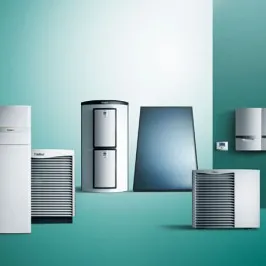
Although Vaillant made its name with gas water heaters and boilers, the company has also been developing and manufacturing heat pumps for many years. Its range is extensive, with 3 to 15 kW hybrid and all-electric air-source heat pumps, and 5 to 45 kW all-electric ground-source heat pumps, together with matching buffer tanks and cylinders. Vaillant has developed a certification and training programme specifically for installers, helping them meet the necessary knowledge, skills and government requirements, including those relating to heat pump sizing. “Our rules of thumb help installers make a sound initial estimate,” says Rutten. “Our Project Advice department is then happy to help with a detailed calculation, ensuring that the right heat pump is installed.”
Question about this story? Ask your question
Keep following this
Get an email when a new story is published. No account needed.
- ThemeGas-free heating and cooling
- SubjectHVAC







