











Start flushing!
Text Lieke BousemaImage KOREX Benelux
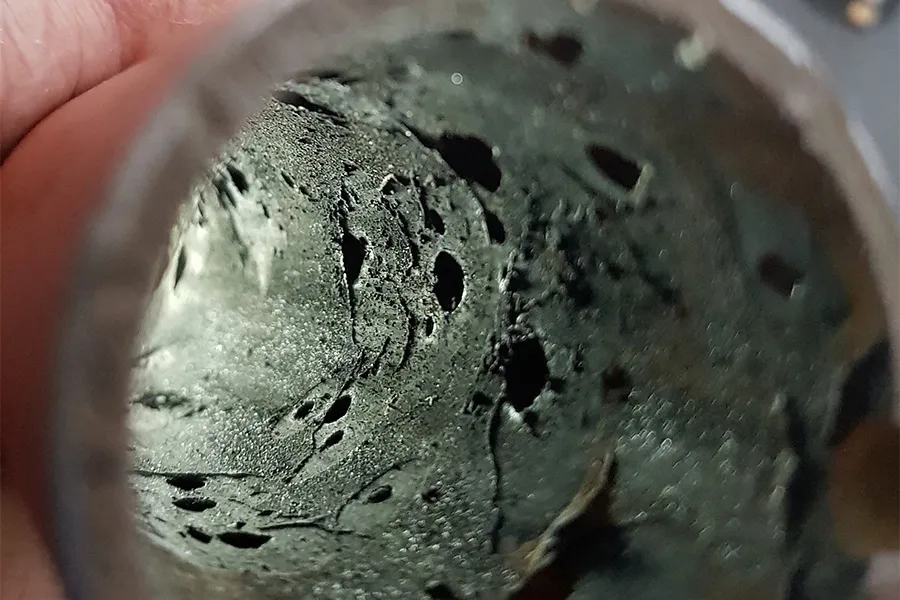
Prevent efficiency problems, comfort complaints and damage caused by construction debris, limescale and corrosion
Energy efficiency and sustainability are high on the agenda of almost every organisation, placing specific demands on our buildings and installations. “Water quality and water treatment in our heating systems are an essential part of this”, says Mario van Gorsel, director of KOREX Benelux. “Only when the system water is treated correctly from the moment the system is commissioned can efficiency, comfort and service life be brought up to the highest possible level. Our new filling and filtration trolley has been specially developed for this purpose and is already attracting considerable interest.”
Van Gorsel identifies several causes of contamination in heating system water. The first is limescale (calcium carbonates) in tap water, which enters the system during filling. “Tap water generally has a pH value of 7.0 to 7.5 and a hardness of 8 to 13 German degrees (˚dH). In areas with hard water, such as Overijssel, South Holland, North Brabant and Limburg, however, hardness can reach as much as 13˚dH! Because limescale contains a lot of CO2, the pH value of the heating water is constantly neutralised. This increases corrosion pressure, resulting in significant losses in efficiency and comfort.”
Corrosion of metal components
While limescale tends to build up on the heating element, pipes and valves in the heating system, air (oxygen) plays a key role in the corrosion of metal components. “Until a few years ago, around 90% of heating systems were made of steel. At the time, oxygen reacted with almost the entire surface of the system”, says Van Gorsel. “The oxygen effectively consumed the steel, automatically reducing corrosion pressure. Now that more and more systems are made of plastic or other materials, and the proportion of steel has fallen to just 10 to 30%, corrosion pressure on the remaining steel components is increasing. If appropriate measures are not taken, for example, connecting pipes can quickly become sacrificial anodes. In this case, the steel oxidises continuously, with all the consequences that entails.”
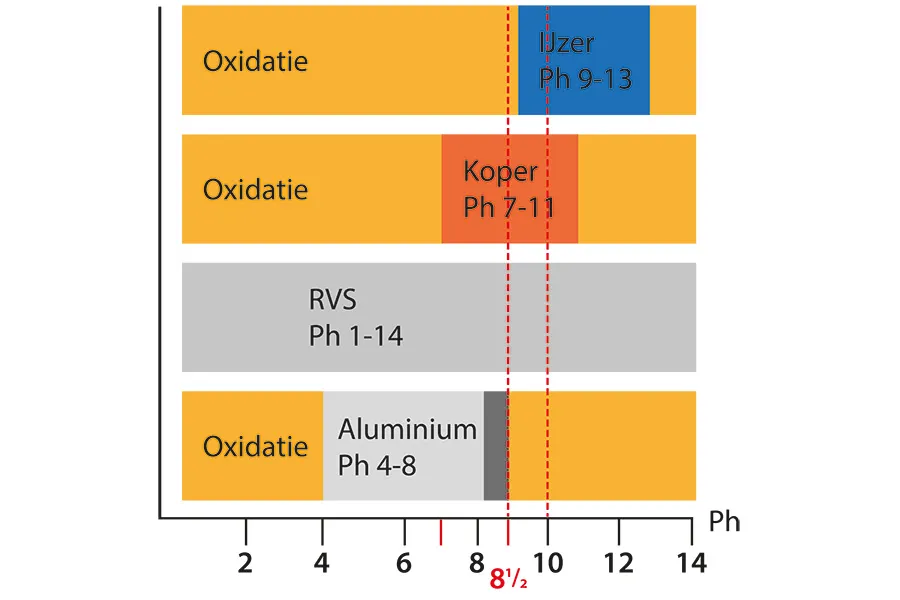
To prevent steel corrosion, Van Gorsel recommends keeping the pH value above 9-10 in closed systems. Unless the heat exchanger in the boiler or heat pump is made of aluminium. “In that case, the pH value must not exceed 8.7, as this could lead to aluminium corrosion. It is a particularly challenging balance, requiring careful advice and water treatment.”
Careful flushing and filtration
Careful flushing and filtration are the basis of this water treatment. “Flush the system as thoroughly as possible and use the right filters. For example, to remove all the construction debris and sludge that gets into the connecting and riser pipes during construction as quickly as possible”, Van Gorsel stresses. “This includes everything from dust and sand to welding beads, welding flux, grease and microfibres, all of which can seriously impair system performance and service life. Careful flushing and filtration can effectively remove this debris. In addition, filling the system as much as possible with soft (softened) water at 3˚dH helps bring the pH value to the correct level as quickly as possible.”
Innovative filling and filtration trolley
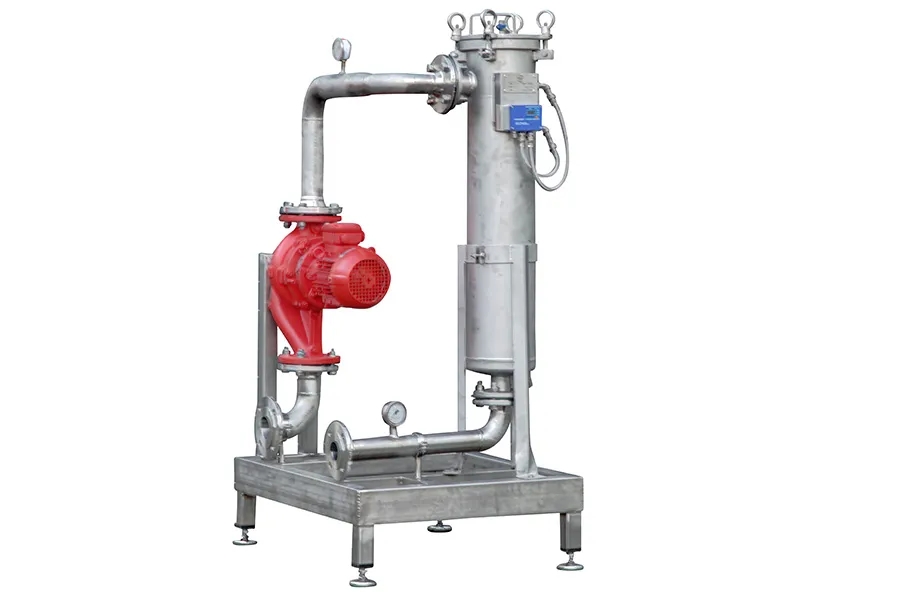
KOREX Benelux has developed a unique filling and filtration trolley for this purpose, complete with a side-stream filter, powerful magnet, variable-speed pump, protected 400V control cabinet, two pressure gauges, and a drain and vent valve. A programmable differential pressure gauge and dosing pump are available as options. Everything is mounted on a wheeled stainless-steel skid, making it easy to move the trolley to the right location in the building. The skid also fits perfectly in a standard service van. “The filling and filtration trolley is equipped with certified Snap-Lock hoses and couplings that are chemically resistant. It also has additional connections for a water softener”, says Van Gorsel. “Users can choose between two filter housings (up to 4,500 cm2). Filtration is also available at various grades, from 200 to 1 μm.” The filter has a stainless-steel housing as standard. “This means it cannot become magnetised, for example when powerful magnets are used to capture even the smallest metal/magnetite particles.” A unique feature is the heavy-duty internal basket, which can be filled with water-softening resin if required. “Variable-speed control ensures effective flushing and rapid refilling.”
Compliant with VDI 2035
KOREX Benelux’s new filling and filtration trolley enables installers to carry out water treatment in full accordance with the German VDI 2035 standard. Among other requirements, this standard stipulates that water in closed circuits must be colourless and odourless, free of sediment, and have a conductivity of ≤ 1,500 μS (depending on the size of the system).
Een zakelijke vraag aan KOREX Benelux? Get in touch
Companies in this story
Keep following this
Get an email when a new story is published. No account needed.
- ThemeFuture-proof water and sanitary systems
- SubjectHVAC
- CompanyKOREX Benelux







