











Sustainable, efficient ventilation units exceed ErP requirements
Text WOLF Energiesystemen and Lieke BousemaImage WOLF Energiesystemen
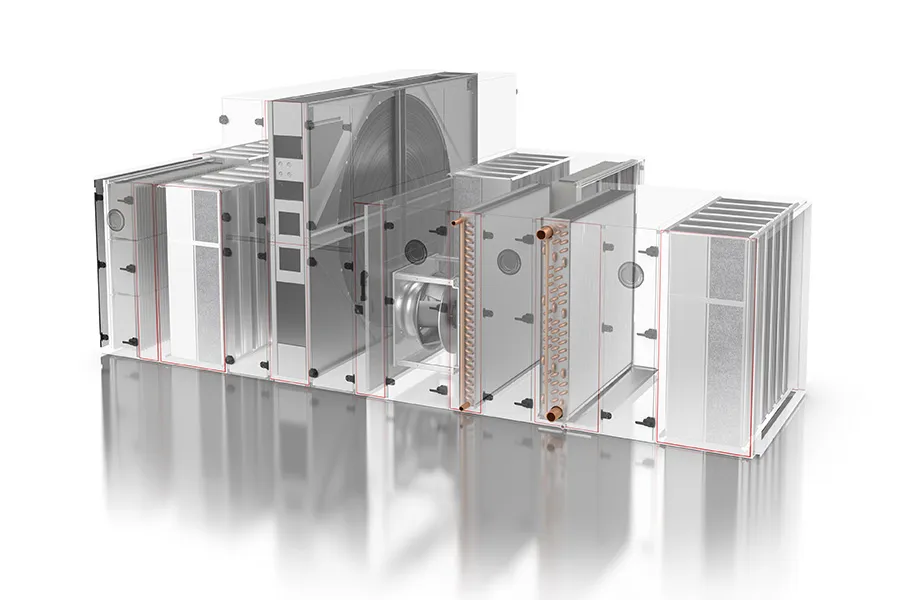
When it comes to the economic efficiency of ventilation units, investing in sustainable, efficient technology pays for itself many times over. “The low energy consumption and small carbon footprint are particularly striking,” says Tom Melching, Technical Adviser at WOLF Energiesystemen. “The operating costs of a unit designed to the WOLF standard are considerably lower than the minimum requirements of the ErP Directive.”
When supplying buildings with fresh air, the applicable standards and guidelines must be taken into account, as must environmental considerations. “Keeping energy consumption for ventilation and air conditioning as low as possible helps to reduce both CO2 emissions and costs,” says Melching. “After all, around 90% of a ventilation unit’s total CO2 emissions occur during operation.”
Significant savings potential
ErP Regulation 1253/2014/EC applies to the environmentally friendly design of ventilation systems. “The WOLF ventilation unit exceeds these requirements,” says Melching, backing up his claim with an example. He compares a WOLF unit in an existing office building in Munich with a hypothetical unit that just meets the current ErP Directive. “Compared with a basic unit that meets the ErP requirements, the WOLF unit offers potential savings of 41% in electricity consumption and 7.9% in heat recovery. This not only has a positive effect on CO2 emissions, the additional investment in energy-efficient technology also pays for itself very quickly.”
In the Munich project, the existing leased space on the 1st floor had to be expanded to create an office and event space for up to 800 attendees. This required an additional air handling unit and a new duct distribution network for the existing unit on the roof. “A total airflow rate of 22,000 m³/h (external pressure: 500 Pa) was required. Due to space constraints, the unit had to be installed in a plant room on the 3rd floor of the building, and the ductwork and associated equipment had to be relocated within the building.”
Low air velocity
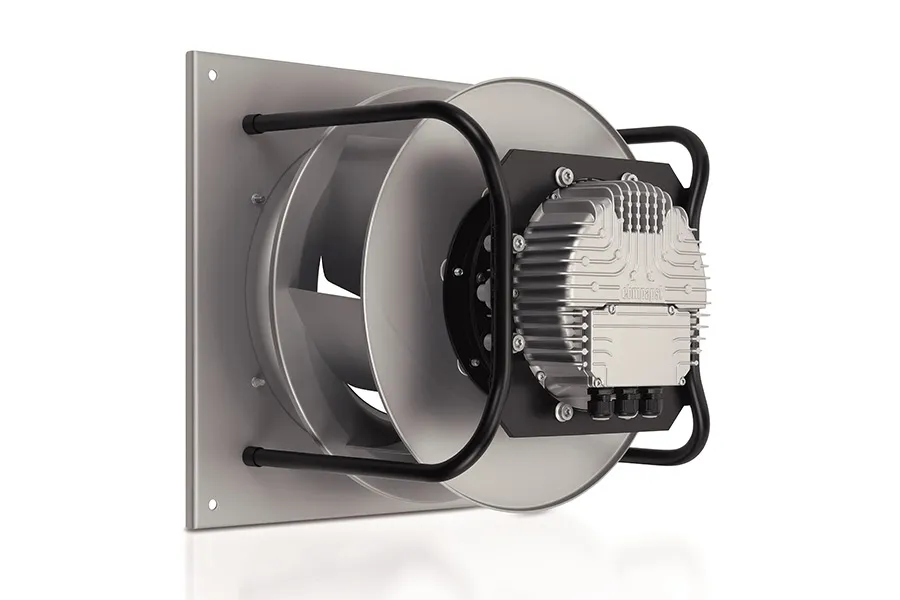
To keep the fans’ electricity consumption as low as possible, the air velocity in the unit is low. This is achieved, for example, by using a larger casing cross-section. “A more compact unit would have generated higher air velocities. Although it would certainly have met the ErP Directive specifications, this would have had an adverse effect on all the other components in the unit. The pressure drops across the individual air handling components, such as the heat exchanger, filter and HRU system, increase at higher air velocities, leading to higher fan electricity consumption.”
Rotary heat exchanger
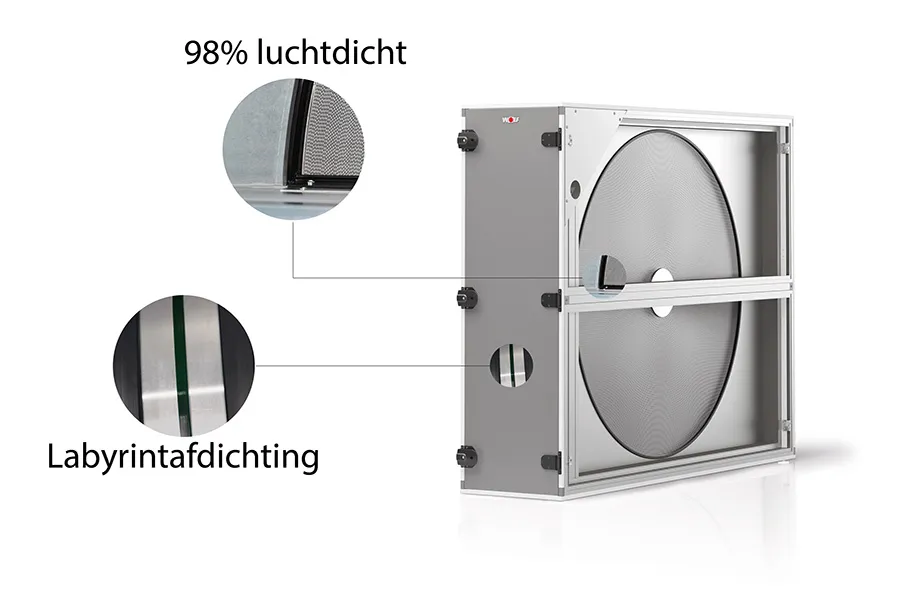
A highly efficient rotary heat exchanger with low leakage was selected for heat recovery. “The sealing system is not positioned at the side of the rotor, but rotates with it. Several sealing fins on the wall provide a high degree of tightness against the rotating section. Combined with central seals using the WOLF SuperSeal labyrinth seal, this achieves a tightness of 98%, compared with conventional models with a leakage rate of around 10%. In this case, additional air volumes must be factored into the fan design for supply and extract air in accordance with VDI 3803/5. This increases the fans’ energy consumption.”
High heat recovery
The heat recovery capacity of the unit described above is 116 kW (ErP: 108.6 kW), and its heat recovery efficiency is 78% (ErP: 73%). “This represents a saving of 7.9%, or 8.2 kW, compared with the ErP value,” says Melching. “With 5,000 operating hours per year, the WOLF unit saves 41,000 kWh of thermal energy through heat recovery alone. In terms of heating oil consumption, this is equivalent to a saving of around 4,180 litres of heating oil, or around 11 tonnes of CO2 equivalent. At a purchase price of 0.80 euros per litre of heating oil, this results in annual savings of 3,344 euros. Without increases in CO2 prices or other price rises, this amounts to total savings of at least 66,880 euros over 20 years.”
High savings potential
The electricity consumption figures are also impressive, according to Melching. “Instead of the 950 W/(m³/s) stipulated by the ErP, only 561 W/(m³/s) per year is needed here. That is just 59% of the reference value. The saving amounts to 389 W/(m³/s), or 2.38 kW. Extrapolated over one year, this totals 11,900 kWh for 5,000
operating hours. At an electricity price of 0.40 euros, the saving amounts to 4,760 euros or 5.18 tonnes of CO2 equivalent. This is equivalent to the average electricity consumption of 3 households of 4 people. Over 20 years, without inflation adjustment or CO2 pricing, this amounts to at least 95,200 euros.”
Adding up the annual operating costs, the technically optimised WOLF unit delivers a remarkably high total savings potential of 162,000 euros or 323.60 tonnes of CO2 equivalent. The break-even point for the additional investment in the more efficient unit is therefore reached after about a year, or much sooner if the number of operating hours per year is higher or energy prices rise. The calculation above does not include the positive effect of intelligent controls. In practice, consumption can therefore be reduced further through demand-controlled operation based on room occupancy.
A business enquiry for WOLF Energiesystemen? Get in touch
Companies in this story
Keep following this
Get an email when a new story is published. No account needed.
- ThemeHealthy indoor air
- SubjectHVAC
- CompanyWOLF Energiesystemen







