











Valve insulation following a personal survey
Office buildings, schools, hotels, swimming pools, municipal buildings and care centres consuming 25,000 m³ of natural gas and/or more than 50,000 kWh of electricity are required to report energy-saving measures to the government. Since 1 July 2019, their managers and owners have had to report through RVO.nl’s eLoket which energy-saving measures have been implemented.
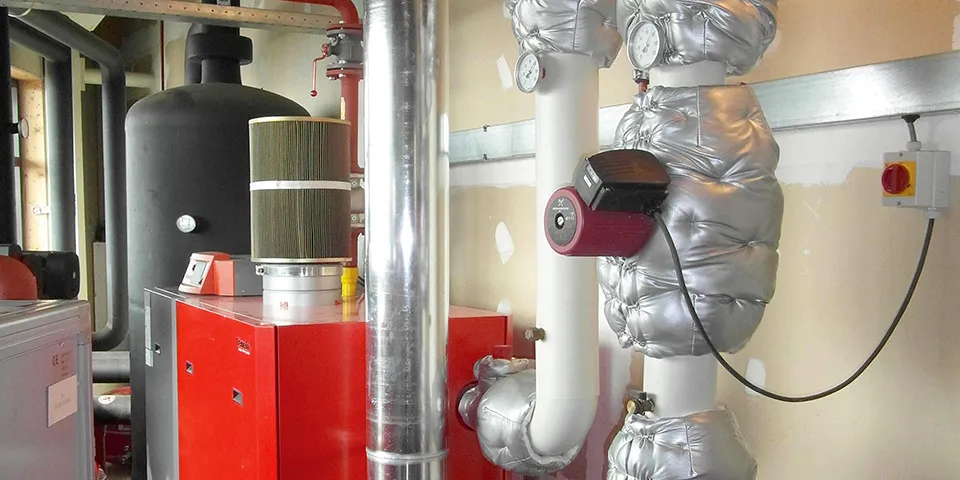
The starting point should be the List of Recognised Energy-Saving Measures (EML) for the relevant business sector (see right). One of the recognised measures is insulating central-heating and domestic-hot-water valves. “In the past, all the pipes in central-heating systems were properly insulated, but the valves were often forgotten. This was considered too difficult or not worthwhile. As a result, many buildings still have heating systems that are inadequately insulated, or not insulated at all,” says Alexander Norder, Managing Director at Thermatras. Norder explains what this means in practice: “The heat loss from a flange is equivalent to 0.5 m¹ of pipe. For a valve, that is equivalent to approximately 1.5 m¹ of pipe. For a small system comprising two central-heating boilers and a central-heating manifold with, for example, 34 fittings, avoidable heat loss of around 2,670 m³ of natural gas during continuous operation is not unusual. This is equivalent to around €1,600.”
Heat loss without insulation on fittings.
Detailed proposal
Depending on operating hours, the payback period will be between 2 and 4 years. Thermatras® specialises in measuring, manufacturing and installing thermal insulation in the form of insulation jackets. “Over the past 27 years, Thermatras® has demonstrated to many organisations that insulating fittings pays off,” Norder continues. “It is meticulous work, and our staff are highly skilled at it. We only start once we have personally surveyed the system in question, either directly or on behalf of the building’s installer or consultant. This enables us to produce a detailed specification of the fittings to be insulated
, including a photographic report and a firm cost proposal. We calculate the payback period using the correct operating hours and energy price. This makes it clear to our customers why valve insulation pays off. Naturally, we also manufacture and install the bespoke insulation jackets.”
List of Recognised Measures
Businesses with high electricity and/or gas consumption are required to implement energy-saving measures that pay for themselves within five years. The Activities Decree sets out the relevant criteria. Businesses consuming more than 50,000 kWh of electricity and/or more than 25,000 m³ of gas are generally required to comply. One way to do so is to follow the List of Recognised Measures (EML), available at www.rvo.nl. The government developed the recognised-measures system to help businesses meet the reporting requirement, which came into force on 1 July 2019. For nineteen business sectors, the government has assessed how energy can be saved cost-effectively. An EML has been established for each sector under the Activities Decree. The competent authority (municipality or province) checks whether businesses have met this requirement.
Question about this story? Ask your question
Keep following this
Get an email when a new story is published. No account needed.
- ThemeSustainable refurbishment of existing buildings
- SubjectHVAC







