First: KPN launches trial with 11,000 connections
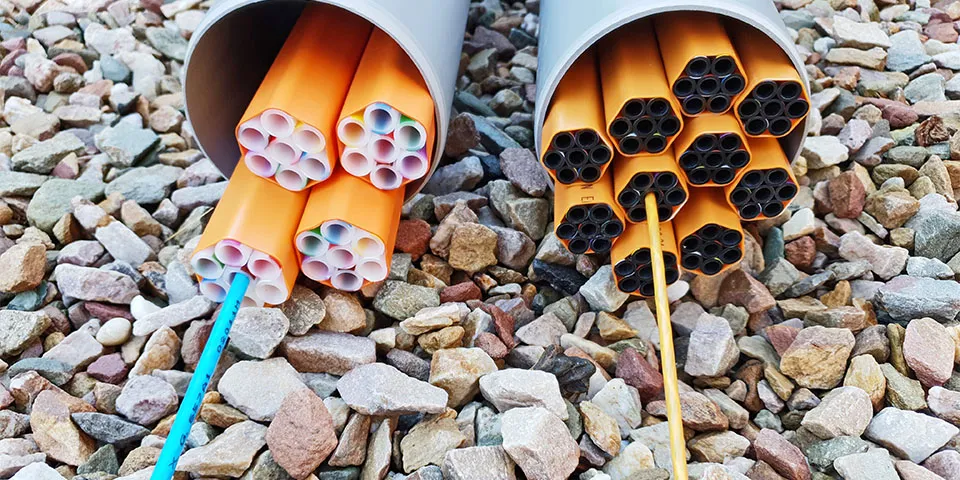
Prysmian Group has developed a unique cable concept for fibre-optic networks. The innovation includes both new fibre-optic cables (Sirocco HD) and ducts (Easenet) with a smaller diameter than conventional cabling. This reduces the total volume of plastic (PE) used and makes fibre-optic network construction more sustainable and efficient. In September, KPN will begin a trial involving the installation of 11,000 connections.
Prysmian cable concept makes fibre-optic network construction more sustainable
As the world’s largest cable manufacturer, Prysmian has ambitious sustainability goals and a track record of leading innovation. “This new development paves the way for telecoms companies and data centres to make infrastructure network construction more sustainable,” says Commercial Director Telecom Benelux Erik van den Oever, describing the new cable concept. As Prysmian supplies complete networks as a system integrator, it has developed thinner ducts alongside its new Sirocco HD (High Density) fibre-optic cables, working with suppliers. Both types of product are manufactured in Europe and available as standard.
Unique collaboration
Following internal development, the new cable concept was tested in a greenfield environment under the leadership of VolkerWessels Telecom. The test was carried out through a unique, open and equal collaboration between KPN, contractors Van Gelder Telecom and Allinq, and Prysmian. This collaboration helped accelerate the cable concept’s market launch and acceptance.
Much more efficient
The tests showed that the new products make fibre-optic network construction much more efficient at almost every stage of the process. “For example, our cables and ducts can be used in the design phase without modification or additional design costs, and fully comply with existing specifications,” says Van den Oever. “Their smaller diameters also mean that much longer lengths can be wound onto a reel, allowing transport, storage and packaging to be optimised significantly.”
The same workforce and equipment can also be used to lay more ducts and fibre-optic cables, while generating less waste. This also reduces disruption for the surrounding area. For example, fewer roads need to be dug up because the smaller volumes fit more easily into existing ducts. Less excavation is also required at network aggregation points, leaving less sand to be removed and processed. “Overall, we see many opportunities for our customers to optimise fibre-optic network construction in several ways, enabling them to connect more premises each year.”
Even more sustainable
Prysmian needs around 50 per cent fewer raw materials (plastic or PE) to manufacture the new cables and ducts than it does for conventional cabling. In addition to this direct saving, there is an indirect environmental benefit: Prysmian manufactures the ducts from more than 90 per cent high-quality recycled PE. These savings immediately reduce CO2 emissions and ultimately (at end of life) the volume of waste.
Prysmian also expects savings in logistics, storage and packaging materials to deliver a further reduction in CO2 emissions. This will be evaluated in a real-life test for KPN. “The strength of the new cable concept lies in the combination of all the features mentioned above,” says Van den Oever.
The cable concept also closely aligns with the United Nations’ Sustainable Development Goals (SDGs), says Frank Middel, Sustainability Officer at Prysmian. “By using significantly less material to deliver the same functionality, we contribute to SDG #12 (responsible consumption). Its innovative approach to telecoms infrastructure contributes to SDG #9 (innovation and infrastructure). And by reducing costs, we make telecoms infrastructure construction accessible to many more cities and communities, in line with SDG #11 (sustainable cities and communities). After all, digital communication is now an integral part of our society and our world.”
First for KPN
KPN is the first telecoms company in Europe to use Prysmian’s new cable concept to connect its customers. The sustainability leader in the telecoms sector has agreed to trial the concept in two existing residential areas, Buitenpost and Nijmegen-Dukenburg, with 2,000 and 9,000 connections respectively. The trial will use 4.5 mm fibre-optic cables and 10 mm ducts, compared with 6 mm and 14 mm respectively for conventional cabling. Van den Oever says KPN will be the first: “This is the first real life test in existing residential areas and the first time the new cable and duct have been used together.”
Question about this story? Ask your question
Keep following this
Get an email when a new story is published. No account needed.
- SubjectBuilding services engineering