Room sensors and control modules for a healthy indoor climate
Sensors account for around 0.08% of a building’s total climate control installation investment. For end users, however, clean, healthy indoor air is worth much more. An investment in sensors therefore pays for itself quickly. Especially when you choose the new room sensors and control modules from Belimo Servomotoren B.V. “Our latest products closely monitor indoor air quality and can be seamlessly integrated into existing building management technology,” emphasises Danny de Laater, Manager Technical Support at Belimo. “They also stand out for their sustainability, design and simple individual configuration via the app. We even won a Red Dot Design Award for them.”
Measurement and control technology as the human body
To explain how measurement and control technology works, De Laater often uses the human body as a metaphor in schools. “The student gets to play neurologist for a while,” he says. “The building management system/controller is the brain, while the Belimo actuators are the patient’s movable arms and legs. Temperature, relative humidity and pressure sensors are like the nerves in our hands and feet, which enable us to feel.” For VOC and CO2 sensors, De Laater points to the senses in the nose and mouth, which allow us to feel, taste and smell. “All our senses and nerves are connected to the brain via the spinal cord. In measurement and control technology, this spinal cord is formed by the ‘communication bus’, such as Modbus, BACnet or the Belimo MP-Bus.”

Compact, elegant housing
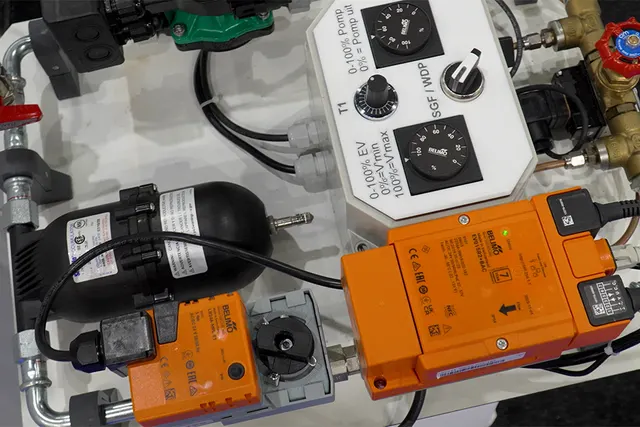
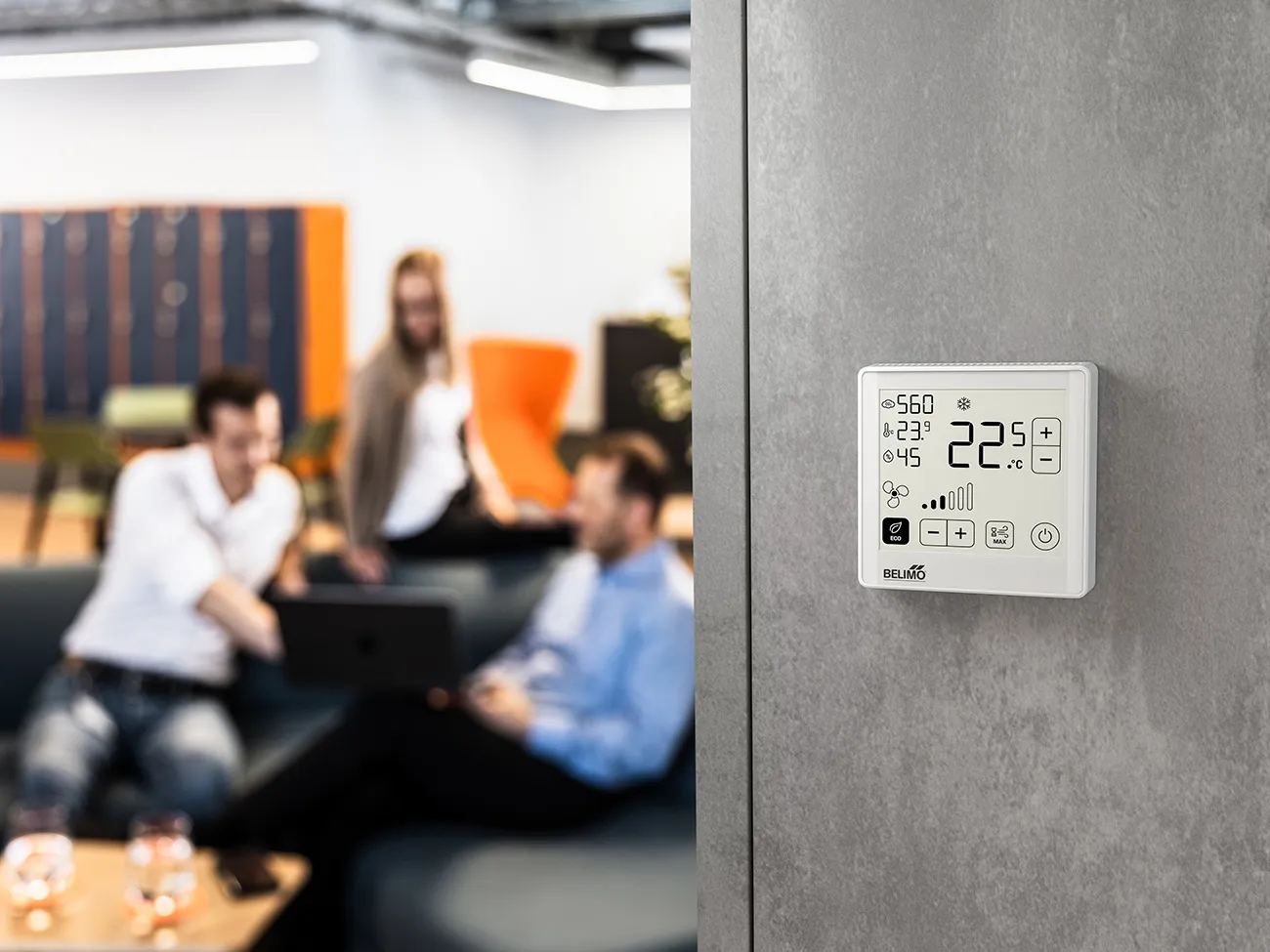
With its P-22RTM-1900D-1 room control module, Belimo has managed to use a single module to measure the current readings (status) from our arms, legs, nose and mouth. The room control module combines three sensors in one compact, elegant housing. “Depending on the configuration, this allows us to measure three values at once: temperature, relative humidity and CO2. Dew point monitoring is also integrated into the module,” says De Laater. “By integrating the systems, we help meet the sustainability ambitions of a growing number of clients. After all, fewer materials and plastics are needed. The Belimo MP-Bus also delivers substantial savings on cabling.” The P-22RTM-1900D-1 was recently expanded to include this communication bus. “As a result, instead of three cables, each with two cores, only one two-core cable per controller is needed to connect to the building management system. Hardware connections and analogue inputs in the control cabinet are no longer required either.”
Freely programmable
The P-22RTM-1900D-1 room control module has a modern, premium look and is freely programmable. “This means there is one standard version that can be configured entirely to suit the user’s requirements,” says De Laater. “Would you like to display only the measured values? No problem. And do you want fan control or not? You can set it easily using the Belimo Assistant App.”
Insight into indoor air quality
Belimo’s latest room control module can measure CO2 levels from 0 to 2,000 PPM. “Measured CO2 levels are becoming increasingly important when it comes to indoor air quality,” De Laater emphasises. “That is hardly surprising, given that we spend around 90% of our time indoors and breathe in approximately 12,000 litres of air every day. When the CO2 level in this air is too high, fatigue, headaches and loss of concentration can result. To address this, our government decided in February that every classroom in primary and secondary education must have a CO2 meter. CO2 meters are also being installed increasingly often in workplaces, to provide insight into current indoor air quality. Are levels within the recommended limits? When is ventilation needed?”
Belimo’s new room control module helps with this. “The controller not only sends the measured value automatically to the controller, but also displays the measured PPM value in the building management system and on the room display,” says De Laater. “As users do not always know what this PPM value means, it is accompanied by a traffic-light LED, in green, yellow or red. Green means the PPM value in the room is acceptable, yellow means improvement, through additional ventilation, is advisable, and red means immediate action is required.”
Automatic self-calibration
According to De Laater, the mandatory installation of CO2 meters in rooms is a good initiative. But users still have more to do. “CO2 sensors are subject to deviations caused by ageing components. To address this, the unit must be recalibrated regularly or replaced. Belimo CO2 sensors come with Dual Beam technology as standard. This ‘dual-channel technology’ enables automatic self-calibration, unlike the one-sided ABC-Logic sensors that are often used. Manual calibration is no longer necessary.” The self-calibration technology is ideal, for example, for spaces that are in use 24/7, such as hospitals and industrial environments.
Short-range connectivity
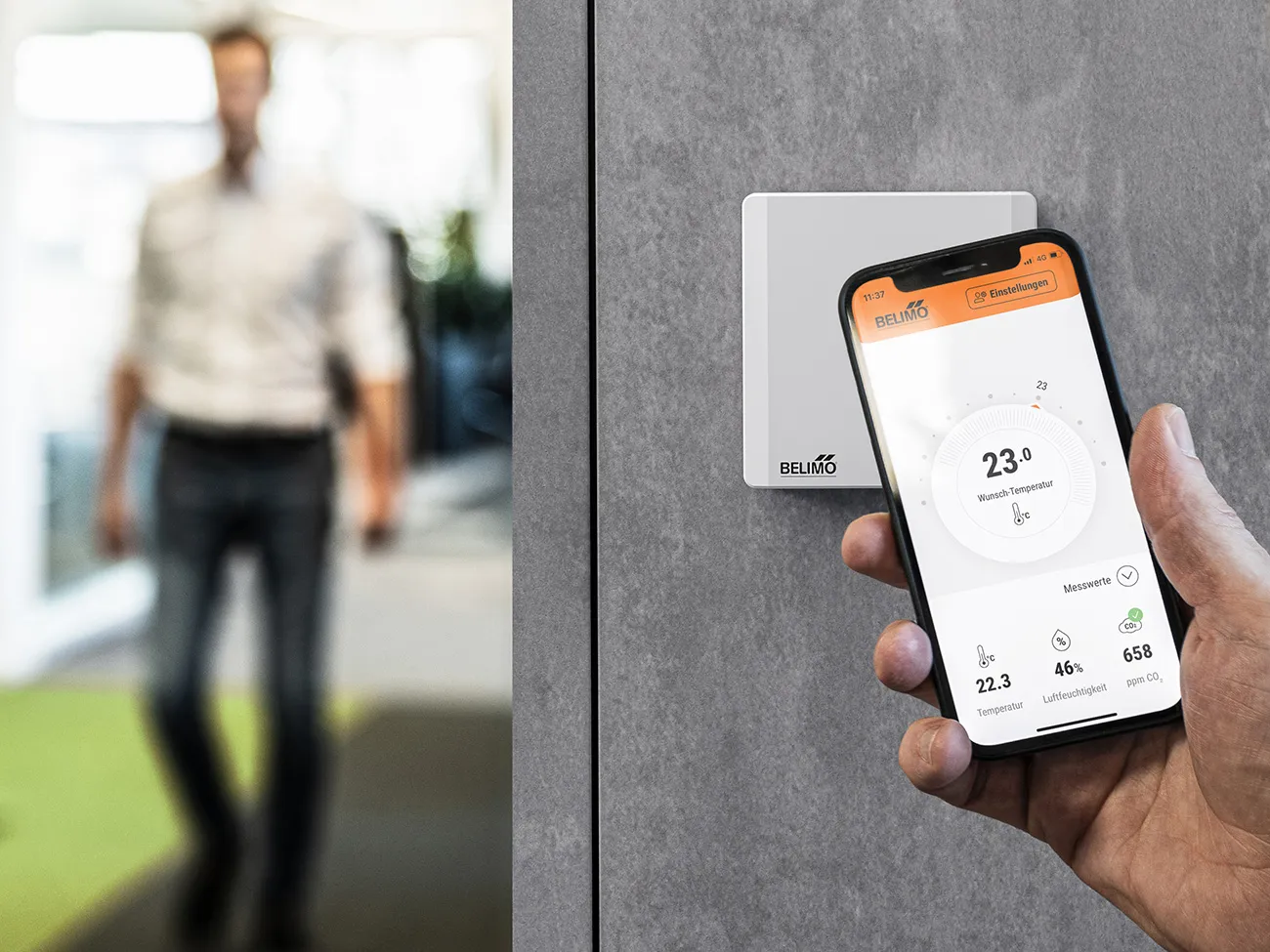
The P-22RTM-1900D-1 room control module also features NFC (Near Field Communication) technology, De Laater emphasises. “This means settings can be easily accessed and adjusted using the Belimo Assistant App. The app also allows service technicians to view the installation live. A trend log of all measurements can be generated in the building management system. What has happened in a room over the past day, week or month? Are there any deviations in, for example, temperature, relative humidity or CO2? This information can be used to take appropriate action and maintain a good indoor climate.”
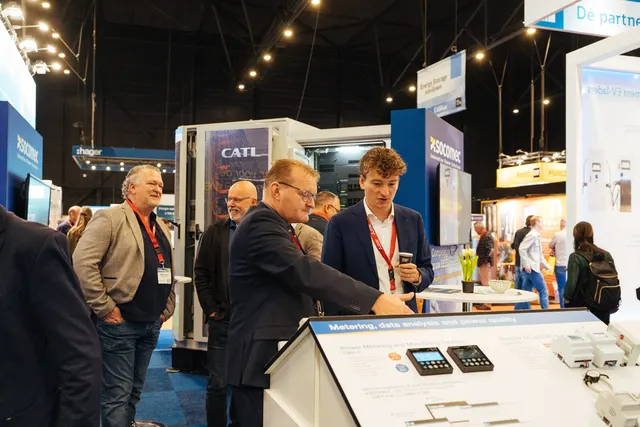
Curious about Belimo’s latest room sensors, control modules and other products? Visit the Installatie Vakbeurs in Hardenberg from 13 to 15 September. You’ll find Belimo at stand 178.
A business enquiry for BELIMO? Get in touch
Companies in this story

Keep following this
Get an email when a new story is published. No account needed.
- ThemeHealthy indoor air
- SubjectBuilding services engineering
- CompanyBELIMO