When installation space is limited…
Text WOLF Energiesystemen and Lieke BousemaImage WOLF Energiesystemen

Established ventilation range expands with new airflows and comfort features
When it comes to deciding where to install a heat recovery ventilation unit, smaller buildings and individual spaces often present the same challenge: there is very little technical space available. At the same time, indoor air quality requirements in these often busy areas are comparable to those in larger buildings. Peter Hofstetter, Technical Training Consultant at the WOLF Campus in Germany, explains in this article why compact central heat recovery ventilation units with rotary heat exchangers are the ideal solution for combining comfort and efficiency in these situations.

What requirements do GP surgeries, nurseries, care homes and, of course, small and medium-sized office buildings place on ventilation systems?
“What these buildings have in common is that they bring together large numbers of people. It is important to prevent them from becoming infected with pathogens through the indoor air. At the same time, ventilation must be demand-controlled, energy-efficient and comfortable, without draughts, while ensuring a steady supply of fresh air and the removal of ‘used’ air enriched with CO2. Limited space for building services is no reason to rule out efficient ventilation technology, however. Compact units with rotary heat exchangers are an excellent choice, both for new-build projects and renovations.”
Why choose a rotary heat exchanger?
“Heat exchangers are generally used to transfer heat from the extract air to the fresh supply air. This recovers more than eighty per cent of the heat energy, so it does not need to be supplied again by a heat generator. This can significantly reduce operating costs, while also meeting the requirements of the Heat Act and nearly zero-energy building standards. On hot days, it also prevents the indoor air from warming up quickly as a result of hot outdoor air. A rotary heat exchanger has the added benefit of positively influencing humidity levels. For example, in a sorption rotor configuration, cold, dry outdoor air is humidified by moisture in the extract air, creating a pleasant indoor climate. In summer, the effect is reversed, drying the usually humid outdoor air.”
What are the main benefits of a compact heat recovery ventilation unit?
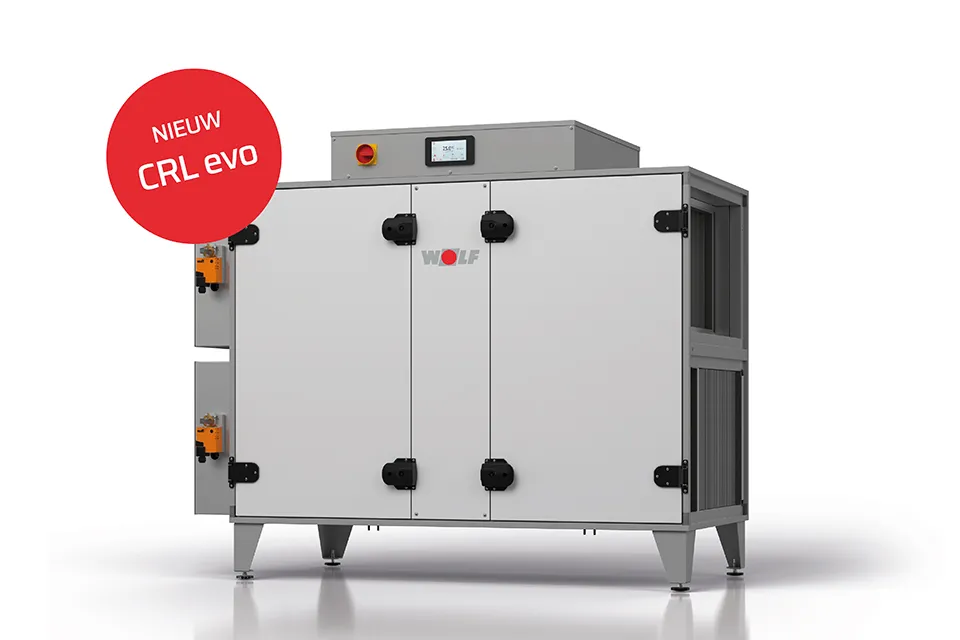
“One notable feature of WOLF’s Eurovent-certified CRL evo range, for example, is its fine-grained selection of airflows from 1,300 to 4,900 m3/h, which means there is a suitable unit for every requirement. Clients therefore do not have to compromise on airflow capacity, but can always choose the right model. Another benefit of the fully wired, plug & play units is that installation work is kept to a minimum. The unit is supplied ready to connect, minimising any disruption to other work. This is a major advantage, particularly for renovations. The intelligent controls enable high outdoor air volumes to be delivered on demand, while the range operates very quietly. The CRL evo is also exceptionally hygienic, thanks to its appropriate filtration.”

Planning and installation also require less effort. “To ensure straightforward installation, CRL evo units for indoor installation with an airflow capacity of 4,200 m3/h and above are modular in design.” The same
airflow capacity range and configuration are also available in a weatherproof version for outdoor installation.
What’s new with the CRL evo?
“We have selected the right rotary heat exchanger for every application. Six models are available in the 1,300 to 4,900 m3/h range. Each model offers a choice of three rotor types, namely condensation, enthalpy and sorption rotors, with different sealing options. This makes it possible to provide highly specific humidity control for all capacities, for both indoor and outdoor installation.”
Active temperature control of the supply air can also be configured individually, with both water-based cooling and heating modules and integrated electric heating modules available. “The Clima-split version for units installed outdoors is available as an optional compact solution on a base frame. The CRL evo can also be expanded with additional external modules, for example for filtration and climate control, to increase the relevant performance range.”
As sustainability remains a key issue in the air handling sector, WOLF offers an optional Green Steel version for all its products, significantly reducing the carbon footprint of production. “The focus on efficiency also includes the use of a labyrinth seal and a fully featured control system with the option of comprehensive energy monitoring.”
A business enquiry for WOLF Energiesystemen? Get in touch
Companies in this story
Keep following this
Get an email when a new story is published. No account needed.
- ThemeHealthy indoor air
- SubjectBuilding services engineering
- CompanyWOLF Energiesystemen