











Communal heat pumps & grid congestion: smarter decarbonisation with STIEBEL ELTRON
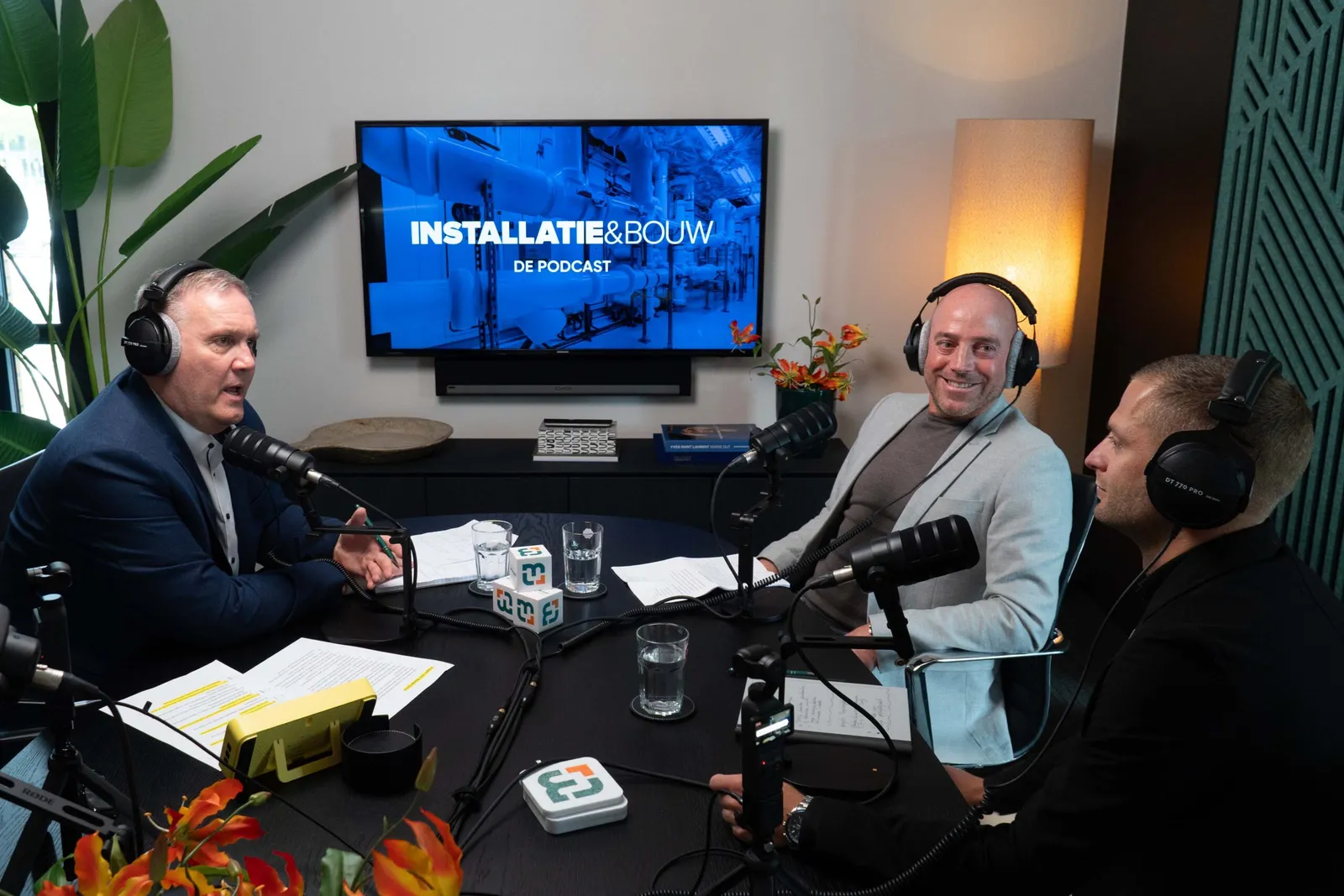
In conversation with Jerry Spanjaard and Pim Snoek
Host: Jerry Helmers
How can we tackle grid congestion, lack of space and rising energy demand in housing? In this episode of Installatie & Bouw, host Jerry Helmers talks to guests Jerry Spanjaard and Pim Snoek of STIEBEL ELTRON about communal heat pump systems, sustainable building services and the future of high-rise construction. From apartment blocks and homeowners’ associations to property developers and installers, this episode shows why communal heating solutions are becoming increasingly important in the energy transition.


Een zakelijke vraag aan STIEBEL ELTRON Nederland B.V.? Get in touch
Full transcript
All chapters (23)
- Introducing the episode and guests
- Sustainable car-sharing on the way to the studio
- Statements on communal heating and the energy transition
- Getting to know Pim Snoek
- Pim Snoek’s background
- First encounter with STIEBEL ELTRON
- Jerry Spanjaard’s background
- The biggest challenges in the market
- Communal solutions versus individual heat pumps
- Why communal heating should be the starting point
- Communal systems and the role of engineering
- The government’s role in communal heating
- Is the market embracing this concept?
- How does a communal installation work?
- Fewer faults and easier maintenance
- Projects in Zeist and Epe
- Building knowledge at STIEBEL ELTRON
- Practical tips for property developers
- Practical tips for installers
- Practical tips for owners’ associations
- Practical tips for building services consultants and architects
- 90 seconds of fame
- Reflections on the podcast and closing
Introducing the episode and guests
Jerry Helmers Welcome to Installatie & Bouw, the podcast for the Dutch installation and construction sectors. My name is Jerry Helmers, and I’m presenting this episode. I’m delighted to be doing so, because joining me in the studio here in Weert today are Jerry Spanjaard, business developer at STIEBEL ELTRON, and his colleague Pim Snoek. Also, not entirely coincidentally, a business developer at the same company.
Jerry Helmers Gentlemen, welcome. Was the journey to Weert a good one? Where have you come from today?
Sustainable car-sharing on the way to the studio
Jerry Spanjaard I’m from Vlaardingen, and Pim and I drove here together from Breda.
Jerry Helmers That’s what we call sustainable car-sharing. Absolutely, absolutely. Look, you’ve already scored your first points on this podcast.
Jerry Spanjaard Already earned, yes.
Jerry Helmers Very good. But we’ll get to know you both better in a moment. First, though, I want to know: who in particular should listen to this episode, and why should people tune in? Can you make any promises already?
Pim Snoek I think so. Apart from my mother and sisters, of course. What we think is really important is that we’re a German heat pump manufacturer, so we work closely with installers. But the project starts much earlier than that. We’re often involved with the architect, building services consultant and property developer too. And in renovation and existing buildings, we work with housing associations. Homeowners’ associations looking to make their existing homes more sustainable are also part of the picture. All those people and organisations should listen.
Jerry Helmers And why should they keep listening? I’ll turn to the other Jerry now. Why should they keep listening?
Jerry Spanjaard Everyone in the construction supply chain faces certain challenges. One of them is the energy available on site. We need to think carefully from the outset about how to accommodate that. The technology is continuing to develop, so that’s not the problem. The problem is that we’re facing limits on the energy available. We can no longer provide enough energy everywhere to ensure every household in the Netherlands can operate as it should.
Jerry Helmers I assume we’ll also be talking about grid congestion and so on.
Jerry Spanjaard Absolutely.
Jerry Helmers So all those parties you mentioned who are running up against problems with grid congestion should keep listening. That’s the message, basically.
Jerry Helmers Well, we’ve made some pretty big promises. But I’m also especially curious about the solutions you’re going to offer.
Read the full transcriptCollapse transcript21 chapters remaining
Statements on communal heating and the energy transition
Jerry Helmers Before I introduce you properly, or rather, before you do that yourselves, I’d like to put a few statements to you. You can answer ‘agree’ or ‘disagree’. And it’ll be fun if the two of you don’t see eye to eye on them.
Jerry Spanjaard That does happen from time to time.
Pim Snoek Yes, definitely.
Jerry Helmers OK, I can already feel the chemistry building here. Here’s the first statement. Are you ready? Here goes. In high-rise construction, communal heating should more often be the starting point. Jerry, agree or disagree?
Jerry Spanjaard Agree.
Jerry Helmers And what does Pim say?
Pim Snoek Agree.
Jerry Helmers That worked out nicely, didn’t it?
Pim Snoek Definitely.
Jerry Helmers But I’ve got a tougher one. This is one you might actually disagree on. Here goes. The government should do more to encourage communal heating systems. I’ll start with Pim.
Pim Snoek Disagree.
Jerry Helmers Disagree. And what does Jerry say?
Jerry Spanjaard Agree.
Jerry Helmers Hey, that’s really interesting. But of course, this is also a bit of a political question. Should the government take charge? Installers are increasingly becoming systems thinkers rather than product installers. Jerry?
Jerry Spanjaard Disagree.
Jerry Helmers Pim?
Pim Snoek Agree.
Jerry Helmers These are always fun podcasts, when colleagues have different views on a few things. One last statement. The energy transition will fail if residents’ comfort isn’t given enough priority. Jerry?
Jerry Spanjaard Agree.
Pim Snoek I agree with that too.
Jerry Helmers I think we’ll come back to these statements later in the podcast. Then I can sit back while you have a little debate. Or get into a discussion.
Getting to know Pim Snoek
Jerry Helmers Tell us who you are. You’ve both come to this podcast studio in Weert on behalf of STIEBEL ELTRON. What do you do at STIEBEL ELTRON, and who are you?
Pim Snoek I’m Pim Snoek, I’m 35 and I’m a business developer at STIEBEL ELTRON. I’ve been working at STIEBEL ELTRON for just over three years. Among ourselves, we usually just call it “Stiebel”.
Jerry Helmers What would you like me to call it on this podcast? Stiebel or STIEBEL ELTRON, whenever the name comes up?
Pim Snoek STIEBEL ELTRON is the full name, of course. Say whichever you like, whichever rolls off the tongue.
Jerry Helmers We’ll see how it goes. So what does a business developer do?
Pim Snoek It’s a very broad role, really. I’ve always found the title ‘business developer’ a bit awkward, but we’re in the business development department, and it covers a lot. We look for new projects across the construction supply chain. We sit down with property developers in an advisory role, looking at the options for projects that are in the pipeline, including future ones. But a business developer also does things like this: recording podcasts, taking part in webinars, and working on marketing and communications.
Jerry Helmers You host webinars yourself too, don’t you?
Pim Snoek Yes, that’s right.
Jerry Helmers And now you’re on the other side of the microphone.
Pim Snoek Yes, definitely.
Jerry Helmers Which do you prefer?
Pim Snoek I really enjoy presenting webinars too. But it’s nice to be on the other side of the table for once. I’ll have to know a thing or two about it as well.
Jerry Helmers Perhaps you can also plug those webinars at the end. They’re online.
Pim Snoek Yes, that’s right. You can find them on YouTube.
Pim Snoek’s background
Jerry Helmers Did you actually train in a technical subject? Or did you just happen to end up in this field?
Pim Snoek It’s actually quite an interesting story, because I don’t have a technical background. I trained as a supermarket manager.
Jerry Helmers A supermarket manager?
Pim Snoek Yes, that’s right.
Jerry Helmers And then suddenly you’re working with heat pumps.
Pim Snoek Well, it wasn’t quite that sudden. I started working at a very young age. I used to work at Super de Boer, which I think a lot of people still remember. I was seventeen and working full-time. I was also doing an mbo course. I did that for a few years. After that I worked briefly in the chocolate industry, but then went back to the supermarket sector, so I stayed in the same industry. But I have a lot of friends who work in the technical world. They studied construction or work in related fields. I always thought that if I could start again, I’d probably choose a technical career, because I find it so interesting. Construction, but technology too. I’ve always had an interest in it. I just never thought I could make the move from the supermarket world into technology.
Pim Snoek Through a contact, I ended up at a modular construction company. And that’s a nice part of the story, because that’s where I met Jerry. So our connection goes back further than STIEBEL ELTRON. A few years ago, I went to the Energiebeurs in Den Bosch. It’s partly a prefabrication trade fair and partly an energy fair. We had a stand at the prefabrication fair with the modular construction company. But when I went for a walk around the exhibition, I also ended up at the energy fair, where STIEBEL ELTRON had a stand.
First encounter with STIEBEL ELTRON
Pim Snoek It was towards the end of the day when I walked up to the STIEBEL ELTRON stand. It was a huge stand in the central hall at the Energiebeurs. It was basically a kind of trailer that unfolded completely, with an upper floor and everything. It looked fantastic and naturally attracted a lot of attention.
Pim Snoek I mainly knew STIEBEL ELTRON for the electric heaters widely used in modular construction, and for electric water heaters, which they’re very good at. But the chemistry and the way I connected with STIEBEL ELTRON at that stand were so special that they stayed with me. I was welcomed into the family straight away. I went over to the stand as a customer, but the rapport and the vibe within the company have always stuck with me. I think I spent two or three hours at that stand.
Jerry Helmers You don’t have a technical qualification, of course. So is it a case of learning by doing?
Pim Snoek Yes. At STIEBEL ELTRON, they really look at who you are, what you want to achieve and how you want to develop. Of course, we have lots of engineers and technical specialists, but they also give opportunities to people without a technical background. They give you really thorough training.
Jerry Helmers And before you know it, you’re a business developer.
Pim Snoek Yes, definitely.
Jerry Spanjaard’s background
Jerry Helmers Jerry, what’s your technical background? Or have you got an interesting story that began somewhere completely different?
Jerry Spanjaard Mine did indeed begin somewhere completely different. I spent twenty years as a store manager in menswear. But I could see retail changing so much that I thought we needed to move more online. I fell into that job straight out of school, and I really enjoyed it. But I could see the market changing. At the time, my current employer was still a good friend of mine. I told him that it hurt to say it, but after twenty years I was going to look around. I couldn’t see retail staying the same for the next twenty years as it had been for the previous twenty.
Jerry Spanjaard Then I took the plunge and went to work for a technical recruitment agency. Through a commercial director I knew there, I got in touch with that company. I started placing welders and metalworkers on temporary assignments in the Botlek area, mainly in tank construction and shipbuilding, that kind of work. I’d always been interested in the technical side too. But finding someone who combines commercial and technical skills is very difficult. You either get a technical person or a salesperson. Finding both in one person is hard.
Jerry Spanjaard They always used to tell me: if you enjoy technology and are interested in it, you can learn it. And I believe that too. It worked out. After that, I got in touch with the modular builder where Pim worked. We hit it off from day one. We had the same commercial mindset and were always proactive with customers. I really enjoyed that.
Jerry Spanjaard At one point, I got in touch with STIEBEL ELTRON. The warm, family-like atmosphere I experienced there was so pleasant that I thought: this is where I belong. I felt at home.
Jerry Helmers So you can become a business developer even without a technical background?
Jerry Spanjaard Exactly. At STIEBEL ELTRON, they really ask themselves: are you a good fit for our team? That’s very important. You can hire someone with extensive technical knowledge, but if they don’t fit in with the team, we’ll still want to know whether they work well with colleagues. Otherwise, it simply won’t work. In that sense, STIEBEL ELTRON has been a really welcoming place for me. We work with some great colleagues.
Jerry Helmers That’s very smart, of course, what you’re saying. With the labour market so tight, you’re making it clear that you’re probably a very good employer.
Pim Snoek There’s a great deal of expertise here too. It’s not as if everyone who works here has no technical background. But last Tuesday, we celebrated our 102nd anniversary. So our company has a tremendous amount of knowledge and history behind it.
The biggest challenges in the market
Jerry Helmers You’ve mentioned a range of target groups: property developers, installers, owners’ associations, building services consultants and architects. What problems are they currently facing in the market when it comes to installation and construction?
Jerry Spanjaard The biggest challenge is whether there’s enough capacity for installation on site.
Jerry Helmers Do you mean the installation of heat pumps?
Jerry Spanjaard Among other things, but really the entire infrastructure network. The technology keeps advancing, so that’s not the problem. The issue is that there are constraints in the Netherlands. You know what’s happening in Utrecht. No more new-build homes can be developed there either.
Jerry Helmers For listeners, we’re recording this podcast in May 2026, and there is indeed quite a bit in the news at the moment about grid congestion in Utrecht.
Jerry Spanjaard Yes, and it’s actually a nationwide problem in the Netherlands. If our engineers can consider the challenges people face at the earliest stage, we can look at whether an alternative system, in the form of a communal installation, might be more suitable than an individual one.
Communal solutions versus individual heat pumps
Jerry Helmers But are you saying, and I’ll put it to you in black-and-white terms, that if you’re dealing with grid congestion in the area where you’re working, there’s no problem because you have the solution?
Jerry Spanjaard Definitely not. It’s not that black and white. This could be an alternative. It’s not necessarily the right solution in every case.
Jerry Helmers When is a communal solution technically smarter than individual heat pumps for each home or flat? Is there a break-even point?
Pim Snoek We don’t just do communal installations. We do both. But we see particular value in high-rise and apartment buildings. With individual houses, there’s often more space for heat pumps. The main benefit of communal installations is the space you get back. You have a dwelling interface unit for each flat, plus a communal section that needs to go somewhere. But each flat needs much less space for equipment. That’s a major advantage.
Pim Snoek A communal installation also helps ease grid congestion, because there’s much less simultaneous demand. With a central plant room and buffer tanks, you can shift operation to different times. When the grid is busy, you run the system less; when it’s quieter, you run it harder. When the sun is shining, you can use your own solar power or take advantage of dynamic tariffs. A larger communal buffer gives you plenty of scope to do that.
Why communal heating should be the starting point
Jerry Helmers You both said, almost in unison, that communal heating should more often be the starting point for apartment buildings. Could you explain why?
Pim Snoek At the outset of a project, from the property developer’s perspective, it doesn’t necessarily have to be the starting point. But I’m much more in favour of locally delivered communal solutions. If you have an apartment building with 100 flats or 30 flats, it’s obviously a much more sustainable choice to consider whether to install one heat pump or 30. That’s a choice you can make. Both options have advantages and disadvantages. But just look at the amount of steel used in an individual system compared with a communal one. The difference is enormous.
Communal systems and the role of engineering
Jerry Helmers Can you express the savings as a percentage? Less steel, more steel?
Jerry Spanjaard Take an apartment building with 30 flats. If you compare a range of components, including costs, total cost of ownership and efficiency, and lay it all out, a communal installation can deliver substantial savings. But it all depends on getting the engineering right from the outset.
Jerry Spanjaard So don’t assume that a communal installation is always better or more efficient. You really need to assess it carefully. We have the expertise to do that in-house. That’s certainly something to bear in mind, because it can make or break the project.
Jerry Helmers So where does it often go wrong? Is it because the parties aren’t involved early enough? At what point should this conversation take place?
Pim Snoek As early as possible, ideally right at the start of the engineering process. That way, you can work out how the risers should run and how the pipework routes should be laid out within the project.
Jerry Helmers So literally at the planning stage?
Pim Snoek Exactly.
Jerry Helmers So are architects your most important target group?
Pim Snoek That’s right, yes. What you often see in practice is that a property developer wants to build an apartment building. They bring in a building services consultant, and together they look at the possible solutions. We have engineers in Den Bosch who advise on the best way to design a residential building or apartment block. Often, we receive the first sketches for a project at a very early stage. The developer and architect then use our advice to incorporate it into the design.
The government’s role in communal heating
Jerry Helmers Ultimately, we’re also talking about sustainability. You disagreed on the proposition that the government should do more to promote communal heating systems. Pim, why do you disagree?
Pim Snoek I’ve always believed that each project should be able to choose what matters for its end result. So I’m not in favour of imposing rules or requirements.
Jerry Helmers Is there a libertarian streak behind that?
Pim Snoek Yes, definitely. But requirements or pressure shouldn’t be the reason for choosing a communal installation, or a heat pump at all. It simply has so many other major benefits that it can sell itself, without requirements or subsidies.
Jerry Spanjaard My colleague said “agree”, but I’m focusing on the word “promote”. That doesn’t mean making it compulsory. And in that sense, I do agree, because a communal installation could be a better way of managing grid congestion. That’s why I agree with the proposition.
Is the market embracing this concept?
Jerry Helmers It all sounds logical. But is the market embracing it? Or is the concept of communal heat pumps not yet widely established?
Pim Snoek We’re in a transition phase, so the idea is gaining traction. Builders, contractors and property developers also focus heavily on making the business case add up. When designing a building, they look at costs, billing and how easy the system is to control. They often choose the easiest solution: install an individual heat pump everywhere and be done with it. Then all the boxes are ticked and they can move on.
Pim Snoek But now you’re seeing more and more people look to the future. They’re really asking: how much energy does a heat pump actually use?
Jerry Helmers That’s perhaps part of the spirit of the times too: climate, the environment, circularity.
Pim Snoek Yes, increasingly so. You might install a cheaper system at the outset, but over the long term it costs much more.
How does a communal installation work?
Jerry Helmers For listeners, what exactly is a communal installation?
Pim Snoek Imagine an apartment building with 30 flats. Each flat has its own electricity connection. The easy option is to install a heat pump in each flat and place the outdoor units on the roof. Each flat then needs a plant room with a heat pump, a hot water cylinder and a buffer tank. You can easily need 2 square metres for that.
Pim Snoek With a communal installation, you have a central heat pump system and a dwelling interface unit for each flat. Those units take up much less space. The communal equipment is housed in a separate room, leaving each flat with much more space.
Jerry Helmers What exactly is the WS-DUO?
Pim Snoek It’s a dwelling interface unit that provides heating and hot water in a single unit. It measures approximately 60 centimetres wide, 80 centimetres high and 15 centimetres deep. It fits in a flat’s heating cupboard, so you need much less space for equipment.
Pim Snoek These interface units are supplied by a communal installation. This could be a ground source heat pump, for example, which extracts heat and cooling from the ground. Or it could be air-to-water heat pumps on the roof. The difference is whether you install 30 outdoor units on the roof or, say, three.
Fewer faults and easier maintenance
Jerry Spanjaard With a communal installation, the central heat generator is commissioned properly once. That makes the system much less prone to faults. Residents can’t adjust the parameters in their own flat. This prevents faults and ensures you always have a stable, properly commissioned system.
Pim Snoek It’s also easier to maintain. Instead of 30 heat pumps, the installer only has to maintain one.
Jerry Spanjaard You can do the maths. What’s more, everything is housed in a communal plant room, so residents don’t need to be at home for maintenance.
Projects in Zeist and Epe
Jerry Helmers Do you have any concrete examples of projects you’ve recently completed?
Pim Snoek Perhaps even more interestingly, we also have projects that have been up and running for longer, so we can look back on them. For example, an apartment building in Zeist with eleven apartments, completed in 2020. The WS-DUO was used there.
Jerry Helmers For listeners, what exactly is the WS-DUO again?
Pim Snoek It’s the communal system with a central heat pump and a delivery unit in each apartment.
Jerry Helmers Was it a new-build project?
Pim Snoek Yes, entirely new-build. And now, six years later, we can look back at its performance. We recently carried out tests related to Legionella because we wanted to know how the system behaves when a home is left unoccupied for a while. All the results were perfect.
Jerry Spanjaard That wasn’t a surprise, by the way. We also have remote monitoring, which means we can work with the installer and make adjustments if something isn’t working properly.
Pim Snoek Residents are very satisfied, and their energy costs are genuinely lower. And there’s no noise in the home.
Jerry Spanjaard We’ve also completed an apartment building in Epe, with a cascade configuration of two ground-source heat pumps. There, too, we use the WS-DUO in the apartments, and residents are very happy with the communal system.
Building knowledge at STIEBEL ELTRON
Jerry Helmers How do you know all this? This is, and remains, an incredibly technical field. How do you organise things to keep that knowledge up to date? We’re also living in an era when technology is developing incredibly quickly. AI, for example. How do you maintain such a high level of technical knowledge so you can continue to deliver all this?
Jerry Spanjaard We have so many brilliant people at STIEBEL ELTRON who can delve so deeply into the technology that sometimes it goes beyond what I can get my head around. Fortunately, as a business developer, I don’t need to know all the details. Our fellow business developer always says: “If we can’t do it, nobody can.” I’ve always liked that. Our engineering department has people with an incredible amount of knowledge. The Emmer brothers, for example, have been in the business for twenty years.
Jerry Helmers Do they also keep an eye on developments abroad, for example? You obviously don’t want to keep reinventing the wheel in the Netherlands.
Pim Snoek No, absolutely not. It’s worth saying that we’re a family business founded in 1924. The company is still 100% family-owned, and that isn’t going to change. It’s even set out in the articles of association. The founder’s son still owns 100% of the company. The next generation is already lined up, too.
Pim Snoek Over the years, you can see that we keep developing. We’re an innovative German company, and quality is hugely important to us. In Germany, and in the Netherlands too, we have many people who have been with us for a very long time. Our current global managing director started with us as a young man. He has all that knowledge, expertise and practical experience at his fingertips.
Pim Snoek There’s a great deal of collaboration between us. We’re a close-knit family business with lots of communication. At our head office in Holzminden, Germany, we have not only our headquarters and factory, but also our own campus. We invite customers there, as well as colleagues from all over the world: America, China, Poland, you name it. They receive comprehensive training there at least once a year on new product portfolios, developments and market trends.
Pim Snoek Our trainers also stay in close contact with one another. We have a dedicated “train the trainers” group within the company. It consists of German trainers from the parent company who also train our trainers. That means knowledge is shared continuously.
Jerry Helmers So developing knowledge internally really is the top priority?
Pim Snoek Yes, but not just internally. Externally, too. In the Netherlands, for example, we have our own STIEBEL Academy. It’s being rolled out across Europe. We provide training at every level, both internally and externally.
Practical tips for property developers
Jerry Helmers Let’s see if we can come up with a practical tip for each target group. Let’s start with the property developer. What’s your tip?
Jerry Spanjaard My tip for property developers would be: get us involved early. If you’re planning an apartment building, ask us to take a look at an early stage. Then we can work together to see whether a communal or individual solution would be the best fit. The earlier our engineers join the discussion, the more likely we are to come up with a sound, well-considered solution. So my tip really is: get us involved early in the process.
Practical tips for installers
Jerry Helmers And what about installers?
Pim Snoek It’s really not as difficult as people often think. People often opt for the easy solution: put a heat pump everywhere and that’s that. But a communal system really isn’t that complicated.
Jerry Helmers So what’s the practical tip?
Pim Snoek Just give it a try. It really isn’t that expensive either. Just do it. In many cases, it’s even cheaper than an individual solution.
Jerry Helmers All right, installers of the Netherlands, you heard it here. Just do it.
Practical tips for owners’ associations
Jerry Helmers Owners’ associations, then. That’s a whole different story, isn’t it? You could make a whole podcast about that.
Jerry Spanjaard Perhaps we should do that next time.
Jerry Helmers But let’s try to reach those owners’ associations.
Jerry Spanjaard I’d actually like to challenge them. My tip would be to set up a committee of two or three people within the owners’ association and bring your issue to us. Then we’ll take a look. The biggest challenge in an owners’ association is that not everyone is on the same page. One person wants this, another wants that. If we can convince them with a good solution, perhaps we can change their minds.
Jerry Helmers So the bottom line is: appoint two or three people to look into it and have them take a concrete recommendation to the general meeting. But don’t all turn up at your door in a group of twenty.
Pim Snoek There are also a great many opportunities there. For example, there are lots of 1980s apartment blocks with communal gas-fired systems. These can often be replaced relatively easily with a communal heat pump solution.
Practical tips for building services consultants and architects
Jerry Helmers Do you have a tip for building services consultants, too?
Jerry Spanjaard Look beyond just ticking the four green boxes and making the BENG calculation work. Take a closer look at the long-term efficiency of a communal system. Also make the total cost of ownership clear, because that’s where the real savings are.
Pim Snoek It’s not just about the initial outlay. It doesn’t even have to cost more upfront than an individual solution. The real savings come from maintenance and energy consumption.
Jerry Helmers Architects come to mind as well. Do you have a tip for them?
Pim Snoek Architects naturally pay a lot of attention to aesthetics and appearance. Whether you have thirty outdoor units on a roof or two or three makes a huge difference. You also have more space left in the apartments and need less space for plant rooms. That’s obviously a win for the seller, because it means more saleable floor area. And it simply looks better, too.
Jerry Helmers So for the architect, it’s actually very simple: you can make the home or building more attractive, larger and more appealing.
Pim Snoek Exactly. And more comfortable.
90 seconds of fame
Jerry Helmers You know what else is great? Your 90 seconds of fame. In every episode, we give our guests some airtime to promote their business. You can use it however you like. Are you ready?
Jerry Spanjaard Absolutely. What I hope, and I really do hope this, is that the market starts looking at decarbonisation differently. Not just at individual products, but at the whole picture. We’re all facing the challenges we’ve outlined today. I’m talking about grid congestion, capacity problems, affordability and the availability of skilled workers. We won’t solve those with traditional ways of thinking.
Jerry Spanjaard What we need to do is design more intelligently and work together more effectively across installers, developers and the entire construction supply chain. Ultimately, everyone wants the same thing: comfortable, sustainable solutions in homes that will still be fit for the future in ten or twenty years’ time.
Jerry Spanjaard What I’d like to ask you to do is contact STIEBEL ELTRON and challenge us. No problem is too much for us. We have a good solution for everything, and we’re always happy to work with you. You’ll be amazed by what we can do.
Jerry Helmers Great pitch. Pim, are you happy with what Jerry just said?
Pim Snoek Absolutely. When we got home, I said: “You still had seven seconds left. You could have mentioned the website as well.”
Jerry Spanjaard Yes, that’s right. It’s www.stiebel-eltron.nl.
Reflections on the podcast and closing
Jerry Helmers Now your pitch is complete. A bit of a call to action at the end: visit the website. Gentlemen, apart from the fact that I have to try to do my job well, I’ve learned a lot again. I’m inspired, too. I was also thinking about the owners’ association I belong to. I’m going to raise the subject with them as well.
Jerry Spanjaard Set up a committee, I’d say.
Jerry Helmers I’ll definitely raise it with them. So that’s an exceptionally useful suggestion you’ve made on a personal level. What did you think of this podcast? Was this your podcast debut?
Jerry Spanjaard It was for me, yes. I was flown in two days ago to do this.
Jerry Helmers You really were a last-minute guest. But if we invite you again one day, you’ll say: “I can handle that.”
Jerry Spanjaard Yes, that depends on what we’ll be talking about.
Jerry Helmers The Jerry & Jerry podcast.
Jerry Spanjaard Well, for example.
Jerry Helmers But what do we do about Pim, then? Pim, did you enjoy it?
Pim Snoek Yes, definitely. I really enjoy explaining how we see things and what’s possible. And I hope that means the market is a little better informed.
Jerry Helmers Have we delivered on the promise we made at the start of this podcast? Do we still have any listeners?
Pim Snoek Yes, definitely.
Jerry Spanjaard Yes, definitely.
Jerry Helmers Well, all the people listening now can confirm that.
Pim Snoek My mother and my sister, at least.
Jerry Helmers And that brings us full circle. Gentlemen, thank you very much for coming. Jerry and Pim, I hope to see you here again. And I was just thinking, perhaps I should come and visit you in Germany sometime, at your STIEBEL Academy.
Pim Snoek That would be great. You’re more than welcome.
Jerry Helmers Let’s do that. I’m always eager to learn new things. I think you’ve got things well organised, so if I spend a day at the academy, I’ll come away with even more knowledge. And who knows, perhaps we can arrange another podcast to talk about it.
Pim Snoek Next time I’ll interview you. We’ll swap roles.
Jerry Helmers Gentlemen, thank you for coming. And of course, thanks to all our listeners as well. You’ve been listening to Installatie & Bouw, the podcast for the Dutch installation and construction industries. Made possible, of course, by Louwers Media Groep.
Jerry Helmers The technology was, and still is, in the very capable hands of my charming colleague Daan Halters. Thank you, Daan. The project managers are Yakup Yalcin and Daniel Bundel. My name is Jerry Helmers. I was, and still am, the podcast host. And of course, I look forward to seeing you next time.
Companies in this story
Keep following this
Get an email when a new story is published. No account needed.
- ThemeGas-free heating and cooling
- SubjectGeneral
- CompanySTIEBEL ELTRON Nederland B.V.







