Wireless emergency lighting management requires trust, insight and collaboration
Text Lieke BousemaImage HBI Bisscheroux
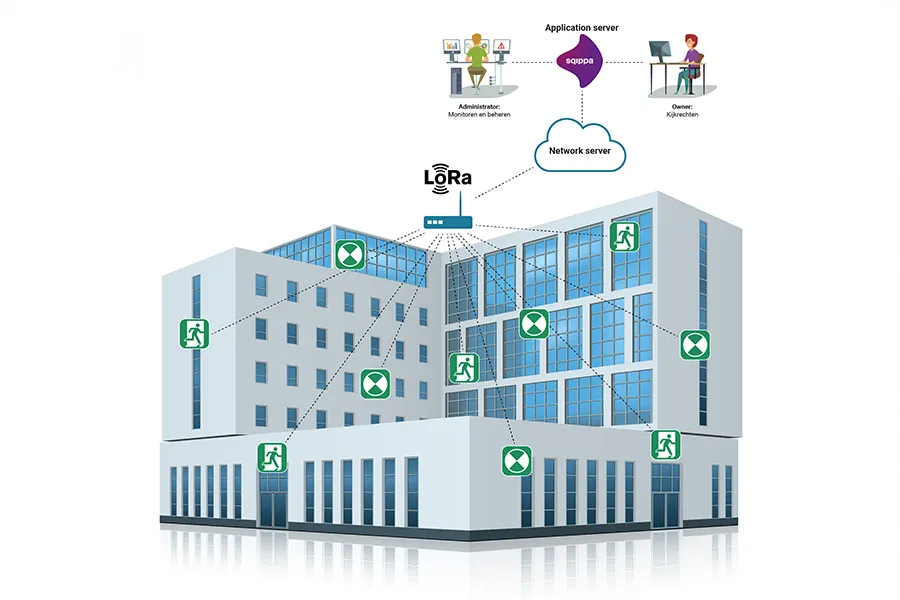
Wireless emergency lighting management requires trust and insight. But it also calls for good collaboration between the client, installer, maintenance company and manufacturer. HBI Bisscheroux is tackling this challenge head-on. “With the help of our Quick Start and onboarding programme, we want to make wireless emergency lighting management more accessible.”
HBI Bisscheroux is the only independent manufacturer of emergency lighting in the Netherlands. “Since we were founded in 1978, we have placed great emphasis on technological innovation,” says lighting consultant Patrick Mestriner. “Wireless emergency lighting management is a natural extension of this and, in our view, the answer to today’s challenges. These include staff shortages, the sustainable employability of staff, energy savings and CO2 reduction.” However, to make implementation a success, installers’ and maintenance companies’ reservations need to give way to a shared mission and vision. “That is something we work towards every day.”

Many benefits
The transition to wireless emergency lighting management offers companies many benefits, including more efficient maintenance and better monitoring. “The technology should be a market revolution, but unfortunately it has yet to gain widespread acceptance in practice, particularly among maintenance companies,” says Margo Leinders, responsible for Sales Support and Development at HBI Bisscheroux. Recent research by HBI Bisscheroux shows that several barriers are at play. Leinders conducted the research as part of her graduation project. “For this study, I interviewed a range of maintenance companies,” she says. “They varied from large to small and from highly experienced to cautious. First, I established whether we shared the same definition of wireless management. From there, I focused on specific circumstances: do companies use wireless emergency lighting management or not? And why? Are customers asking for it? What is holding companies back from responding to this? How do they see its potential for the future?”
Barriers identified
The interviews identified fifteen barriers, which could be grouped into four main categories: technological, financial, organisational and psychological. “It soon became clear that organisational barriers were the most significant,” says Leinders. “As many as 89% of respondents said that an unclear business model was a major obstacle. Switching to wireless monitoring requires a new way of working, and it is often unclear how the new technology will affect the existing business model. Companies also often find it difficult to get everyone on board with the new technology.”
A technological challenge frequently mentioned was the fragmentation of suppliers. “Maintenance companies often work with different emergency lighting brands, each with its own wireless monitoring systems. This can make it difficult for companies to adopt a consistent approach,” says Mestriner. “That is why HBI has chosen international IoT standards, based on what benefits the market.” The initial cost of switching to wireless monitoring can also be a barrier. “But the investment can quickly be recouped through savings on maintenance hours.” However, the real added value cannot be measured in euros alone. “Think of the latent needs that are addressed when you switch to wireless management. In today’s conservative market, it can sometimes be difficult to proactively make the case for better solutions, but we advise maintenance companies to have that conversation with their clients.”
Greater confidence, better insight
“Of course, the barriers do not exist in isolation,” Leinders emphasises. “For example, if you do not know what kind of business model you are entering, you will be more cautious, both psychologically and financially. That is why it is important to overcome the barriers as a whole.” The challenge is not so much technological as organisational, Mestriner stresses. “We are all following developments in digitalisation and automation with interest, but actually incorporating them into our business operations can feel daunting.” In his view, trust, collaboration and greater insight are essential to lowering this barrier. For example, how should you prepare your technicians? And how can you adapt your business model and justify it to customers? “Our Quick Start helps you quickly identify the steps needed for successful implementation,” says Mestriner. “For maintenance companies that want more support, we also offer our onboarding programme, which involves the client and installer as well. This can help create a shared vision and broad support, address current challenges and meet latent needs. Our advice is to think big but experiment on a small scale. Start with small, manageable steps and see what they can deliver. The enthusiasm this generates provides a great foundation for successful, future-proof implementation.”
A business enquiry for HBI Bisscheroux? Get in touch
Companies in this story
Keep following this
Get an email when a new story is published. No account needed.
- ThemeBuilding electrical systems
- SubjectElectrical engineering
- CompanyHBI Bisscheroux